
 E-Paper



Ludhiana: Cabinet minister launches project to help heart attack victims
The project aims to save precious lives from heart failure by initiating the treatment within golden hour (first 90 minutes) of the onset of symptoms

 Prefer HTon Google


Punjab food, civil supplies and consumer affairs minister Bharat Bhushan Ashu on Saturday launched a project funded by Indian Council of Medical Research (ICMR) focussing on the timely intervention in case of heart attacks in Ludhiana.
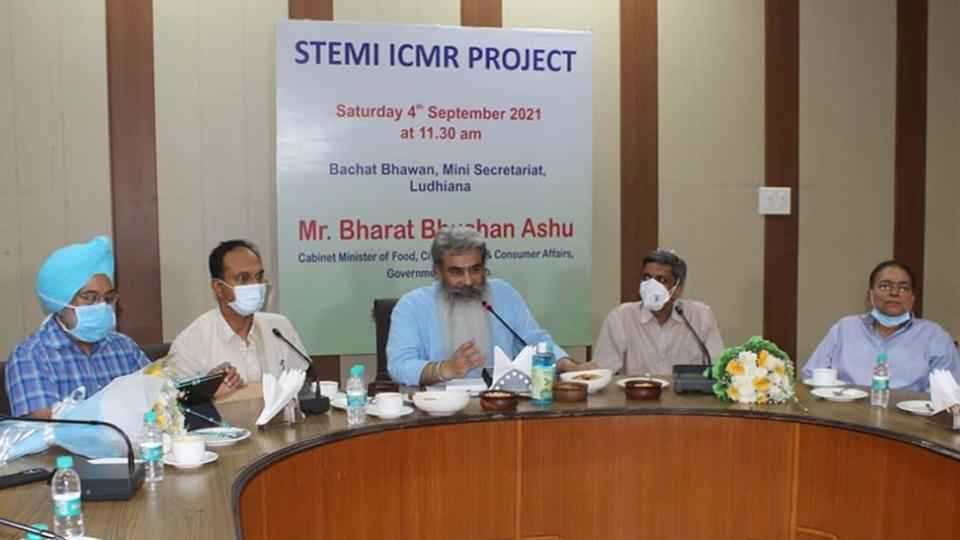
The project aims to save precious lives from heart failure by initiating the treatment within golden hour (first 90 minutes) of the onset of symptoms.
Accompanied by Ludhiana deputy commissioner Varinder Kumar Sharma, director health services, Punjab, Dr GB Singh besides Dr S Ramakrishna, Dr Bishav Mohan, Dr GS Wander, Prem Gupta and others, the cabinet minister termed the project the biggest service to mankind under which clot-buster drug tenecteplase would be given free of cost to patients at 11 centres.
Ashu said not everyone can afford to buy tenecteplase drug being used to dissolve blood clots in the heart because of its high cost (around ₹25,000- ₹30,000). He said in 70% of the cases, this drug cannot be administered because of late arrival.
Deputy commissioner Sharma directed the health department to sensitise the public about the symptoms of the heart attack through its ground-level health workers as most of the victims are not aware of the signs and ignore by considering it a gastrointestinal problem.
He said that the 11 centres included civil hospital, Krishna Hospital, Pahwa Hospital, RCH Pohir, Sarabha Hospital, SDH Jagraon, SDH Payal, SDH Samrala, Life Care Hospital and SDH Machhiwara, where best possible treatment for the patients suffering from heart attack can be availed.
He said the doctors and paramedics of these hospitals have been trained at Dayanand Medical College and Hospital (DMCH) in the last one year.
Dr Bishav Mohan from DMCH thanked director health services Dr GB Singh for playing a pivotal role in bringing this project to Punjab.
He said that Dr Singh brought seven government hospitals which cover the majority of the rural areas of the district under the project’s ambit.
He said that coronary heart diseases, especially ST Elevation Myocardial Infarction (STEMI or heart attack), are leading cause of mortality globally and in India.
“Punjab falls in the red zone with the mortality rate of 250 deaths per lakh of population,” he added.
‘Acidity, gastric issues could be signals of heart attack’
In 33% of cases, a person who suffers a heart attack confuses sudden deterioration of health with acidity and gastric issues, said senior cardiologist Dr Bishav Mohan while speaking on the sidelines of the programme of ICMR-funded project of timely intervention in heart attack cases.
In the majority of cases, people ignore such symptoms, he said, adding that 95% lives can be saved from heart attacks if the patient receives the treatment within three hours and 80% lives can be protected if the drug is administered within six hours.
He said erratic lifestyle, pollution, genetic issues, stress, diabetes and obesity are some of the common reasons behind increased the number of heart attacks.
“Fortunately, incidents of heath attacks in Punjab due to excessive smoking are less, but findings have shown that extreme workouts (in some cases body is not accustomed to it) and high intake of protein supplements (which also leads to thickening of blood) are also becoming the leading causes of heart attacks,” Dr Mohan said.
Dr S Ramakrishna of ICMR stressed that ECG was quite important to get timely treatment. “ECG is the most cost-effective measure to detect such abnormalities. That is the reason why a lot of stress has been laid on the availability of ECG services. Early detection is an early cure,” he added.
In many cases, it has been found that people are not aware of the cardiopulmonary resuscitation (CPR) and timely administering of tenecteplase, which could save lives in case a patient suffers a heart attack.
Symptoms of a heart attack
Pain in the area between shoulder blades, arm, chest, jaw, left arm, or upper abdomen, dizziness, fatigue, light-headedness, clammy skin, cold sweat, or sweating.
Heartburn, indigestion, nausea or vomiting anxiety, chest pressure, feeling of impending doom, palpitations, shortness of breath, or shoulder discomfort are also among the signs of heart attacks


