
 E-Paper



Ludhiana sees surge in dengue cases; 43 hotspots identified
The cases of dengue are surging with each passing day in Ludhiana. The civic body was urged to lay special emphasis in hotspots which lead to dengue outbreak each year.


As Covid-19 infections are fading out with one case reported on Monday, the cases of dengue are surging with each passing day.
As many as six fresh cases of dengue were reported in Ludhiana on Monday taking the total count to 217 cases in the district.
While 127 dengue cases were found from the city alone, the town of Khanna has also emerged as the new dengue hotspot with 28 confirmed cases. As many as 23 dengue cases have been officially reported from Koom Kalan and Sehnewal, which caters to a strong migrant population.
The anti-larvae team has found dengue larvae from 1,289 houses, besides dengue mosquito larvae were found in 1,329 containers. The health department has sent a report of 1,105 locations with the civic body out of which the municipal corporation (MC) has issued challan against 715 persons for violations of civic norms, said epidemiologist Ramanpreet Kaur.
Out of 217 patients, 90 were hospitalised, while 14 are still undergoing treatment at local private hospitals. According to the health department, no death due to dengue has been reported in the district so far.
There are as many as 1,898 suspected dengue cases in the district. Earlier during the year, the health department had prepared a report and identified hotspots in which dengue larvae are found each year. Further, a report of high-risk areas where dengue larvae were detected and, subsequently, destroyed was shared by the department with the civic body.
Ramanpreet said that proactive measures helped in curtailing the cases. She said 43 hotspots from where dengue cases are reported each year were shared with the civic body. The civic body was urged to lay special emphasis in these areas which led to dengue outbreak each year.
Besides, the health department team has also identified 97 high-risk areas where the Aedes aegypti mosquitoes’ larvae were found on repeated occasions.
The health department has also shared the information of these areas with the health branch of the Municipal Corporation and asked them to start fogging in these areas at the earliest.
Municipal Corporation (MC) health officer Vipul Malhotra confirmed that the health department has shared the data of high- risk areas and hotspots of dengue breeding points in the city.
“Accordingly, we are carrying out fogging in these areas. At the same time, we urge people to remain vigilant about their surroundings and eliminate the dengue mosquito points in and around their houses,” said Malhotra.
He said the treatment of dengue is costly and in some cases mosquito bite could turn fatal as well.
43 Hotspots:
Haibowal Kalan, Civil Lines, Kundan Puri, Guru Nanak Pura, Pavitar Nagar , Kailash Nagar, BRS Nagar, Rajguru Nagar. Agar Nagar, Dugri Phase, 1, 2 and 3.
Barewal Road, Pakhowal Road, Haibowal Raod, Mall Road. Rani Jhansi Road, Tagore Nagar 1,2,3,4, Sarabha Nagar, Gurdev Nagar, Model Town, Model Gram Extension, Jawahar Nagar Camp, Ambedkar Nagar, Chandigarh Road, Sector 32, 34, Ram Nagar, Samrala Chowk, Cheema Chowk, 33 Gutta Road, Atam Nagar, Model Town, Model Town Block- B, Shivaji Nagar, New Shivaji Nagar, Hargobind Nagar, Field Ganj, Chander Nagar, Islam Ganj, Habib Ganj, Indra Colony, Bahadurke Road, Fatehgarh Mohalla, Shimlapuri and Giaspura.
Reasons:
The vacant plots in posh localities like Gurdev Nagar, Sarabha Nagar, Dr Shamr Singh Road, Mall Road, Model Town and BRS Nagar serve as breeding ground for the mosquitoes.
Advisory and preventive measures:
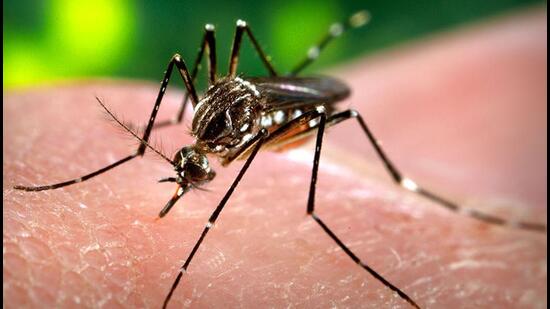
Civil surgeon Dr Hitinder Kaur said that dengue fever is caused by the bite of female Aedes aegypti mosquito hence it is also called tiger mosquito. It has tiger-like stripes on its body and grows in clean water in mosquito coolers, containers, trays behind refrigerators, flowerpots, rubbish on roofs, tires, etc.
She said that within a week a complete adult mosquito is ready from the egg and this mosquito could also breed in a spoonful of water. This mosquito bites mostly in the morning after sunrise and in the evening at sunset. This mosquito bites mostly on the lower part of the body and its production is higher at a temperature of 20°C to 34°C.
Symptoms of dengue fever include high fever, headache, muscle aches, skin rash, pain in the back of the eye and bleeding gums and nose.


