Expressing concern over the loss of lives in the Nepal flash floods, chief minister Sukhvinder Singh Sukhu stressed the need for scientific research into cloudbursts, glacier behaviour, changing temperatures and the formation of glacial lakes across the Himalayan region amid rising temperatures.
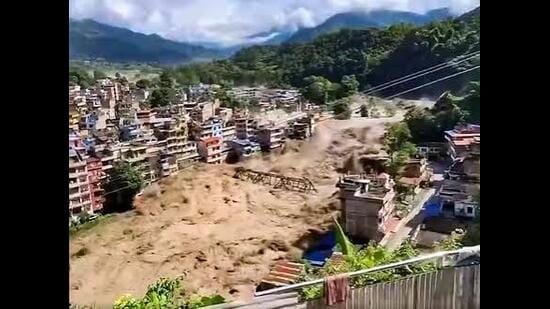
Speaking to Hindustan Times, Sukhu said the increasing frequency of cloudbursts, flash floods and glacial lake-related events across the Himalayan region pointed to the growing impact of climate change. He recalled the devastating cloudburst in Kinnaur in 1993, as well as the disasters experienced by the state in recent years.
“I met the Union home minister earlier and suggested that a team comprising IIT experts and other scientists conduct a scientific study. A team had visited Himachal for the same. I do not know what emerged from the study,” Sukhu said.
Citing the threat to other Himalayan states, including Uttarakhand and Jammu and Kashmir, he expressed concern over glacial lakes forming in the Tibet region. “Glaciers in Himachal Pradesh are also being studied. In some places, glacial lakes have formed in Lahaul-Spiti. In some areas, glaciers are increasing, while in others they are receding because of climate change. All these aspects need to be studied scientifically,” he said.
Sukhu said the state government, through its scientific departments and disaster-management machinery, was monitoring the situation and had also secured an ₹850-crore project for disaster management.
{{/usCountry}}Sukhu said the state government, through its scientific departments and disaster-management machinery, was monitoring the situation and had also secured an ₹850-crore project for disaster management.
{{/usCountry}}5-fold rise in glacial lakes
The number of potentially hazardous glacial lakes in the state has risen from 107 in 1990 to 669 in 2024. Among the high-risk glacial lakes identified nationwide, 48 of the most vulnerable ones are located in Himachal Pradesh—the highest number among all Himalayan states in the country.
Ghepan Lake in Sissu, Lahaul-Spiti, also poses a significant threat, and there have been proposals to install an early warning system there. The lake’s expanse has grown by 173% over the past 33 years. Glaciers in Lahaul-Spiti district of Himachal Pradesh are melting rapidly. According to a joint study by IIT Ropar and the University of Technology Sydney, the number of glacial lakes in Himachal has increased more than fivefold since 1990.
The total area of glacial lakes has expanded by 102%—from 5.54 sq km to 11.20 sq km. Nine lakes have been categorised as ‘very high risk’, 18 as ‘high risk’ and 26 as ‘medium risk’.
Tibetan leaders in exile call for study
Tibetan leaders in exile have called for a detailed examination of the possible causes that triggered the Nepal crisis. Dolma Tsering Teykhang, speaker of the Tibetan Parliament-in-exile, said, “It is important to establish whether the disaster was entirely natural or whether human factors could also have played a role. I think the Nepal government will have talks with China to share what are the things that are going on at the very origin of that cause and then try to sort out,” she said.
More than 2,000 Tibetans gathered at the main Tibetan temple, Tsuglagkhang, in Dharamshala to offer prayers for those affected by the floods in the Nepal-Tibet region.
Dalai Lama condoles loss of lives
Tibetan spiritual leader the Dalai Lama condoled the loss of lives in the floods in Nepal and Tibet. Since this region has seen calamities in the past as well, these are certainly symptoms of a deeper underlying cause, whether climate change or other factors, he observed.
Assembly observes 2-minute silence
The state assembly observed two minutes of silence for those who lost their lives in Nepal. Sukhu said he had so far received no information from the Centre regarding any Himachal resident missing in Nepal. The district administrations have set up special helpdesks to gather information about individuals from the state stranded or missing in Nepal.