
 E-Paper



No room for third party, results reaffirm bipolar nature of HP politics
Aam Aadmi Party (AAP) which tried to make a foray into state politics after its emphatic victory in neighbouring Punjab left the battlefield midway turning its focus to Gujarat where it managed to win five seats


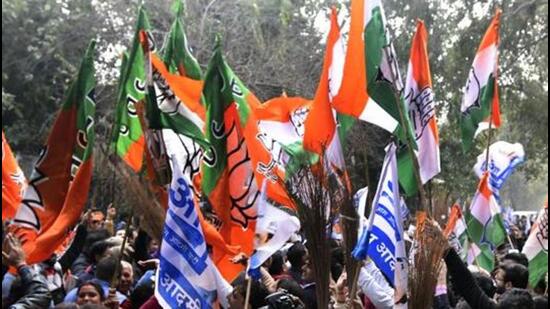
SHIMLA Himachal Pradesh kept up the tradition of bipolar politics as it was a Congress-BJP contest again. The other parties failed to make an impact again.
Aam Aadmi Party (AAP) which tried to make a foray into state politics after its emphatic victory in neighbouring Punjab left the battlefield midway turning its focus to Gujarat where it managed to win five seats.
All the AAP candidates forfeited their deposits while the Bahajun Samaj Party (BSP) which contested 57 seats also met the same fate. Rakesh Singha, CPI (M) leader, was the lone legislator to enter the house in 2017 but lost the election this time from the Theog assembly constituency. In 2012, the scion of the Kullu royals Maheshwar Singh, after parting ways with the BJP floated his party Himachal Lokhith Party and he was the lone legislator from his party in 2018.
Since 1985, the state has been electing the Congress and the BJP to power on an alternate basis with 1990 and 1988 being the only exceptions when Janata Dal and Himachal Vikas Congress won 11 and five seats, respectively. In 1985, Congress had bagged 58 seats in the 68-member house. Virbhadra Singh, who was the chief minister then had contested from Rohru and Jubbal-Kotkhai segments. He won from Rohru but lost to former chief minister Thakur Ram Lal at Jubbal and Kotkhai.
However, in 1990, the political landscape again changed with the BJP winning 46 seats, reducing the Congress to just nine.
The election in 1998 resulted in a hung assembly with both the Congress and the BJP winning an equal number of seats — 31 each. The BJP managed to form the government by allying with the Himachal Vikas Congress (HVC), which bagged five seats. This was the first time in the hill state that a coalition government (through a post-poll alliance) came into power.
The government changed again in 2003 as the Congress won 43 seats while the BJP could manage only 16. Independents secured six seats, while regional parties won two seats.
In 2007, the BJP wrested power from Congress by winning 41 seats. In the 2012 elections, the Congress won 36 seats as well as the popular vote, putting Virbhadra Singh back in the saddle. The BJP had bagged 26 seats then.
In the last assembly elections held in 2017, the BJP won 44 of the 68 seats, while Congress secured 21 seats. Though the BJP had won a two-thirds majority, its chief ministerial candidate Prem Kumar Dhumal lost in the Sujanpur assembly segment. The BJP then picked up Jai Ram Thakur for the top slot.
Ramesh Chauhan, head of the political science department at Himachal Pradesh University (HPU), Shimla, said that the people in Himachal reject a third party as they have failed to provide a strong alternative against the Congress and BJP. “If some party has won in one election it was completely decimated in the next. The bipolar politics is well set in Himachal. People voted intelligently this time,” he said.


