Even though Haryana farmers have begun harvesting in some areas, the state government has ordered field-level verification for nearly 23.98 lakh acres of non-basmati paddy registered on the Meri Fasal Mera Byora (MFMB) portal over concerns of overstated acreage.
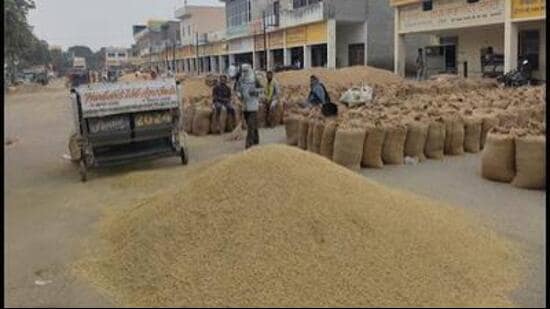
According to the reports, the verification was ordered amid the concerns that a majority of farmers growing basmati varieties could have registered their crop as parmal to become eligible for government procurement at the minimum support price (MSP), which may lead to bogus procurement.
Moreover, the officials entrusted the task are of the view that the verification assumes significance, as the state’s assessment of the likely paddy available for procurement has risen to around 65 lakh metric tonnes (LMT), while the Centre has recently enhanced Haryana’s paddy acceptance target to 59.62 LMT, up from the earlier allocation of 58LMT.
According to the MFMB data provided for the current kharif season, 3.85 lakh farmers have registered across 23.98 lakh acres of non-basmati paddy. In comparison, two lakh farmers have registered for around 10 lakh acres of basmati varieties. However, farmer leaders were demanding the government to open registration on the MFMB portal claiming that the registered area under non-basmati paddy was around 4.8 lakh acres, less than last year’s 28.8 lakh acres.
Thus, the combined area registered under basmati and non-basmati paddy stands at around 34.03 lakh acres. However, officials suspect that 3-4 lakh acres registered as parmal may actually be under basmati or other crops, raising concerns over possible misdeclaration on the MFMB portal.
{{/usCountry}}Thus, the combined area registered under basmati and non-basmati paddy stands at around 34.03 lakh acres. However, officials suspect that 3-4 lakh acres registered as parmal may actually be under basmati or other crops, raising concerns over possible misdeclaration on the MFMB portal.
{{/usCountry}}The field verification has therefore been ordered to ascertain the actual crop sown and determine the extent of any discrepancies in the registrations, as the officials are of the view that around 15 lakh acres in the state remains under basmati varieties which are procured by the private traders.
“Around 19.35 lakh acres have been verified under parmal so far and verification of around 4.64 lakh acres is yet to be done. Now the department is taking the help of the concerned deputy commissioner, SDM and tehsildar to complete this process as early as possible”, said an official from the state agriculture department pleading anonymity. However, some officials associated with the procurement said if the area under parmal rice remained unchanged after the verification, paddy procurement in the state may increase beyond 60 lakh MT.
Agriculture and farmers’ welfare minister Shyam Singh Rana said that even though the central government has revised the target to 59.50LMT, the state government remains committed to purchasing every grain brought by farmers, even if arrivals exceed the target.
According to the schedule, the procurement in Haryana is to begin from October 1. However, the state government has requested the Centre to prepone the procurement to September 20 amid early arrivals and farmers’ requests.
Dharmendra Singh, chief administrator of the Haryana State Agriculture Marketing Board, said that all arrangements for the procurement season have been completed. He added that the procurement of some early varieties of basmati is already underway in several mandis.