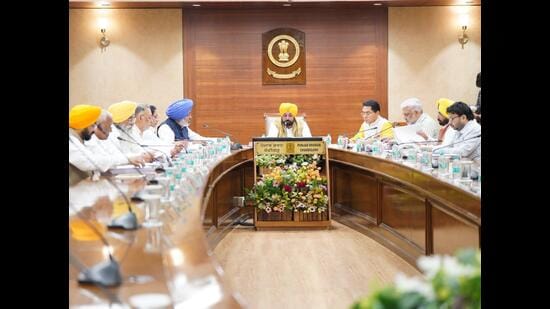
With Punjab facing a severe shortage of storage space ahead of the new paddy procurement season, the state cabinet, chaired by chief minister Bhagwant Mann, on Friday approved the Punjab Custom Milling Policy for the 2026-27 season allowing rice millers to receive fresh paddy even if they are yet to complete delivery of rice milled from the previous crop.
Millers who have delivered at least 90% of the rice against the paddy allotted to them during the 2025-26 season will be eligible for fresh paddy. The relaxation is aimed at ensuring that milling and procurement operations continue without disruption once procurement of the new crop begins later this month. Most of the Punjab millers are yet to complete the milling of rice of 2025-26.
The move aims for smooth procurement ahead of the next year’s assembly election, and government wants to ensure a smooth procurement season for farmers.
The storage crunch has created a peculiar situation for the government. While rice millers are ready to hand over milled rice, state agencies are struggling to accept fresh stocks as their godowns and plinth storage facilities are already full. This forced the state to amend the policy.
As per earlier policies, millers are required to complete delivery of rice by March 31 following the procurement season. However, the deadline for delivery of rice from the previous season has already been extended to October 31 this year, underlining the severity of the storage constraints.
{{/usCountry}}As per earlier policies, millers are required to complete delivery of rice by March 31 following the procurement season. However, the deadline for delivery of rice from the previous season has already been extended to October 31 this year, underlining the severity of the storage constraints.
{{/usCountry}}Punjab has set a procurement target of around 180 lakh metric tonnes (LMT) of paddy this season, against an estimated production of 185 LMT. However, the state is facing acute shortage of storage capacity, with grain from previous procurement seasons occupying available covered and plinth storage space.
As per officials Punjab’s entire 280 LMT foodgrain storage capacity is currently occupied. The slow lifting of rice by the Union government for transportation to consuming states has compounded the problem, leaving the state with limited space to accommodate rice that will be generated from the upcoming paddy crop.
Pertinently, CM Mann had recently met Union minister for consumer affairs, food and public distribution Pralhad Joshi and sought expeditious lifting of rice from Punjab’s granaries to create space ahead of the new procurement season. The Centre had assured the state that 18 LMT of rice would be lifted by September 20, but the state government has said the promised lifting has not taken place.
Apart from the Custom Milling Policy, the Cabinet also approved the Punjab Foodgrains Transport Policy, 2026, and the Punjab Foodgrains Labour and Cartage Policy, 2026, aimed at ensuring smooth and uninterrupted procurement operations during the coming season.
Box:
Other decisions
The cabinet approved amendments in the Punjab Public Service Commission (Group ‘A’) Service Regulations, 2012, paving the way for the addition of a provision for promotion from personal assistant to personal secretary.
The cabinet approved the revival of 33 newly created posts at the sub-divisional hospital, Chamkaur Sahib. The hospital was upgraded from a community health centre.
The cabinet also approved the creation of 19 new posts of various cadres for the office of the civil surgeon, Malerkotla, so that official work can be carried out efficiently.
In another decision, the cabinet approved the creation of 119 new posts of various cadres at the sub-divisional hospital, Dhuri, and the newly constructed maternal and child health centre.
The cabinet also gave its consent for filling 80 vacant posts of medical officer (dental) in the department of health and family welfare. Of these, 53 posts have been lying vacant for more than a year, while 27 posts have been lying vacant for less than a year.