
 E-Paper



Punjab CM Bhagwant Mann, Union petroleum minister Hardeep Puri inaugurate India’s largest bioenergy plant at Lehra
Punjab chief minister Bhagwant Mann and Union petroleum minister Hardeep Puri on Tuesday inaugurated India’s largest bioenergy plant at Bhuttal Kalan village in Sangrur’s Lehragaga


Punjab chief minister Bhagwant Mann and Union petroleum minister Hardeep Puri on Tuesday inaugurated India’s largest bioenergy plant at Bhuttal Kalan village in Sangrur’s Lehragaga. The unit will collect stubble from fields of nearby villages at free of cost to produce compressed biogas (CBG) and manure.
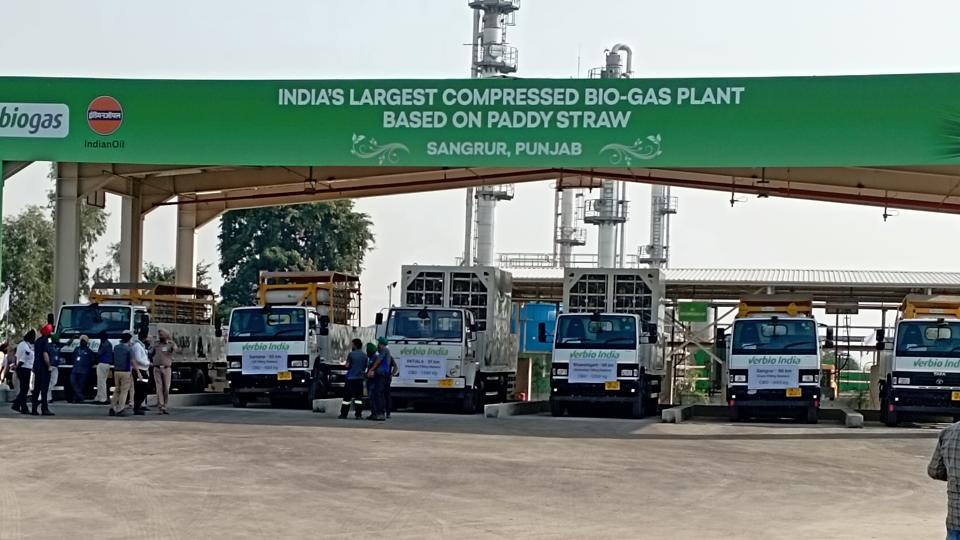
Built at a cost of ₹230 crore, the construction of plant was started in 2018. The facility was to be inaugurated in 2021, but it was delayed due to the pandemic and pending construction.
Addressing the gathering, the chief minister said this step will go a long way in wiping out the menace of paddy straw burning from Punjab.
Germany-based Verbio Group’s Indian subsidiary has set up the plant.
“This is the largest biofuel (biomethane/bio-CNG) production unit in India with 33 TPD (tonnes per day) capacity of compressed biogas,” said Mann.
The annual straw consumption in this unit will be 1.3 lakh tonnes, he said, adding that it will help in solving the problem of paddy straw burning.
Set up over 20 acres of land, this unit will contribute to an annual reduction of 1.5 lakh MT of pollutants and 20,000 MT of fly ash currently produced due to paddy straw burning, said an official release quoting Mann.
This unit will also give employment to 1,000 youth, he said, adding the acreage of soil enriched from biomanure will be 2,150 acres.
Currently, the plant is functioning at 21% of its total capacity. It is producing about seven tonnes of biogas per day and the same will be supplied to 10 outlets of Indian Oil Corporation. The manure produced by the plant (600 to 650 tonnes per day) is supposed to be utilised in fields as fertiliser.
Manure failed to meet mandatory specifications
However, the manure has failed to meet the specifications of the Fertiliser (Control) Order for its use in farm fields due to high moisture in it.
Confirming it, plant head Pankaj Jain said, “As per the fertiliser control order, the amount of moisture should be 30% to 40%, but the manure produced by this plant has 75% moisture. However, we are taking advice from Punjab Agriculture University, Ludhiana, and fertiliser companies. We are also requesting the central and state governments to amend the specifications as we are producing manure organically.”


