Punjab Congress’ simmering factional battle has run into a firm roadblock, with the party high command refusing to bow to pressure from former chief minister Charanjit Singh Channi and his supporters over the continuation of Amarinder Singh Raja Warring as the Punjab Pradesh Congress Committee (PPCC) president.
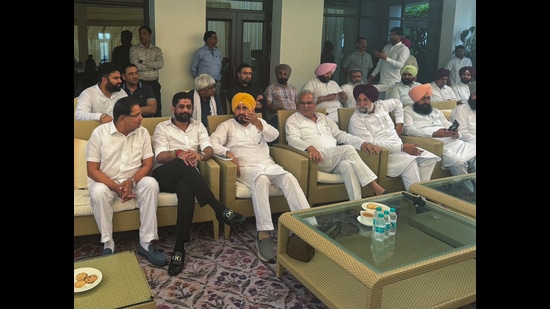
Despite a sustained show of strength, boycott of party meetings and repeated attempts to persuade the central leadership, the Channi camp has failed to secure any assurance of a leadership change. The latest round of talks with All India Congress Committee (AICC) general secretary in charge of Punjab Bhupesh Baghel also ended without a breakthrough, underscoring the high command’s determination to stay the course.
Party insiders say the refusal to replace Warring is rooted in a broader electoral strategy crafted by Congress leader Rahul Gandhi. According to senior leaders, the party has decided to contest key state elections under a model of collective leadership, deliberately avoiding the projection of a chief ministerial face before the polls. Instead, the Congress plans to decide the chief minister only after securing a legislative majority.
The internal discord intensified after the Congress high command announced a major organisational reshuffle in Punjab on July 1 in preparation for the 2027 assembly elections. While Raja Warring was retained as the state unit president, Channi and senior leader Sukhjinder Singh Randhawa were appointed to head separate organisational committees in what was seen as an attempt to balance competing factions.
{{/usCountry}}The internal discord intensified after the Congress high command announced a major organisational reshuffle in Punjab on July 1 in preparation for the 2027 assembly elections. While Raja Warring was retained as the state unit president, Channi and senior leader Sukhjinder Singh Randhawa were appointed to head separate organisational committees in what was seen as an attempt to balance competing factions.
{{/usCountry}}However, the arrangement failed to satisfy the Channi camp, which immediately launched a campaign demanding Warring’s removal. On Saturday, at least 12 Congress MLAs backed the demand during a meeting with Baghel, reiterating that the party needed a complete change in its state leadership.
Baghel’s five-day visit to Punjab, aimed at resolving the growing internal rift, concluded without any consensus. While acknowledging that leaders had expressed their views, he publicly dismissed suggestions of an organised rebellion.
Describing the gathering of dissident leaders as “merely an informal lunch invite”, Baghel maintained that no leader had openly challenged the high command’s decisions.
Rahul’s new electoral formula
Senior Congress leaders say the Punjab impasse reflects Rahul’s evolving political approach following a series of electoral setbacks and internal leadership battles in several states.
According to party insiders, the Congress leadership has concluded that pre-election contests over the chief minister’s post often weaken the organisation, divide party workers and shift public attention away from governance issues.
“The message from Delhi is clear: First win the election, then decide the chief minister. No leader can claim the position merely by controlling the organisation or demonstrating support from a section of MLAs,” a senior Congress leader familiar with the high command’s directive said.
Lessons from previous polls
Congress leaders say the shift has been shaped by recent electoral experiences across several states. “Allowing dominant regional leaders such as Bhupinder Singh Hooda in Haryana, Kamal Nath in Madhya Pradesh, Ashok Gehlot in Rajasthan and Bhupesh Baghel in Chhattisgarh to overshadow the organisation ultimately proved counterproductive,” said a senior Congress leader not wishing to be named. Similarly, projecting a chief ministerial face before elections has not always delivered electoral gains, he added.
Leaders also point to the Congress’ decision to project Gaurav Gogoi prominently in Assam, which, according to party insiders, did not yield the desired political dividends.
By contrast, the party considers Karnataka’s 2023 assembly election a successful example of collective leadership. Despite intense competition between Siddaramaiah and DK Shivakumar, the Congress refrained from officially naming either leader as its chief ministerial candidate before the election. A similar approach was adopted in Telangana, while Kerala has also become a key example of the strategy.
Encouraged by these experiences, the Congress leadership is reportedly determined to replicate the model in Punjab, Uttarakhand and Goa.
Punjab’s 2022 experience
The Congress’ campaign in the 2022 assembly elections was overshadowed by an intense leadership battle involving then chief minister Charanjit Singh Channi and then state Congress chief Navjot Singh Sidhu. After weeks of speculation and internal conflict, Rahul eventually declared Channi as the party’s chief ministerial face.
The Congress suffered a crushing electoral defeat when it was reduced to just 18 seats from 77 in the 2017 polls in the 117-member House — a development that many within the party now cite as evidence of the risks associated with leadership contests before elections.
Political analyst and former professor of political science at Guru Nanak Dev University, Amritsar, Jagroop Sekhon said: “Rahul has matured as a leader and now exercises greater control over the organisation. The Congress has paid a heavy political price in several states because of leadership tussles. Punjab presents one of the party’s strongest opportunities, and the high command is unlikely to announce a chief ministerial face or change the state leadership under pressure,” Sekhon said.