Punjab has drawn up a comprehensive five-year long-term plan to achieve ‘zero’ stubble burning by 2030, with the state government submitting the roadmap to the Commission for Air Quality Management (CAQM) and proposing measures ranging from crop diversification and next-generation crop residue management machinery to biomass industrial parks and permanent stubble storage depots across the state.
The 85-page-long “Comprehensive plan for prevention and control of stubble burning in the State of Punjab for 2026-2027”, prepared by the Punjab Pollution Control Board (PPCB), lists short-term measures for the ongoing kharif season and a long-term strategy for 2026-30 by strengthening institutional set-ups involved in in-situ and ex-situ management of the crop residue.
HT has a copy of the plan submitted to the CAQM.
The state has witnessed a significant drop of 54% in stubble fire incidents, with 5,114 cases recorded in 2025, down 54% from 10,909 in 2024.
A senior state functionary familiar with the matter said the long-term plan aims to structurally transform Punjab’s stubble management ecosystem through diversified agriculture, expanded industrial utilisation, and permanent supply-chain infrastructure.
“There has been a significant reduction in the stubble burning events in the state during the year 2025 as compared to the years 2023 and 2024. The targets for in-situ and ex-situ management, as mentioned in the plan, shall be achieved with the collaborative support of all the stakeholders, ministries, departments and concerned agencies. In order to strengthen these efforts, the policy interventions and financial support by the central government are imperative, especially in the provision of viability gap funding for biomass power plants and addressing impediments faced by the upcoming compressed biogas plants,” the official said, requesting anonymity.
{{/usCountry}}“There has been a significant reduction in the stubble burning events in the state during the year 2025 as compared to the years 2023 and 2024. The targets for in-situ and ex-situ management, as mentioned in the plan, shall be achieved with the collaborative support of all the stakeholders, ministries, departments and concerned agencies. In order to strengthen these efforts, the policy interventions and financial support by the central government are imperative, especially in the provision of viability gap funding for biomass power plants and addressing impediments faced by the upcoming compressed biogas plants,” the official said, requesting anonymity.
{{/usCountry}}“A strong mechanism needs to be established for making the paddy straw a resource and remunerative for the farmer community for effective management of the residue,” the official added.
The state is expected to generate 18.81 lakh MT of paddy straw from 31 lakh hectares of area under paddy cultivation this season.
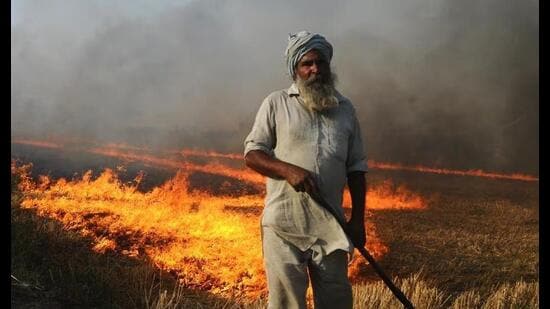
Paddy straw burning in Punjab and Haryana is considered one of the factors contributing to an alarming spike in air pollution in the national capital during October and November. As the window for sowing wheat is very short after paddy harvest, farmers tend to set their fields on fire to quickly clear off the crop residue.
Biomass parks, more CBG plants
For in-situ management, the plan aims to reach sustained availability of crop residue machines (CRM) by 2030, with respect to the area under paddy. At present, 10.15 lakh tonnes of straw is being integrated into soil using 1,58,898 subsidised machines, according to the plan.
The plan proposes crop diversification to reduce paddy acreage by 7 lakh hectares, besides developing and introducing next-generation low-cost CRM machinery suited for small and fragmented fields.
For ex-situ management, the government aims to develop biomass industrial parks with common boilers, and set up compressed biogas (CBG) plants for the use of 10-12 lakh tonnes of paddy straw within three to five years.
Presently, six CBG projects of total capacity of 107 tonnes per day are operational, while five more CBG projects of total capacity 37.5 TPD CBG are expected to be commissioned in the current financial year. As many as 46 CBG projects, including CBG projects allocated to GAIL, HPCL, and BPCL, are at different stages of execution or pre-construction clearances and are expected to be commissioned in the next 2-3 years.
“Once commissioned, these projects shall consume about 2.80-million-tonmes paddy straw annually,” the plan stated.
The plan also proposes increasing pellet-production capacity to utilise 25-30 lakh tonnes of paddy straw in the thermal power plants, brick kilns and industries; utilisation of about 6 million tonnes of straw in industrial boilers and setting up of permanent bale-storage depots across the state.