In times when the very art of writing is threatened by the ticking and clicking of digital media, artists are making it a point to return to the warmth of the human hand and the fine art of painting letters in a stylised form with a pen or a brush. The experiments are many, and photographers and painters combine it with other forms for heightened expression and harmony. The art, which is said to have originated in the times of the Han dynasty (206 BCE-22O CE), spread to the Indian subcontinent, Japan and Europe. Ancient sacred texts were calligraphed and the tradition spread far and wide all over the world and evolved in different styles.
India has a long tradition of calligraphy, and it continued through the 20th century with children painting the alphabet on the takhti (wooden board) with a sharpened reed pen and the practice continued for long in village schools. It is this joy of painting and sketching words which adds grace to contemporary Indian art. Contemporary artist Sidharth hailing from Punjab, who moved to Delhi, says: “In our village school in Bassian, it was a daily task to coat our wooden plaques with ‘gachni-mitti’ (clay) and ready it for school. Calligraphy was a part of our education. It subconsciously entered my paintings, and I have not let it go”. He goes on to relate that Pandit Achru, who taught him this fine art, would say that words should flow out like music: “ I now include not just Gurmukhi, but symbols and imagined scripts to create my own calligraphic code.”
Words and visuals
{{/usCountry}}Words and visuals
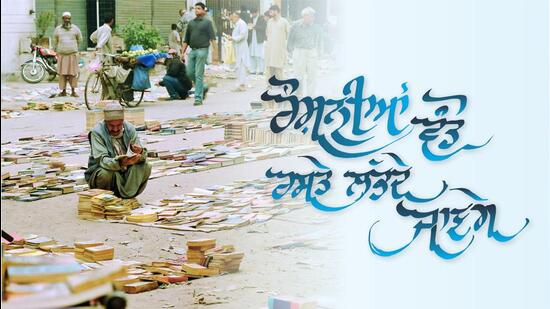
{{/usCountry}}An interesting experimental book called ‘Zindagi de Rang’ (Hues of Life) has been brought out by photographer Sandeep Singh and calligraphist Hardeep Singh of Amritsar. The glossy book with words and visuals serves as an extension of the old tradition. Included in this catchy art book are 34 photographs by Sandeep superimposed by calligraphic quotes mainly from the Gurbani, writings of the Sufi poets and a few others. The heartwarming introduction is by Sidharth, of course.
As one turns the pages, one stops to look in appreciation at the beautiful images that are accompanied by gems of poetry. Sandeep’s click of the drops of rain on lush green foliage is celebrated by a line from a verse penned by the Sufi poet, Bulleh Shah, calligraphed aesthetically: Sawan maah suhavna je dharti boond payi (The rains bless the earth with drops). As one moves from one beautiful leaf to the other, one stops at the catchy display of the weekend book bazaar of Lahore and accompanying it a famous line from African American civil rights activist Ela Baker: “Give life and people will find the way” calligraphed in Punjabi. It is indeed a precious inspirational book, which one can turn to again and again. In appreciation of this joint venture master calligrapher Anis Siddiqui says, “Beautiful calligraphy is one of the most distinctive features of Indian epics. The Gurmukhi script embellished by calligraphy is a thing of beauty. This book revives the art of calligraphy and is indeed a connoisseur’s pride.”
Giving peace a chance
One of the most inspiring cross-border art events took place in Delhi’ s new Red House Gallery in Okhla, Delhi, started by young Arjun Shivaji Jain, a physicist with art in his heart. The opening show at the red brick gallery culled out of his father’s warehouse opened to immense applause this August with the exceptional works of calligraphy from across the border in Pakistan. Their creator is the legal luminary, Syed Muhammad Anwer, who delves deep into the art. His master stroke is that he creates a rare fusion of the Devnagri and Nastaliq (Arabic) scripts where strokes of Hindi and Urdu collaborate to create the same word with such apparent ease. Interestingly, his mother told him that in her school in Faridabad Urdu and Hindi were taught in the same class and she learned it by just seeing her classmates write the language.
Born to a family that had migrated at the time of Partition from Faridabad to Rawalpindi, Syed got the right lessons early in life when his mother schooled him the Hindi language along with the Urdu lessons. Language she told him has no religious bias, it is a way of connecting one to the other. Syed has already brought out a book ‘Samrup Rachna: Apni Boli (Hindi-Urdu)’,of this unique interaction of languages and this was the first time his works were displayed in a gallery in India. Little wonder his show is titled ‘Give Peace a Chance’ not just across borders, but within two with differences merging into unison as his art of calligraphy shows. Well if words can merge thus with one another then why not the human hearts.
While the artist was not present, his works spoke of the language of togetherness and were held up informally by clips in little brick alcoves in a show that was held for art’s sake rather than commerce. It was an inspirational introduction by veteran writer and art critic Prayag Shukla, who compared the calligraphy to a symphony of music reaching out in a simple and soothing manner and yet lighting up the soul. Such is the power of this spontaneity that words cease to be mere words but emissaries of something more.
nirudutt@gmail.com