The northern white-lipped pit viper (Trimeresurus septentrionalis) may well be described as the “wandering vine” or the “evergreen snake”. It is a thickish serpent cast by nature in an exquisite shade of jade. The colour merges so well with maize fields, lush grass and monsoon-flushed jungle foliage that humans seldom get to see it. That works well for both humans and the venomous serpent.
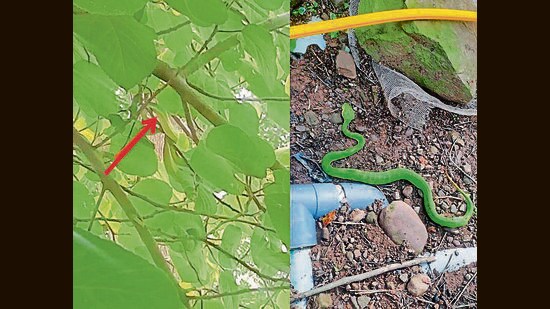
Nissar works at a greenhouse in village Saron, Himachal Pradesh, situated adjacent to the Badi Sher Morni Hills, Nissar must possess an extraordinary eye. He spotted a viper that had merged perfectly among the jade leaves of an “anjeer” (fig) tree near the greenhouse.
The question arises as to what evolutionary purpose does its green colour predominantly serve. Is it to avoid detection from mightier predators such as mongooses and serpent eagles? Or, does the green colour serve to camouflage the serpent in its ambush posture in the foliage while hunting?
We turn for an answer to Dr Anita Malhotra, who is quite well acquainted with the green pit viper species. Malhotra is a reader in zoology (molecular ecology) at the Bangor University, North Wales, and has conducted field studies on Indian serpents and their venoms, including the Trimeresurus septentrionalis in states such as Sikkim and Himachal Pradesh.
“No definitive answer to this but since it is a nocturnal species (hunts at night) it seems more likely that (the green colour serves to) camouflage from potential predators during the inactive daytime period. That would be more important,” Malhotra told this writer.
{{/usCountry}}“No definitive answer to this but since it is a nocturnal species (hunts at night) it seems more likely that (the green colour serves to) camouflage from potential predators during the inactive daytime period. That would be more important,” Malhotra told this writer.
{{/usCountry}}Again, it is not that the viper on the anjeer tree was necessarily hunting for birds. It could have climbed the tree to avoid detection during daytime though Nissar’s sharp eye thwarted its objective.
“Most similar pit viper species prey on small mammals and frogs, also small lizards like geckos and sometimes birds. But I don’t think birds constitute a significant dietary item,” added Malhotra.
As free as the water flows
The young ones of wild creatures, once forcibly separated from their parents, are not easy to rear and rehabilitate in the wilderness. It took strenuous efforts from two ardent wildlife conservationists to give a fighting chance to the ducklings of a lesser whistling duck abducted from their parents.
Anmol Arora chanced upon a person carrying two ducklings in a cage near Patiala chowk, Zirakpur. He accosted the poacher and managed to retrieve the two ducklings after a showdown. Having administered preliminary care and feeding, Arora sought the intervention of Nikhil Sanger, who has been in the forefront of rescue and rehabilitation of diverse wild creatures.
“Of the two ducklings, one was quite weak. In the first few days, this duckling made a valiant effort to eat and keep pace with the more energetic sibling. However, the duckling could not survive. In every brood, there will be young ones which lose the cruel battle for survival. However, the other duckling did very well,” Sanger told this writer.
Sanger has experience in rearing such ducklings rescued earlier from precarious situations. He set a shallow, earthen bowl of water for the ducklings. Since the species feeds on aquatic vegetation, Sanger innovated by feeding the ducklings with wild grasses, amaltas and litchi leaves, and flower petals soaked in the water.
The duckling that survived not only relished the vegetation but took to gobbling ants, snails and other insects emergent with rains. “The duckling was elated when it poured. It splashed about with vigour in the flowing waters. The duckling grew fast and wanted more and more space. I realised it was time for me to return the duckling to the wilderness and I released it in the Siana jungle wetland near Balachaur, where lesser whistling ducks thrive,” said Sanger.
vjswild2@gmail.com