
 E-Paper



Three killed as Ludhiana drowns in deluge
Torrential rain in Ludhiana has caused three deaths, infrastructure damage, and flooding, with polluted water raising disease concerns among residents.

 Prefer HTon Google


Torrential rainfall has unleashed widespread destruction across Ludhiana, claiming three lives and leaving a trail of collapsed buildings, submerged roads, and severe waterlogging. The deceased, including an eight-year-old child, succumbed to the disaster’s devastating effects.
As many as three individuals were killed in separate incidents. An eight-year-old boy, identified as Vikas Jha, died after a dilapidated house on Tibba Road in Puneet Nagar collapsed during the early hours of Monday. “His parents were unharmed but the boy could not survive. He was rushed to Christian Medical College and Hospital (CMCH) but died on the way,” said Tibba Police Station SHO, inspector Harpreet Singh.
Meanwhile, in Sangowal village, two 20-year-old men—Tejwant Singh and Manjot Singh—were electrocuted. Village sarpanch Iqbal Singh said the electrocution occurred when they were near the gate of their kacha (mud) house; one was electrocuted, and the other died trying to save his friend.
Civic infrastructure crumbles
The relentless downpour triggered a domino effect of infrastructure failures. Multiple building collapses and road cave-ins have created a landscape of chaos. While three structures in the old city areas of Bagh Vali Gali, Raman Market, and Banival Gali sustained significant damage, no injuries were reported as these were vacant structures that had been previously served with dismantling notices.
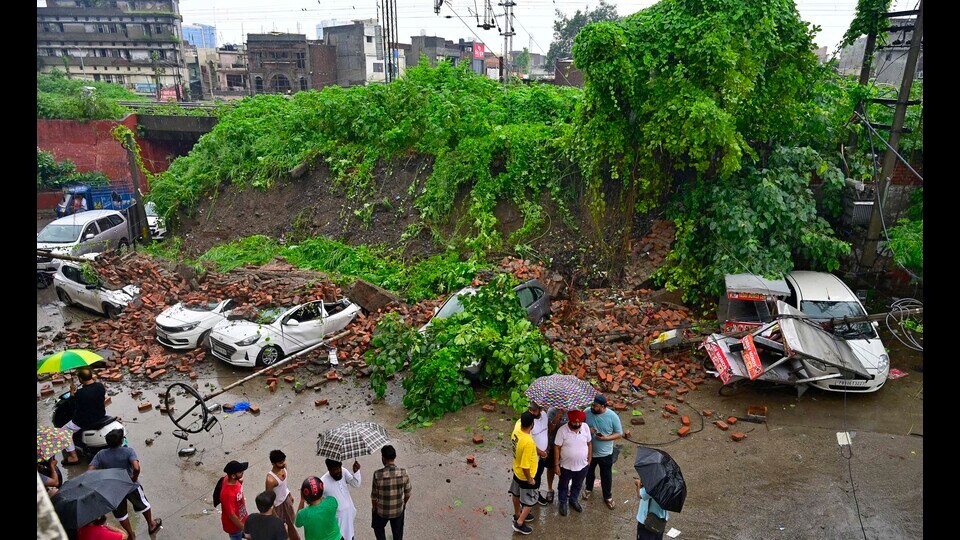
Further destruction was reported near Damoria Bridge, where a retaining wall buckled after being weakened by the rain, crushing five parked cars beneath a cascade of bricks and debris. Additionally, two major road cave-ins tore through the city’s surface. One took place in SBS Nagar near City Centre, where a local resident, Arvind Sharma, recounted, “Suddenly, a large portion of the road just sank. Water started gushing in, and we had to warn commuters to stay away.” Another massive cave-in occurred in Dugri Phase 2, attributed to a damaged sewerage line. Both areas have been barricaded to prevent further accidents.
In response to the crisis, deputy commissioner (DC) Himanshu Jain and municipal commissioner Aaditya Dachalwal visited affected localities, including Dhokha Mohalla, to assess the overwhelming situation. As a precautionary measure, all dyeing and printing units in low-lying industrial areas like Bahadur Ke Road, Focal Point, and Tajpur Road were ordered to halt operations. “We’ve asked all industrial units close to the Budha Nullah to halt work to avoid further complications and contamination,” said DC Jain. Repairs for the damaged infrastructure are slated to begin once the weather stabilises.
Toxic water enters homes as Budha Nullah overflows
Meanwhile, the separate Ganda Nullah overflowed in Dhokha Mohalla, causing flooding in houses in Ranjit Singh Park, Dharampura, Kot Mangal Singh Nagar, and New Deep Nagar. Dheeraj Kumar, who runs a small grocery store in Ranjit Singh Park, expressed a sense of weary familiarity with the situation. “Every year, we face the same situation. The nullahs are never cleaned in time. The authorities only wake up when the disaster has already happened. This is routine now,” he said.
Highly polluted water raises disease fears
The overflow of both drains, particularly the notoriously toxic Budha Nullah, poses a significant health hazard. These water bodies are heavily contaminated with industrial effluents, domestic sewage, and solid waste. As this polluted water mixes with rainwater and enters homes, it creates a serious risk of waterborne diseases and infections. While there has been no official public health advisory yet, residents are advised to take precautions and avoid contact with the contaminated water. The recurring crisis underscores the long-standing failure to address the city’s drainage and waste management issues.
In response to the crisis, MC officials stated that teams have been deployed to the affected areas. Additional commissioner Paramdeep Singh Khaira confirmed that water-suction machines are being used to clear flooded zones. MC chief Aaditya Dachalwal, along with local MLAs, inspected different parts of the city, including Dhokka Mohalla and Haibowal, and issued necessary directions to drain out the rainwater and strengthen the nullahs’ banks with sandbags.
The civic body has established a 24x7 flood control room at the Daresi sub-zone office. Residents can call 0161-2749120 for assistance. Officials have appealed to the public to remain vigilant and to approach authorities in case of an emergency.


