
 E-Paper



To curb pest attack on cotton: In a first, Punjab plans subsidy on mass use of green tech
Sensing a threat of losing more on the crop diversification front, the Punjab government has for the first time decided to give a subsidy on Specialised Pheromone and Lure Application Technology (SPLAT), a wax-based formulation to combat pink bollworm infestation in cotton crop, in the next kharif season.


Sensing a threat of losing more on the crop diversification front, the Punjab government has for the first time decided to give a subsidy on Specialised Pheromone and Lure Application Technology (SPLAT), a wax-based formulation to combat pink bollworm infestation in cotton crop, in the next kharif season.
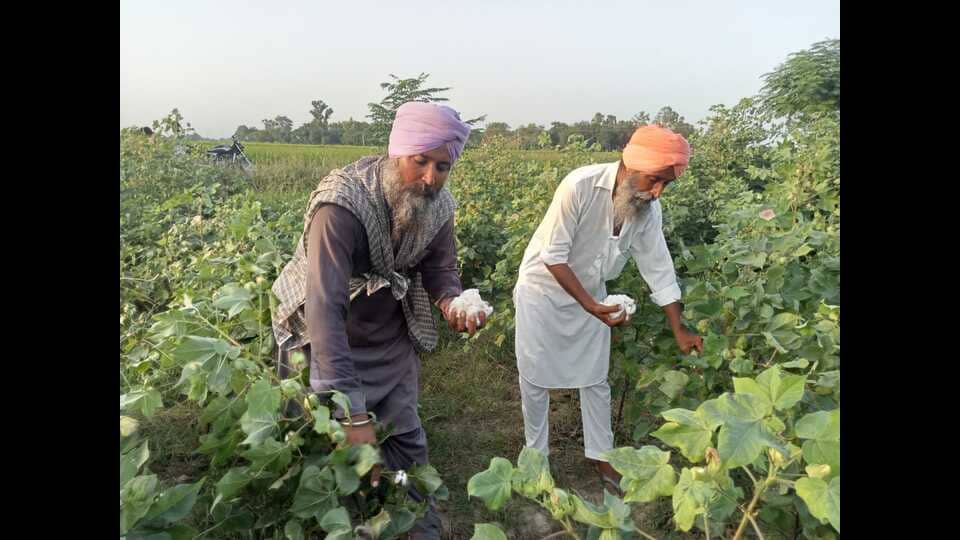
Experts said the initiative is aimed at rebuilding confidence among the loss-making cotton growers to stop switching to the water-guzzling paddy. Trend shows that farmers are losing interest in the cash crop by opting for rice cultivation.
SPLAT is an advanced mating disruption technology (MDT) containing chemicals secreted by insects to lure male moths. Expert says MDT targets only pink bollworm’s (PBM) population cycle and other insects remain completely unharmed.
MDT is duly approved by the Central Insecticide Board (CIB) of the Union ministry of agriculture and farmers’ welfare.
As per the official data, this year cotton was on 1.73 lakh hectares which was the lowest since 2010.
Experts said following a widespread attack of the deadly pink bollworm and whitefly, acreage under the traditional cash crop of the semi-arid region of southwest Punjab is showing a downward trend since 2021.
State agriculture director Jaswant Singh said the Centre government will be approached for financial assistance in the mass use of SPLAT as pink bollworm is the key challenge.
“Modalities are being finalised for the implementation of the scheme,” he added.
The department has identified repeated pest infestation, use of unapproved seeds, poor irrigation support and unfavourable weather conditions behind the downward interest of farmers in cotton as it is the third consecutive season in a row of poor crop.
“The government is making concentrated efforts to put cotton farming back on track. We have set a target to grow cotton on 4 lakh hectares in 2024-25 and groundwork will be started from the first week of January to achieve it,” said the director.
He said that the bio-safe SPLAT is a mating disruption technique, and the Punjab Agriculture University (PAU) has validated its efficacy after field experiments.
In the 2021-22 season, the first bollworm infestation caused widespread damage to the cash crop, particularly in Mansa and Bathinda, which are considered the economic lifeline of Punjab’s semi-arid zone.
Push for mass use of SPLAT is the second major incentive after giving subsidies on the seeds.
“The 33% subsidy on seeds helped us to eliminate the use of unapproved cotton seeds that are susceptible to pest attacks and low yield. Modalities are being finalised to have an ample supply of SPLAT and we are eyeing financial support from the Centre for the project,” he added.
The director said that the water resources department has ensured the canal water supply by the first week of April.
“Chief minister Bhagwant Mann is personally taking an interest in making cotton popular again as a part of crop diversification. From the first week of January, field teams will be activated to boost the morale of cotton growers by making them aware of the programme chalked under the guidance of experts,” he added.
As per data from the state agriculture department, in 2022-23, a total 2.47 lakh hectare area of eight districts was covered with the cash crop.
It was 4,000 hectares less than the area in 2021-22 when 2.51 lakh hectares were used to sow cotton.
Data says in 2011-12, a total of 5.16 lakh hectares were under cotton which was the highest in the last 13 years.
In 2010-11, 4.84 lakh hectares was used to cultivate the traditional crop in the semi-arid region of Punjab, and till 2015-16, the state witnessed more than 3 lakh hectares under cotton.
Principal entomologist of PAU Vijay Kumar said about 4,000 acres of farmers’ land was demonstrated under SPLAT which is like a paste.
“It is highly effective and leaves no chemical load used after 40-45 days of sowing and it must be applied before the flowering stage. To get the best results of SPLAT, whose application of a pea size of pheromone paste is put on cotton plants, in the maximum area. After the first use, the next two applications should be done after 30 days each. The non-chemical approach of insect pest management in cotton significantly benefits in reducing the load of chemical pesticides and cost of protection,” added the expert.
In figures
Year Area under cotton in lakh hectares
2023 1.73
2022 2.47
2021 2.52
2020 2.50
2019 3.35
2018 2.68
2017 2.91
2016 2.95


