Species of the trinket snakes are being unearthed one after another in the extended hinterland of the tricity. These non-venomous snakes came to light with the rescue of a common trinket snake (CTS) in Pinjore (April 2024) and the copper-headed trinket (CHT) or radiated trinket photographed on June 2, 2024, in the Morni hills by Gagandeep Singh. Another record of the CHT surfaced more recently from a house near the Morni Fort and this specimen was rescued by Bahadur Khan.
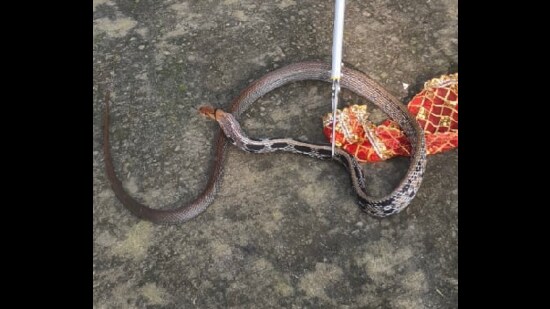
“Prior to the above evidence of the species’ presence, there were no historical records for the CTS from Haryana and Chandigarh and none for the CHT from Punjab, Haryana and Chandigarh. The closest CHT record to the two Morni hills specimens is a solitary road-kill observation from Solan in Himachal Pradesh from 2018. From Rajasthan, I found one record from Tonk Road, Jaipur, of April 12, 2020,” the Mohali-based naturalist, professor Gurpartap Singh, told this writer after undertaking a review of historical literature relating to distribution records and geographical range of the trinkets.
The records of the CHT from Morni hills and Solan indicate the north-western limits of the species’ known geographical distribution. The CHT is also found in other Indian states and also in South China, Nepal, Bangladesh, Myanmar, Thailand, Vietnam, Sumatra, Java, Bali, Borneo, etc. It is evidently a serpent enjoying quite an international representation!
The CHT is a fast-moving serpent or a racer. Adults can attain body lengths of 230 cm, ie, over seven feet. Hunting birds and rodents, it is often found in trees and was photographed by Gagandeep Singh in the branches of a Morni hills tree. The CHT kills its prey like a python by constricting it and is found close to human habitation and around agriculture due to the prevalence of rodents. As a defensive measure, the CHT when confronted or in danger, inflates its forebody and lifts it up to appear larger than life, while simultaneously emitting warning hisses in the manner of a cobra. The CHT female lays eggs in a clutch of 5-15 eggs.
{{/usCountry}}The CHT is a fast-moving serpent or a racer. Adults can attain body lengths of 230 cm, ie, over seven feet. Hunting birds and rodents, it is often found in trees and was photographed by Gagandeep Singh in the branches of a Morni hills tree. The CHT kills its prey like a python by constricting it and is found close to human habitation and around agriculture due to the prevalence of rodents. As a defensive measure, the CHT when confronted or in danger, inflates its forebody and lifts it up to appear larger than life, while simultaneously emitting warning hisses in the manner of a cobra. The CHT female lays eggs in a clutch of 5-15 eggs.
{{/usCountry}}How petals brave the Drass LOC
In my column last week, I dwelt on the alpine blooms of the Drass LOC and the symbolism of life and resilience these flowers hold for our infantry soldiers and officers braving the icy, barren terrain. We know soldiers are equipped with alpine clothing, special foods and shelters but how do the flowers of super-high altitudes survive tonnes of snow falling upon heights of 17,000 ft and above? What special adaptations do the stunted flowering shrubs display to glimmer briefly from June to September?
“An adaptation mechanism for a special group of plants known as chamaephytes helps them to survive. These are low-growing shrubby plants with buds above ground and protected by the snow cover. When the snow melts, the buds simply grow up to produce leaves and flowers. Since the growing season is short, this adaptation helps plants to flower fast and complete their life cycle. In temperate climates, perennial plants usually have buds hidden at ground level (hemicryptophytes) or buried bulbs, corms, rhizomes, etc, (cryptophytes, geophytes),” said Dr Gurcharan Singh of the renowned “efloraofIndia” group of botanists.
Chamaephytes are low shrubs less than 25 cm tall, with perennating buds above ground level but not higher than 25 cm, so they remain protected by snow in winter and, being very low-growing, are not damaged by winds when snows melts.
Due to security considerations, botanists are not allowed into the super-high altitudes of the LOC to undertake field research. The unique photographs of flowers from the war-torn, LOC super heights come from the army or an adventure expedition granted exceptional clearance by the ministry of defence. Botanical research by academics in the Kargil-Ladakh region is thus confined to valleys, lower mountain slopes and along road-heads. “We had botanised these regions in 1970-’72. We took rides in army vehicles as there was no regular transport to the remote areas. We walked long distances and took pony rides. Subsequently, we travelled in Kashmir University jeeps. As there were no digital cameras, and film cameras were a luxury, we could only collect specimens to be deposited in the university herbarium. We explored Kargil and its surroundings, and the Suru valley, extensively for botanical diversity in 1970-’72,” Singh told this writer.
vjswild2@gmail.com