The migratory booted eagle has seldom been photographed around the Sukhna Lake, and that, too, in flight. No tricity lensman has captured this raptor in its majestic flourish when he is hunting. For a moment, drenched in raw power, we turn to a seemingly unlikely lens lover, Dr Nisarga, the chief cardiac surgeon at KIMS Hospitals, Hyderabad.
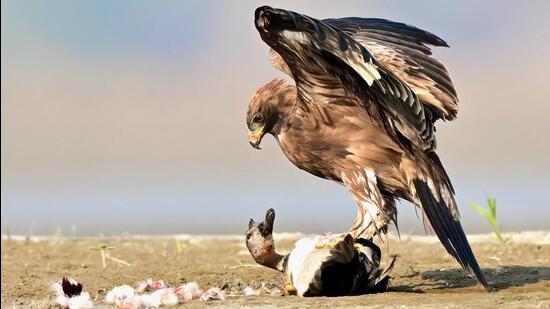
Named by his father after nature (Nisarga) and choosing not to bear the family surname in deference to his wishes, the heart doctor took to bird photography two years ago. Recently, with the assistance of his eagle-eyed wife, Prateeka, who spotted it from afar and then directed him to a vivid hunting scene, Nisarga captured one of the most definitive moments of a booted eagle – the raptor landed imposingly on a gentle gadwall and then proceeded to strip the duck of its feathers to relish fresh flesh at the waterfowl haven of Gajoldoba (West Bengal).
Having inserted its raking claws deep into the tender breast of the duck, whose raised neck quavered in a feeble death dance, the eagle’s eye radiated a look of brute, remorseless power. It contrasted with the despair visible in the eyes of the duck, whose resistance was dying out like a wicker lamp lashed by the winds. Finally, a doomed look came upon the duck, similar to the one that besets a convict on death row on whose cell door the final knock has rung true.
The posture of “terrified submission to power” is a timeless theme, whether as an exercise of might in nature or in the guise of a right in humans. It vividly evoked a painting by 18th century Pahari master artist, Nainsukh, who depicted a fierce hawk pinning down, flat on its back, a migratory ruddy shelduck. That was on the face of it, but as per Nainsukh, he had subtly symbolised the state of mind of a timid and young newly-wed wife caught in the brutal moment of an enjoinment of conjugal rights by a hawkish husband, who was impatient, unsubtle and ravenous.
{{/usCountry}}The posture of “terrified submission to power” is a timeless theme, whether as an exercise of might in nature or in the guise of a right in humans. It vividly evoked a painting by 18th century Pahari master artist, Nainsukh, who depicted a fierce hawk pinning down, flat on its back, a migratory ruddy shelduck. That was on the face of it, but as per Nainsukh, he had subtly symbolised the state of mind of a timid and young newly-wed wife caught in the brutal moment of an enjoinment of conjugal rights by a hawkish husband, who was impatient, unsubtle and ravenous.
{{/usCountry}}But that was where the analogies between humans and nature ended. Nisarga’s photo also drew comments on social media in the context of Russia’s ruthless war on Ukraine. An amoral nature kills for hunger and is limited by her needs but moralistic humans “attack for more wanton needs – oil, ports, arms – even out of spite!”
No wind, but ‘leaf’ flew
This spring, flying and fallen leaves are abundant. But when one of these “dry leaves” took flight all of a sudden in a windless tent, it caught the eye of marathoner, Munish Jauhar. In his words: “I was participating in an ultra-marathon event at the Tau Devi Lal Stadium, Panchkula. Around 4.30am, I saw this leaf-like creature fly in and come to rest on a tablecloth in our tent. No one else noticed it ,and I, too, might have missed it as it was extremely still and unmoved by all the din created by the marathoners, had I not seen the moth fly and land on the tablecloth.”
The moth’s snout resembles a leaf stalk, so the mimicry is near-perfect. It can remain motionless even if physically disturbed. From Jauhar’s quick photograph of the cryptic creature, Roger Kendrick, an authority on South Asian moths, identified it as a Lappet moth hailing from the family, Lasciocampidae. “Further, the moth is of Gastropacha species. There is a need to dissect it (the male genitalia) to arrive at precise identity. It falls in the Gastropache pardale group,” Kendrick told this writer.
More than 2,000 species of Lappet moths exist across the globe, though not all have been named and described. Apart from disguising themselves as leaves, moths like these may have scales that help reduce reflection of ultrasonic signals from their bodies which reduces the ability of predators (bats) to find them via echo-location.
vjswild1@gmail.com