Diwali festivities routinely see visits of neighbourhood civic employees such as sweepers, garbage collectors and sometimes, cops, to residences. Some reeking of arrogance, others more meek, they all seek a “Diwali” from householders who are in no position to bang the door on them.
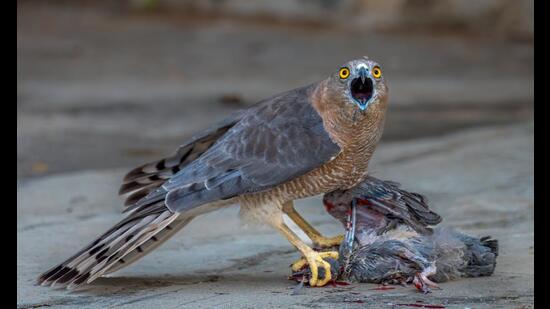
For award-winning bird photographer and Sector 17 apparel retailer Anuj Jain golden moments to photograph a resident hawk, the Shikra, on a rare pigeon kill were curtailed by a bumbling brace of beat constables.
Jain was packing Diwali gifts into his car for distribution to his near and dear ones when the cops stole in. As Jain engaged them in festive pleasantries, his eye was distracted by a glimpse of a bird through the gates of his neighbour’s house in Sector 18 B. Jain left the cops and his gaze fell upon a pigeon seized by the Shikra in his neighbour’s driveway.
“I took a click with my cellphone but raced back to the first floor of my house and within 45 seconds was back at the gate with my camera. I told the cops to stay put as they could have disturbed the Shikra. Just as I had taken a few photographs, curiosity got the better of the cops who had been left quite intrigued at my ‘queer’ behaviour,” Jain told this writer.
The cops ambled to the neighbour’s gate with a Holmes air. They were left gawking at the busy Shikra, as if the bird was a busty Zeenat Aman pinup! They started exclaiming in excitement. The Shikra, which had not been disturbed by Jain’s unobtrusive presence to the gate’s side, flew into a rage seeing the cops and emitted loud, agitated calls seeking the cops dismissal from the hunting scene. Naturally, no such grace or sensitivity flitted through the cops’ minds. Disgusted by the overbearing intrusion, the Shikra abandoned the pigeon. Jain was left aghast, having been denied an extensive photo shoot of a mauling Shikra.
{{/usCountry}}The cops ambled to the neighbour’s gate with a Holmes air. They were left gawking at the busy Shikra, as if the bird was a busty Zeenat Aman pinup! They started exclaiming in excitement. The Shikra, which had not been disturbed by Jain’s unobtrusive presence to the gate’s side, flew into a rage seeing the cops and emitted loud, agitated calls seeking the cops dismissal from the hunting scene. Naturally, no such grace or sensitivity flitted through the cops’ minds. Disgusted by the overbearing intrusion, the Shikra abandoned the pigeon. Jain was left aghast, having been denied an extensive photo shoot of a mauling Shikra.
{{/usCountry}}The silver lining was that the cops also departed sensing Jain’s suppressed displeasure and distracted state. It finally dawned upon the proverbial bulls in a China shop that a self-inflicted malady would require them to forego their 2022 ‘Diwali’ from the Jain kothi.
The arrow stork
In the absence of satellite tracking and other scientific tools, the mystery of avian migration was a much misunderstood natural phenomenon till the first two decades of the 19th century. Ignorance of bird behaviour – akin to the dogged belief that the world is flat – threw up bizarre theories of why birds disappear from colder latitudes in winter and appear again the following summer. Some of the most vaunted intellects failed to assess the correct reasons for bird disappearance and instead let their rather fertile imagination take flight.
Aristotle believed birds morphed into other birds, like a caterpillar turning into a butterfly, with seasonal change. So, the redstarts Aristotle saw in summer simply turned into the robins seen in winter. Harvard College educator Charles Morton argued in 1694 that birds disappearing into thin air as summer waned had fled to the hospitable climes of the moon. Other naturalists contended that birds hibernated in the soft, unfrozen mud of lakes and rivers or at the bottom of the sea.
They had no idea of the prowess of the actual phenomenon: birds disappear because they journey across earth. Modern scientific tracking has since established that the Arctic tern undertakes an annual journey from the Arctic to Antarctic and back, covering 1.5 million miles over its life, an odyssey equivalent to three trips to the Moon and back!
A surreal incident cleared the “science fiction” fogging bird disappearance. In 1822, a hunter shot down a White stork near Mecklenburg in Germany. The stork was impaled with a 31-inch-long African wooden spear. It meant the stork had flown 2,000 miles from Africa in that impaled state to summer in Germany. In the course of time, 25 more such impaled storks were discovered. It became crystal clear that birds migrated to more hospitable habitats across continents as winter approached because their summer grounds had turned icy and could no longer provision food and shelter.
vjswild1@gmail.com