The imperative of finding daily food and catering to the demands of raucous chicks leads birds to adapt fast and figure out things. Hawks in the US have learnt to zero in on garden bird feeders as they realise their prey, small birds, are bound to make regular forays. Nesting Black ibises in Udaipur not only made an improvised nest on an electricity tower. Faced with a paucity of their traditional wetland foods, the ibises started stealing pigeon chicks from nearby houses for their own chicks, a food source not known to be associated with the ibis. The ibis parents even discovered a nearby point where the Jains fed pigeons. Very innocently, the ibises would park themselves there and make off with adult pigeons. In a similar adaptation, Dusky eagle owls observed a nesting colony of Woolly-necked storks. Once the storks were done with breeding, the owls promptly occupied the empty stork nests and hatched their chicks as the nests suited them. The clever owls had obviated the need to make their own nests.
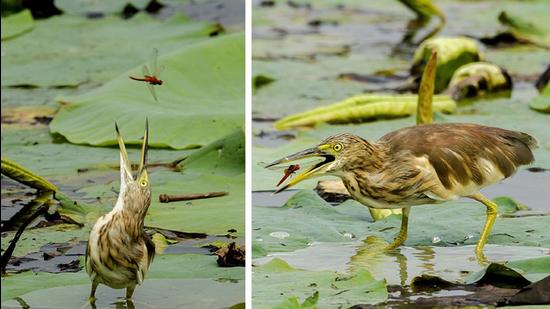
Closer home at the Mote Majra pond near Banur, an Indian Pond heron speedily self-corrected its faulty “catch practises”. Perched on a lotus leaf in the water, the heron was trying to snap up Red-veined Darter dragonflies buzzing over it by thrusting upwards. The dragonflies were too fast and the heron incurred a dozen failed hunts. “However, the cravings of an empty stomach forced the heron to observe the dragonfly flight more carefully and modify tactics. Having observed that there were brief interludes in the dragonfly’s swift flights in which the insect either slowed down or hovered, the heron seized upon those particular moments as the widow of opportunity. The heron finally caught one during a slowed-down flight and then snapped up three more in quick succession by keeping a sharp eye on speed variations,” Chandigarh-based photographer, Vikas Salil Sharma, told this writer.
Creepy to cryptic beauty
{{/usCountry}}Creepy to cryptic beauty
{{/usCountry}}The Sukhna Lake Nature Trail that darts off delightfully opposite Nagar Van is frequented by a host of notables and humble folk. Chief justices, diplomats, editors, advisers, officers, lovers, politicians, and even the once-regular Aroosa Alam, Pakistani “friend” of then Punjab CM Amarinder Singh, have been spotted walking on this trail which meanders through scrubland forest. Sambars, peacocks, wild boars and umpteen birds are frequently encountered here. However, one creature has spooked all species of walkers, especially during humid months when they spawn in the hundreds.
These are caterpillars hanging down on thin white threads from the invasive, alien species of Prosopis juliflora trees/shrubs flanking the trail. Caterpillars get attached to the clothes of unsuspecting walkers. Upon reaching home, these walkers find the creepy-crawlies all over them, leading to shrieks from awaiting kin and threats to disinfect and outcast them. However, back at the trail, the caterpillars that did not “go home” eventually metamorphosed into enigmatic Geometridae moths.
During the day, these moths remain as still as mannequins and cling to tree barks in cryptic camouflage to avoid predator birds. Moths shed their stillness when the sun has safely slipped between the night’s sheets. They are like nightjar birds that perch perfectly still during the day, feathers merging with tree foliage or ground cover. Walkers certainly cannot miss the spectacle of caterpillars and larvae dangling over them like a veritable minefield. However, there is every chance of them missing out on the caterpillars’ subsequent manifestation: as moths right there, besides the trail, within an arm’s length, on the trees...and strictly non-sticky.
vjswild1@gmail.com