Citizen science is yielding to wildlife conservationists and ornithologists a richness of data and behavioural observations from the field, the latter a much-neglected domain of natural history.
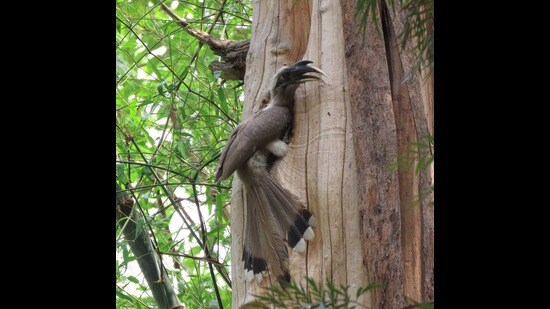
Retired banker Rajesh Khurana took time off from the ongoing renovations in his house to observe and photo-document the incredible work the male Grey hornbill puts in for nesting success. Khurana went for seven days to the Garden of Fragrance, Sector 36, Chandigarh, where a hornbill pair had a nest. This species has been bestowed the honorary title of the State Bird of Chandigarh (UT).
Khurana’s dedication paid off richly, he took a video of the male bringing 22 fruits (probably figs) in one go to the barricaded nest in a tree hollow, which had the female and eggs/chicks. This kind of enumeration of the number of food items the hornbill can carry in its pouch (crop) in the oesophagus and then regurgitate through a slit it at the nest entrance to the awaiting female has rarely been documented. It requires much more work and passion than clicking pretty bird pics and posting them on Instagram.
“For the first few days, the male hornbill would bring a few food items in its crop and discharge them. But on one occasion, I took a video in which the male expelled 22 fruits from its crop, one by one. That gave me an idea as to the extent of the food it can carry to the nest after foraging within a radius of a kilometre or so from the nest. I observed that the male had gone very thin during the nesting service because he was constantly at work, finding food,” Khurana told this writer.
For weeks, the male indulges in the most rigorous form of `patni sewa’. Female birds are known to test a male’s capacity to put in hard work for food collection before turning coy to conjugal bliss. Hornbills are known to lay two-three eggs, rarely four. After the eggs hatch, and sometime later, the female breaks down the barricaded nest and flies out to assist in collecting food for the ravenous chicks.
{{/usCountry}}For weeks, the male indulges in the most rigorous form of `patni sewa’. Female birds are known to test a male’s capacity to put in hard work for food collection before turning coy to conjugal bliss. Hornbills are known to lay two-three eggs, rarely four. After the eggs hatch, and sometime later, the female breaks down the barricaded nest and flies out to assist in collecting food for the ravenous chicks.
{{/usCountry}}She drowned while plucking buds
Edith Holden (1871-1920) was a naturalist of uncanny sensitivity. Her eyes ever so brooding and curious, Holden would wander in the woods and along the brooks of the Midlands (UK), resulting in poems, jottings and watercolour paintings. The month of June in Europe’s temperate climates or in the Himalayas is one where the meadows and moors are all starred over with flowers.
And so, in one of her seasonal tributes to June (published in ‘The Nature Notes of an Edwardian Lady’, 1989), Holden’s watercolour and verses blossomed thus: “I wake with the flowers that will watch out the night; Yellow and white, In the midsummer twilight, over the land, For the dawn at hand.”
In her time, her nature sketchbooks went unfelt. But when published decades after her death, they created a wave of misty-eyed regret over the passing of a naturalist’s era where life had been attended by the sighs of daffodils, arias of warblers and fireflies flitting like stars in nights so tender.
The circumstances of Holden’s death were cast in poetic finesse. The English bard, Robert Herrick (1591-1674), whose lines below she inscribed on one of her watercolours, may have well have presaged her epitaph: “Gather ye rosebuds while ye may, Old Time is still a flying; And this same flower that smiles today, Tomorrow will be dying.”
In March 1920, Holden was found drowned in a backwater of the river Thames, near Kew Gardens. She had tried to reach a branch of chestnut buds. The bough was out of reach, and with the aid of her umbrella, Holden had tried to break it off, fallen forward into the river, struggled intensely, and then surrendered gently to nature’s eternal embrace. A pebble tossed into a stream, only the swans had seen her end in ripples.
vjswild2@gmail.com