
 E-Paper



Wildbuzz | The night’s door, ajar
Nightjars are mysterious birds because their plumage, silence and stillness during the day helps them evade detection; they rest on low boughs or on the ground during the day

 Prefer HTon Google


On a moonlit night last Thursday, the great, distant stars appeared anaemic, paling in deference to a vain moon basking in the reflected glories of the sun. I had driven out to the Shivalik foothills to a ground machaan by a watering hole to listen to the most astounding of the birds of the night, the long-tailed and savanna nightjars.
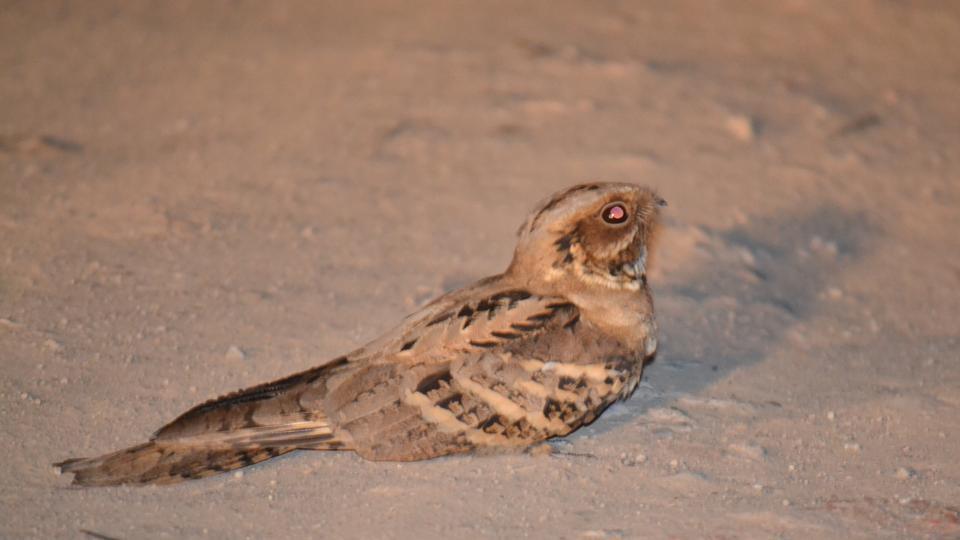
The night has been described as the ‘queen of darkness’ and nightjars as the ‘princes of pristine nocturnal sounds’. Nightjars are mysterious birds because their plumage, silence and stillness during the day helps them evade detection. They rest on low boughs or on the ground during the day. Even country folk, who dwell near nightjar habitats, may never have seen this bird during the day. When it calls at night, the ‘ruralites’ will not know which creature makes those strange sounds from dark crevices falling between moonbeams.
At the water hole, large-tailed nightjars had situated themselves close to the banks and indulged in long choruses of their characteristic call, ‘chaunk, chaunk, chaunk...’, like a carpenter hammering hollow planks. The awakening frogs croaked and twittered in perfect unison. A little distant from the water, on hillock slopes, were flitting Savanna nightjars. The Savannas enriched the cosmic concert hall, lit by the great chandeliers of the heavenly bodies, with their ‘chiveet, chiveet, chiveet...’ calls. A nearby Neem was lit up with hundreds of ‘jugnoos’ like a Christmas tree. Some jugnoos detached from the galaxy-like glitter to glide over rippling waters, like twinkling diyas released from the great ghats of the Ganges by a pious lady on Pooranmashi.
It is doubtful whether any bird of the day could muster such lung power and call without interruption. Last May, I timed a large-tailed nightjar for 9.5 minutes calling incessantly. The recent night, that record was eclipsed, this nightjar went on and on, like Draupadi’s infamous disrobing whence the unfurling robes had flowed endlessly saving her modesty.
Nightjars hunt for insects on the wing at night. The hot weather is their courtship and breeding season, with eggs being laid on ground without a nest.
Masters of colour
When we compare fickle, greedy politicians, who change parties and ideologies, to chameleons, the analogy renders great injustice to these wild creatures. Chameleons specialise in changing colours to camouflage, warn rivals, allure mates and for thermoregulation. The other common malady is to mistake the Oriental Garden lizard or the ‘korkirla’ of our hedges as a chameleon.
The ubiquitous korkirla does not quite possess the chameleon’s versatility of colour change. The main hue change of the korkirla is the male donning orange-crimson-royal blue hues in breeding season, apart from other fundamental differences between the two species.
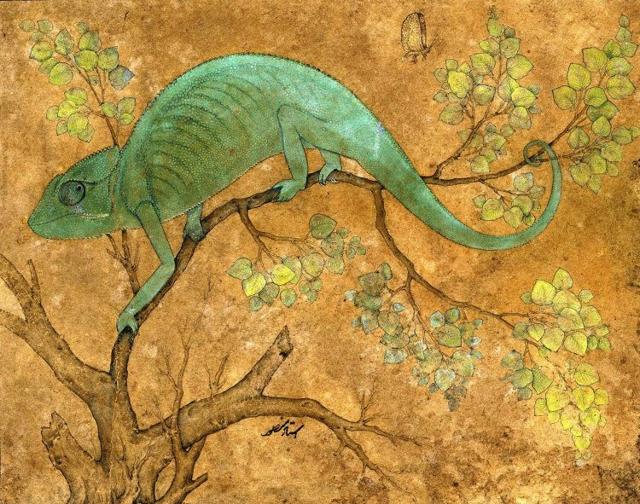
The Indian chameleon (Chamaeleo zeylanicus) is the only chameleon species found in India, specifically in South India and to the west of the Ganges. This creature possesses amazing abilities, such as a long tongue that can be thrown out to catch insects and eyes that swivel and focus in different directions. It is befitting that the iconic depiction in art of Nature’s master of colours is credited to Ustad Mansur Naqqash, the artist of flora and fauna patronised by Emperors Akbar and Shahjahan. Shahjahan had conferred upon Mansur the title, ‘Wonder of the Age’.
Mansur’s painting of a chameleon, reckoned as one of the greatest faunal paintings of the Mughal era, was undertaken with a characteristic accuracy of anatomical detail. It has the chameleon with its prehensile tail looped around a branch.
An eye which frames a golden crescent is also seemingly devilish, swiveling slyly back to look upon a butterfly hovering innocently above the tail. Mansur was legendary for his abilities to innovate with paints. The rough texture and lustre of the chameleon’s skin and conical scales was simulated on paper by Mansur’s incredible novelty: a myriad of thickly-laid, discrete dots of paint.
vjswild1@gmail.com


