Butterflies can be shy, impish creatures — those that teasingly fly off of a flower top just as one is about to close in following a wearying, tip-toe stalk. And, left stranded like a foolish, empty-handed Peter Sellers’ ‘Pink Panther’ while the dainty creature giggles and sallies forth to binge on another bloom! Moths, their nocturnal cousins, come across as simply inscrutable to the uninitiated eye. Whether beautifully-plumaged or dull-coloured, moths are nevertheless given to secretive habits.
A moth chanced upon may remind one of a peevish damsel sulking in a dark corner of the house only to react as if struck by lightning if touched. Yet, some humans seem to effortlessly attract these graceful creatures.
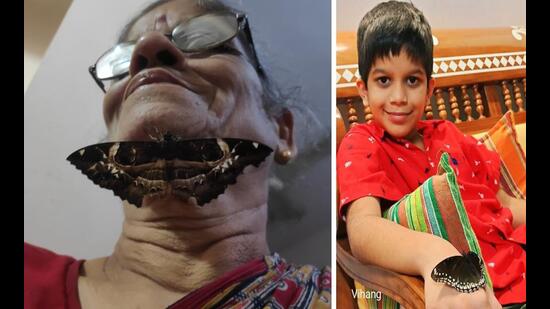
Usha Sadhale’s clan, down to her grandson, Vihang, revel in “Nature at the doorstep” of their house in the verdant city of Ponda (Goa). Vihang has been brought up to understand and empathise with living creatures. “Vihang has no desire to trouble or kill or harass any living creature,” Usha tells this writer. “A beautiful butterfly came into our house at night and sat under a table. I went close to her and the butterfly came and perched on my wrist. I was very excited and she did not leave me for a long time,” Vihang adds.
His granny is a role model — tolerant and compassionate. Usha saw a huge, disoriented moth in her kitchen as she went in to undertake her chores at 8 pm. “I called my son, Abhijit, to click a photo of the beautiful moth. Suddenly, the moth flew and alighted under my chin and would not leave. I was taken aback, but stood still for 10 minutes, not wanting to disturb the creature. After that, I moved a bit, looking to resume my kitchen work and the moth flew off. The feel on my skin was not prickly and I was comfortable,” says Usha, whose “chin moth” picture drew astonishment, curiosity and rave comments.
{{/usCountry}}His granny is a role model — tolerant and compassionate. Usha saw a huge, disoriented moth in her kitchen as she went in to undertake her chores at 8 pm. “I called my son, Abhijit, to click a photo of the beautiful moth. Suddenly, the moth flew and alighted under my chin and would not leave. I was taken aback, but stood still for 10 minutes, not wanting to disturb the creature. After that, I moved a bit, looking to resume my kitchen work and the moth flew off. The feel on my skin was not prickly and I was comfortable,” says Usha, whose “chin moth” picture drew astonishment, curiosity and rave comments.
{{/usCountry}}Pretty perches
What makes shy moths and butterflies perch on people out of the blue?
Dr Krushnamegh Kunte, butterfly scientist at the National Centre for Biological Sciences, Bengaluru, assigns possible reasons: “They could land on a human seeking a perching spot, just as they would do on any other suitable place (which seems to explain the moth on Usha Sadhale’s neck and the butterfly on Vihang’s wrist). The most common biological reason for alighting on a human, meanwhile, is to seek salts from human sweat. Certain moth species alight at night on sleeping humans to feed on secretions from the eyes and nose.”
And then there are times, he says, when humans turn into vantage points, “Butterflies can also alight on the head of a human walking through a forest clearing, and these are usually male butterflies. The human head serves as a vantage point, just as a tree stump. From that vantage point, the male watches out for passing females and goes after them in an attempt to mate. The human head also serves as a surveillance point for keeping an eye on rivals. A butterfly can perch on a human and stay put as it cannot fly. This is when it has just emerged from the tight, enclosing space of the pupa, is moist and its wings are wet and wrinkled. The wings need time for exposure to the sun to dry and elongate then take flight. In the interim, they perch, if need be on a human.”