The myriad and unknown events that make up the routine of jungle life cache many mysteries. Scavenging at carcasses is normally associated with vultures and mammals. So, when researchers at the Kalesar National Park (KNP), Yamunanagar, camera trapped a red jungle fowl (RJF) besieging a foul-smelling sambar carcass, the explanations for their presence varied. These birds are normally observed picking the ground in the early mornings for grains, seeds etc. while foraging along jungle paths and tracks.
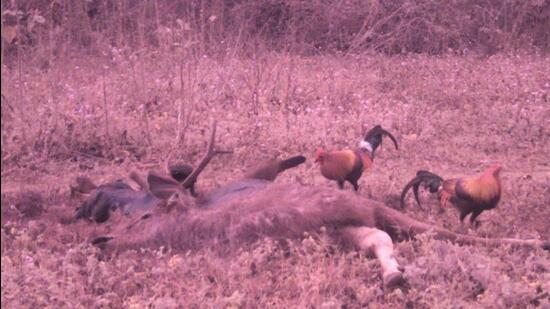
Were the RJFs picking the carcass for “maggots, insects, flies etc.”, as KNP researcher Janam Jai Sehgal opined? He backed his view by citing a study undertaken in Thailand that examined the crop and gizzard of 23 RJFs and came up with similar contents. Sehgal’s view was largely supported by Brig Ranjit Talwar (retd.), a shikari-turned-wildlife conservationist with vast field experience and a former coordinator at the WWF-India’s Tiger Conservation Programme for 13 years. “Picking up meat morsels, in all probability. The carcass does not appear old enough for maggots to have developed. Also, RJF could be eating Blue bottle flies. RJFs are likely to go for tasty meat morsels first rather than look for grains in faecal matter,” Brig Talwar told this writer.
An opposite view came from ornithologist and vulture scientist, Dr Vibhu Prakash: “The RJF must be picking grass seeds or grains from Sambar’s intestines. I have seen Yellow-eyed pigeons similarly feeding on grains from intestines of cattle carcasses at Bikaner. The RJF are largely granivorous birds and insects/larvae are occasionally taken, so grain feeding is most likely.”
{{/usCountry}}An opposite view came from ornithologist and vulture scientist, Dr Vibhu Prakash: “The RJF must be picking grass seeds or grains from Sambar’s intestines. I have seen Yellow-eyed pigeons similarly feeding on grains from intestines of cattle carcasses at Bikaner. The RJF are largely granivorous birds and insects/larvae are occasionally taken, so grain feeding is most likely.”
{{/usCountry}}Zoology associate professor Rajiv Kalsi, who is Sehgal’s supervisor and project investigator for the KNP research, differed with his student: “I think the RJF were merely curious birds. They were checking out the death of a Sambar in their locality. I have seen doves on a Chital carcass and other birds and animals merely observing that death and getting kind of curious without the motive of securing food from the Chital carcass. RJF are granivorous birds and take in insects etc only in breeding season as a source of proteins to foster rapid growth in chicks.”
Sukhna brims with emptiness
The season for migratory birds is well underway, but the Sukhna lake bears an abandoned look. The recent count of migratory birds at the lake turned up dismal numbers. This has been the trend since the last few years with the lake brimming with monsoon waters and turning inhospitable for wintering waterfowl that fly in from the northern latitudes.
A deep lake does not offer natural basking sites for birds, ie, silted isles, mudflats and exposed shores. Neither does it afford aqua foods typical to shallow, marshy wetlands preferred by migratory waterfowl. So, one will find a higher concentration of migratory avians in the humdrum, waterlogged fields of Jhajjar, Haryana, than a sprawling body of water like the Sukhna designated as a “wetland”.
The other threat gnawing away at the Sukhna poses a challenge beyond birding opportunities. It is the advance of the colonising and exotic lotus weed. In just a couple of years, the weed has intruded into the prime birding area of the erstwhile rowing canal at the lake and currently covers 60% of the surface there. The canal was a designated birding area where the forest and wildlife department would set up spotting scopes/binoculars for migratory bird viewing every winter.
The department has been lax in setting up bamboo floats or constructing islands for the migratory birds to bask and rest. Neither has it erected bird-watching hides along the ponds in the reserve forest. The department’s strategic plan to lower water levels in the canal by constructing a sluice gate at its mouth and erect a series of silt islands in the middle for bird basking remains caged in the musty files.
Apart from “savouring the spectacle” of lotus weeds and a sprinkling of resident and migratory birds, it is difficult to envisage what bird lovers will watch this winter and in coming cold seasons. For regular observers of the lake’s avian diversity, the iconic water body bears a look not dissimilar to the summers. In its heyday seen at the turn of the century, thousands of birds bejewelled with rarities and vagrants would settle at the lake and provide wonderful opportunities to children for nature awareness.
vjswild2@gmail.com