There are many species of warblers — tiny look-alikes that are very secretive in their habits. Differing calls and songs usually help distinguish different species. However, in the case of the Tytler’s leaf warbler, an International Union for Conservation of Nature (IUCN) near-threatened species, an alternative is available to ornithologists. The warbler’s head and chin is often stained with pollen when the bird migrates back to the Western Himalayas in spring from its wintering grounds in the Western Ghats. Pollen smears were not found by ornithologists in months outside of spring. Much like light Holi smears, these stains distinguish the Tytler’s leaf warbler from other species.
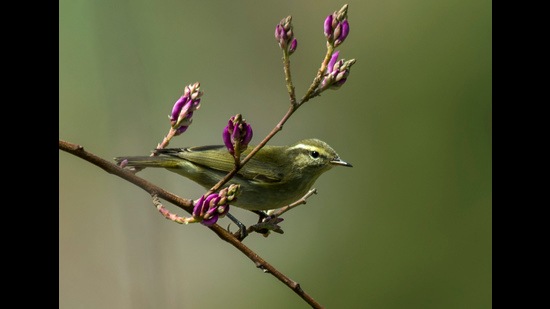
“Thus, the flower-probing habits of the Tytler’s (shared with the dissimilar-looking Buff-barred warbler) may provide a supplementary clue to identification in spring. The thin bill of Tytler’s warbler is apparently related to the species’ propensity of foraging by picking and probing in various substrates rather than fly-catching,” wrote American ornithologist and an authority on South Asian birds, Pamela C Rasmussen. Her research paper was based on an examination of Tytler’s specimens curated in museums across the globe.
The first record for the Tytler’s from the inter-state capital region (encompassing an area within 40-km radius from Chandigarh) came last week from Chakki Modh, Solan, which is brimming with nectar resources. The specimen was merrily feeding on petals while in passage migration to its breeding grounds in higher altitudes. Tytler’s warbler is endemic to the sub-continent while the common name commemorates British infantry officer and naturalist Robert Christopher Tytler (1818-1872), who took part in the first Anglo-Sikh War.
Palkon ki chhaya
{{/usCountry}}Palkon ki chhaya
{{/usCountry}}I have walked calmly through swarming honey bees in spring in Chandigarh and the surrounding countryside. Bees are hyperactive while swarming as they are finding spots for new hives. Some of these ‘bizzee, buzzin’ bees alighted on my bare forearms to check me out, and then flew away to more pressing tasks. Never has a bee stung me during such swarming interactions. I did not indulge in piteous cries and flailing limbs that would have readily invited stings. They sensed my good intentions.
Bees don’t want to sting us because it is suicidal for these pollinators. When a worker bee releases the sting from her lower abdomen, it leads to a rupture, body fluids are lost and she dies as a result of ‘bleeding’. Similarly, coy butterflies rarely alight on a human wrist but when they do so, it is because they discern noble intent.
A painting of great visual delight and reflecting nature’s immensity was on display recently at the 19th all-India annual exhibition hosted by the WE Group of Contemporary Women Artists at the Government Museum and Art Gallery. Employed as an art teacher at Delhi World Public School, Zirakpur, Sonam Goel invested her artwork, Exploring Nature’s World, with a woman’s intuitive understanding. Ensconced in Vibgyor colours, Goel depicts one eye resplendent with flowers and shrubs sprouting like eyelashes that tenderly shade vision and lure many butterflies.
In creative contrast, Goel is austere with the eye’s soulmate. “The other eye has lesser flowers and shrubbery but a butterfly still comes and perches at the edge. I want to convey that the butterfly has sensed a beauty in the defoliated eye that is welcoming, radiates harmony and brims with benign feelings,” Goel told this writer.