
 E-Paper



Women of rural Himachal leading the change towards natural farming
Women of rural Himachal Pradesh, who have been working hard in silence for many years, are now emerging as leaders in the implementation of non-chemical, low-cost and climate-resilient natural farming


Women of rural Himachal Pradesh, who have been working hard in silence for many years, are now emerging as leaders in the implementation of non-chemical, low-cost and climate-resilient natural farming. The environment-friendly and sustainable techniques have helped improve their lives and livelihoods and they are now serving as inspiration for others.
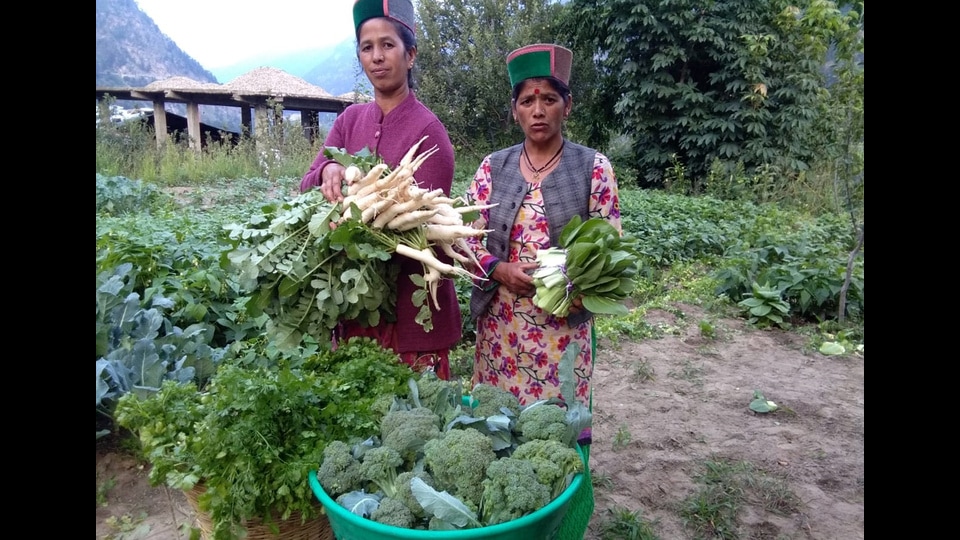
The Himachal Pradesh government had launched the Prakritik Kheti Khushal Yojana (PK3Y) in 2018 to promote this zero budget natural farming (ZBNF) technique, renamed Subhash Palekar natural farming (SPNF) in the state. Given the significant role of women in agriculture, the Yojana focused on them and brought them out for capacity building workshops, exposure visits to fields and gave them a platform to share their experience.
So far, 1,74,394 farmers have been trained in natural farming techniques in Himachal Pradesh under PK3Y, out of which 1,71,063 have adopted this practice, partially to fully, over an area of 9,421 hectare. Women comprise over 60% of the trained and practising farmers in the state. Around 99% panchayats have been covered in the state under the scheme.
The natural farming technique reduces the dependence of farmers on the external market and focuses on use of farm inputs made from dung and urine of “desi cow”. This reduces the cultivation cost drastically and increases the net income of farmers. A number of women adopted this technique despite initial opposition. They moulded their families’ opinion by showing them the results on a smaller chunk of land or on the kitchen garden.
Shared Radha Devi, 40, of Koti village in Solan district, said, “I adopted natural farming a couple of years ago after I saw the success of women practising it in the adjoining village of Dugri.I am now growing garlic, onion, spinach and many other vegetables on 5 bighas of land. Apart from bringing down my annual farm expenditure from ₹20,000 to ₹500-700 annually, it has given me an exposure to grow and motivate others.”
“My life was limited to travelling between my in-laws and parents’ place all these years. Since I got associated with PK3Y, I have attended so many workshops, have given training and my social connect has improved,” she added.
Rishu Kumari from Jamanabad in Kangra district, said, “It is easier to make all the inputs on the farm. I am growing a mix of crops on the same field now and the produce is chemical-free and nutrition-rich. So many buyers come to my farm now to buy vegetables and place the orders in advance. This has reduced family’s hassle for marketing to an extent.”
Kumari grows crops like peas, mustard, grams, broccoli, ginger, radish, carrot and wheat, has an indigenous cow and is also a designated natural farming trainer. “I am getting such confidence and recognition for the first time in my life,” she said with pride.
This confidence building in women farmers is actually working wonders. A group of women from Peja in the interior Chirgaon area of Shimla district, who shifted to natural farming of red rice three years back, have even got an award of ₹10 lakh from the government of India. Their success has also motivated other farmers in the village to take up natural farming.
Secretary agriculture and state project director of PK3Y, Rakesh Kanwar, said special focus is being laid on women farmers under the scheme in the current financial year in Himachal Pradesh. “As hill women play a significant role in agriculture, the effort is to reach out to more and more of them for better results in natural farming,” he said.
According to data shared by State Project Implementing Unit (SPIU), over 100 women farmers in the state are designated natural farming trainers. Also, several women groups are being formed at village/panchayat levels, who have adopted natural farming techniques collectively after training.
The extension officials working under PK3Y are providing regular handholding, including financial support to these groups for new initiatives. As many as 502 “krishi sakhis” designated under the National Rural Livelihood Programme (NRLM) by the rural development department have been trained in natural farming in the entire state.


