
 E-Paper



Work to clean Buddha Nullah starts with release of 200 cusecs fresh water in Ludhiana
Initially, water resources minister Sukhbinder Singh Sarkaria and food and civil supplies minister Bharat Bhushan Ashu were to inaugurate the project, but both leaders cancelled at the last minute, triggering speculation that they had backed out due to the farmers’ agitation


The project to transform the polluted Buddha Nullah (seasonal rivulet) into a clean dariya (river) kicked off with the release of 200 cusecs of freshwater here on Sunday.
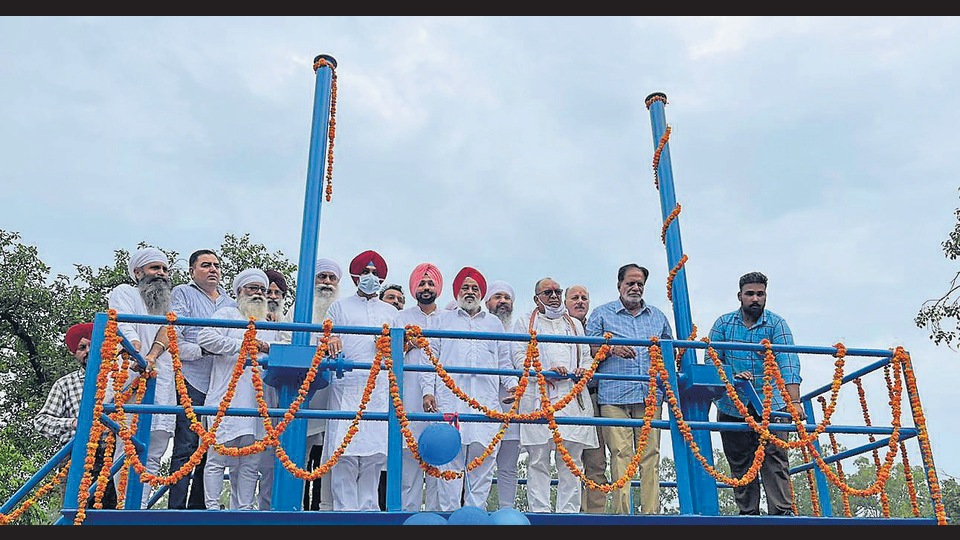
The ₹9.8-crore project, under which 200 cusecs of fresh water will be released into the Buddha Nullah daily, was inaugurated by Samrala MLA Amrik Singh Dhillon, Payal MLA Lakhvir Singh Lakha and Ludhiana mayor Balkar Singh Sandhu.
Initially, water resources minister Sukhbinder Singh Sarkaria and food and civil supplies minister Bharat Bhushan Ashu were to inaugurate the project, but both leaders cancelled at the last minute, triggering speculation that they had backed out due to the agitation.
However, the mayor said that Sarkaria had cancelled his visit due to heavy rain and traffic snarls near Jalandhar. “Ashu entrusted us to inaugurate the project,” said Sandhu, adding that the project to release canal water into the Neelon Drain was part of the Punjab government’s ambitious ₹650-crore project to clean the nullah.
Special earthmover arranged from Meerut
Ludhiana drainage division executive engineer Harjot Singh Walia said that it was for the first time that a project had been executed without stopping or diverting the flow of water in the Sirhind feeder canal, for which a special earth mover was arranged from Meerut.
The water resources department used sheet piling technology to build an escape regulator channel to carry 200 cusecs water from the Sirhind Feeder Canal.
In preparation for the project, four village road bridges and five field paths were repaired and the Neelon river was cleaned within eight months. The project is being funded by the Ludhiana municipal corporation and the Punjab Pollution Control Board (PPCB).
The mayor said that work has already started on two new sewage treatment plants (STPs) with a combined capacity of 285 MLD – Jamalpur 225 MLD and Balloke 60 MLD; the rehabilitation of existing STPs with a treatment capacity of 418 MLD, two effluent treatment Plants (ETPs) for the treatment of 6 MLD wastewater from two dairy complexes in Tajpur and Haibowal, six intermediate pumping stations and the laying of a 10-km pipeline under the ₹650-crore rejuvenation project. “The project will be completed by December 2022,” he said.
Bouquets and brickbats
However, Jaskirat Singh, of the Naroa Punjab Manch said that the Buddha Darya Rejuvenation Project should be led by eminent scientists not politicians and bureaucrats.
“Did they conducted any study before initiating the ₹9-crore project. A project that could impact on the health and lives of millions should be led by an eminent scientist who can assess the consequences of the project,” he said.
Kapil Arora, the president of the counsel of engineers, says the release of 200 cusec of water into the Buddha Nullah from Neelon is merely a cosmetic activity. “The dyeing and electroplating industries have always been saved by the PPCB. Now, with the release of water from Neelon before Common Effluent Treatment Plants (CETPs) become operational will help mask the fact that industries are primarily responsible for polluting the rivulet,” he said, adding that if mixing of freshwater would have effectively reduced pollution, the polluted waters of Sutlej would not have caused serious health problems such as cancer and Hepatitis-B among citizens residing hundreds of kilometres away from Ludhiana.
Rahul Verma, a social activist, said, “I can see Buddha Nullah turning into Budha Dariya in the next two years. Simply blaming the industry will not provide a solution. The contribution of the industry cannot be ignored. The industry is playing a pivotal role in the development of the city and providing employment to many. As responsible citizens, we should also reduce the use of detergents, dishwasher, toilets cleaners and other chemicals as the city is the biggest consumer of such products in the state.”


