E-Paper



Forest research team captures rare video of King Cobra mating in Himalayas
Uttarakhand’s chief conservator of forests Sanjiv Chaturvedi said this is the first time that the state forest department has captured the mating of King Cobra on camera

 Prefer HTon Google


Nainital: Uttarakhand forest department’s research wing has captured the mating of King Cobras in the forests of Nainital district of the himalayan state under its five-year research project on the world’s largest poisonous snake. Sanjiv Chaturvedi, chief conservator of forests (CCF) and in-charge of state forest research wing said they had been tracking the presence of these snakes in various parts of the state as part of this project.
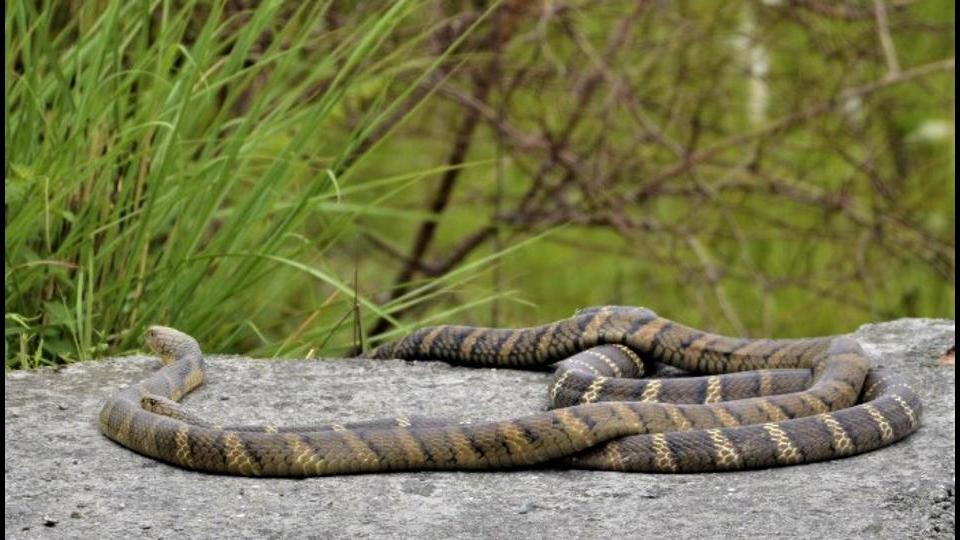
“Over a week ago, our research fellow Jyoti Prakash Joshi and another researcher Jigyasu Dolia spotted and captured the mating of King Cobras pair in forests of Nainital district on video. Though King Cobras have been sighted many times in the state, especially in Kumaon and their nests have also been found, this is for the first time that the state forest department has captured their mating on camera”, Sanjiv Chaturvedi said.
In June 2018, the research advisory committee (RAC) of the forest department had approved the proposal on a five-year research project on King Cobras in the state. The research fellows named for the project work with the forest department’s field staff were mandated to study the King Cobra’s habitat, estimate their numbers, threats to their existence and conservation initiatives needed to save them.
Even as King Cobras are mostly found in hot rain forests of South India and North East, researchers and scientists have recorded King Cobra nests and their sightings in Uttarakhand since the 1920s.
Chaturvedi said in October 2012, a King nest was sighted at 2303 m elevation at Mukteshwar, which is the highest recorded elevation for the King Cobra in its worldwide range.
“Over 132 sightings of King Cobra have been confirmed in Uttarakhand between 2015 to July 2020. In the last 5 years, they have been seen in 5 districts of the state, including Nainital (83), Dehradun (32 records), (12 records), Uttarkashi (3) and Haridwar (2)”, he said.
Chaturvedi said the study will help them to form a conservation plan for this magnificent snake species in the Himalayan state, where it is facing similar threats faced by the wildlife.
“For conservation of King Cobras, it is necessary to monitor their movement and involve local people in conservation initiatives by effective awareness-building efforts. This would develop an understanding of locals towards their conservation”, he said.
Vipul Mourya, wildlife expert from Dehradun-based Wildlife Institute of India (WII) said given its reputation, King Cobras mainly face threat from people who consider it very dangerous.
“Apart from that fragmentation of forests and increasing human presence in forests can also affect it in varied ways. Till now I haven’t come across any video of its mating in the state”, he said.
AG Ansari, wildlife expert from Nainital, who has rescued many King Cobras said they were first reported in the state in 1920s and are mainly found in pine and oak forests of Nainital where they find humid conditions for their temperature-sensitive hatching of eggs.
“Till now, I have not come across any video of its mating. This is likely the first such video and that makes it very interesting”, he said.
Ansari said King Cobra is also on the target list of the poachers. “Till now it has been found in areas like Nainital, Dehradun, Haridwar, Rishikesh, Rajaji National Park (RNP), Ramnagar and other forest divisions of the state”, he said.
In India, King Cobra (Ophiophagus Hannah) is found in the Western Ghats, the Shivalik and Terai regions of Uttarakhand and Uttar Pradesh, Bihar, Odisha, West Bengal, and the Andaman Islands. It is known to feed primarily on snakes including their own species. King Cobra is the national reptile of India and the only snake known to build nests. It is listed under Schedule II of the Indian Wildlife (Protection) Act, 1972 and as Vulnerable in IUCN Red List of Threatened Species. The venom of the King Cobra consists primarily of neurotoxins, known as the Haditoxin.