An estimated 1,300 tonnes of unprocessed cattle waste goes into drains in Delhi and eventually into Yamuna everyday, adding to the river’s pollution burden, as per data by the Municipal Corporation of Delhi (MCD). To prevent this waste from entering Yamuna, the civic body has signed a Memorandum of Understanding (MoU)on July 15 this year with National Dairy Development Board to develop processing plants across Delhi, officials said.
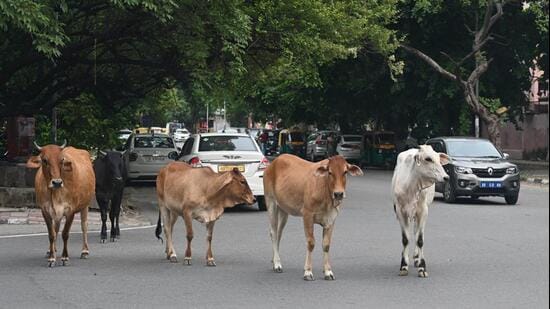
As per MCD’s livestock enumeration -- part of the Yamuna clean-up exercise being overseen by the Union home ministry -- a total of 1,500 tonnes of cattle dung is generated in the city everyday, combining both authorised and unauthorised dairies and cow shelters. Of the total, only 200 tonnes is currently utilised and processed at the compressed biogas plant in southwest Delhi’s Nangli dairy -- the only operational facility in the city.
The remaining 1,300 tonnes of unprocessed cattle waste is estimated to enter drains, and eventually Yamuna.
The data, also accessed by HT, shows there are a total of 123,164 cattle in authorised and legal dairies and shelters in Delhi. The civic body has separately estimated that around 500 unauthorised dairies operate in the city.
A total of 82,750 cattle are housed in legal and authorised dairy colonies, while government animal shelters account for 19,638 cattle, and 20,776 are housed in private gaushalas.
{{/usCountry}}A total of 82,750 cattle are housed in legal and authorised dairy colonies, while government animal shelters account for 19,638 cattle, and 20,776 are housed in private gaushalas.
{{/usCountry}}A senior government official said that the data was presented last week during deliberations on the Yamuna clean-up initiative being monitored by a committee chaired by the Union home secretary. The committee includes senior officials from Delhi and other states and has been tasked with coordinating measures to improve Yamuna’s condition.
“The discharge of cattle dung into drains has emerged as a significant source of organic pollution in the river. Large quantities of dung entering the water can increase organic load and contribute to depletion of dissolved oxygen, further affecting the river’s already stressed ecosystem,”the senior official added.
Notably, a biogas plant at Nangli dairy is operational, which can process around 200 tonnes of waste per day.
Officials said several other projects are in the pipeline, such as plants with processing capacities of 200 tonnes per day each at Ghogha and Goyla dairies, a 300-tonne-per-day facility at Ghazipur dairy and a 125-tonne-per-day plant at Bhalswa dairy. According to the MCD report, a 75 TPD plant will come up at Masoodpur dairy, 200 TPD plant at Indira camp Sector 3 Rohini, 50 TPD unit at Sri Ram Colony in Khajoori, 100 TPD facility at Sarita Vihar, and 200 TPD plant in Indira Park in Sagarpur.
“Five of these facilities are expected to be completed by June 2027. Once all the plant are operational, the total cattle dung capacity will rise to 1,625 TPD, which will be above the existing dung generation,” an official explained. Construction at the Goyla and Ghogha dairy plants is reported to be 72% and 70% complete, respectively.
Stay updated with all top Cities including, Bengaluru, Delhi, Mumbai and more across India. Stay informed on the latest happenings in World News along with Delhi Election 2025 and Delhi Election Result 2025 Live, New Delhi Election Result Live, Kalkaji Election Result Live at Hindustan Times.
Stay updated with all top Cities including, Bengaluru, Delhi, Mumbai and more across India. Stay informed on the latest happenings in World News along with Delhi Election 2025 and Delhi Election Result 2025 Live, New Delhi Election Result Live, Kalkaji Election Result Live at Hindustan Times.