Despite the Supreme Court’s restriction allowing firecrackers only between 8pm and 10pm on Diwali, widespread violations and bursting of crackers across Delhi resulted in an increase in the ambient noise levels at most monitoring locations to several times the prescribed guidelines. 19 of the 26 stations in the city recorded higher noise levels this year compared to 2025, according to a report by the Delhi Pollution Control Committee (DPCC).
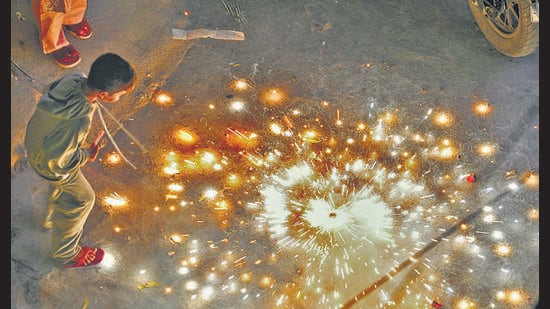
The DPCC’s assessment of ambient air quality during Deepawali 2026, showed that noise levels increased at nearly 73% of the locations where real-time noise monitoring terminals (NMTs) are installed. Only seven locations recorded a decline.
Highest Readings and Sharpest Increases
The highest noise level was recorded at Karol Bagh, where it stood at 89.1 decibels (dB(A)), marginally lower than the 89.2 dB(A) recorded last year. Jahangirpuri recorded the second-highest level at 81.2 dB(A), a 9.7% increase from 74 dB(A) in 2025. Dwarka recorded 79.8 dB(A), while Patparganj registered 79.5 dB(A), an increase of 5% and 8.4%, respectively.
Sonia Vihar witnessed the sharpest year-on-year increase, with noise levels rising 16.6% from 64.3 dB(A) in 2025 to 74.9 dB(A) this Diwali. Najafgarh recorded an 8.2% increase, Mundka 9.1%, Wazirpur 7.8% and Jahangirpuri 9.7%.
Declines and Overall Noise Range
Among the seven locations that registered a decline, Ashok Vihar recorded the steepest fall of 8.8%, from 74.9 dB(A) to 68.3 dB(A). Connaught Place saw a 5.7% decline, while Vivek Vihar recorded a 1.7% drop.
The overall noise levels across the 26 monitoring locations ranged from 57.5 dB(A) in Najafgarh to 89.1 dB(A) in Karol Bagh on Diwali.
Also Read | Delhi pollution monitors went dark as AQI surged on Diwali
Noise Standards and Pollution Control Measures
The Central Pollution Control Board (CPCB) divides noise monitoring stations into four categories – silence zones, where the day and night-time decibel levels should not exceed 50 and 40 dB(A) respectively, residential zones, where the day and night-time standards are 55 and 45 dB(A) respectively, commercial zones, where the day and night standards are 65 and 55 dB(A) respectively and industrial zones, which have by far the most lenient standards of 75 dB(A) during the day and 70 dB(A) at night.
{{/usCountry}}The Central Pollution Control Board (CPCB) divides noise monitoring stations into four categories – silence zones, where the day and night-time decibel levels should not exceed 50 and 40 dB(A) respectively, residential zones, where the day and night-time standards are 55 and 45 dB(A) respectively, commercial zones, where the day and night standards are 65 and 55 dB(A) respectively and industrial zones, which have by far the most lenient standards of 75 dB(A) during the day and 70 dB(A) at night.
{{/usCountry}}A July 2022 order of the National Green Tribunal (NGT) had directed that noise pollution be treated at par with air pollution, and that any plan to curb air pollution must also include measures to mitigate noise.
Frequently Asked Questions
How many Delhi monitoring stations recorded higher noise levels on Diwali?
Where was the highest noise level recorded?
Which location saw the sharpest year-on-year increase in noise?
What did the National Green Tribunal order say about noise pollution?
Stay updated with all top Cities including, Bengaluru, Delhi, Mumbai and more across India. Stay informed on the latest happenings in World News along with Delhi Election 2025 and Delhi Election Result 2025 Live, New Delhi Election Result Live, Kalkaji Election Result Live at Hindustan Times.
Stay updated with all top Cities including, Bengaluru, Delhi, Mumbai and more across India. Stay informed on the latest happenings in World News along with Delhi Election 2025 and Delhi Election Result 2025 Live, New Delhi Election Result Live, Kalkaji Election Result Live at Hindustan Times.