The crackdown on illegal fifth floors in the city announced by Delhi chief minister Rekha Gupta after the fatal Satya Niketan building collapse faces significant hurdles from regulatory amnesties, including an Act of Parliament that has been periodically updated since 2006, and the recent regularisation of 1,511 unauthorised colonies by the current state and central governments.
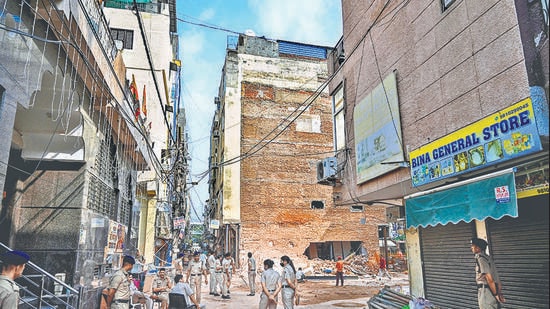
While officials may promise an immediate crackdown on illegal construction, subject experts and former officials say implementation will be easier said than done. Multiple laws and revisions to regulations over the past two decades have strengthened the protective cover available to unauthorised structures.
A senior MCD official dealing with building provisions, who asked not to be identified, said the scale of illegal construction involving additional floors was massive and a city-wide drive would leave few areas untouched.
“Most of the urban villages, abadi areas, resettlement colonies, unplanned trans-Yamuna areas and even Old Delhi have buildings with more than four floors. In unauthorised colonies, even seven and eight storeys have been constructed. But the biggest problem is that we expect a large chunk of these buildings will find protection under one provision or the other,” the official said. “A massive Delhi-wide drive to seal fifth floors will impact hundred-thousands of buildings,” the official added.
Also Read | Satya Niketan collapse: Delhi Master Plan-2047 leaves regulation of PGs in grey area
Why Delhi’s illegal fifth-floor crackdown faces an uphill task
{{/usCountry}}Also Read | Satya Niketan collapse: Delhi Master Plan-2047 leaves regulation of PGs in grey area
Why Delhi’s illegal fifth-floor crackdown faces an uphill task
{{/usCountry}}Under prevailing regulations, most residential areas permit a ground floor plus three floors, with a maximum height of 15 metres. Buildings with stilt parking are allowed an additional floor, taking the maximum permissible height to 17.5 metres.
But a walk through almost any neighbourhood shows how widely these limits have been breached. In many buildings, even stilt parking is used for purposes other than parking.
Two decades of laws have shielded unauthorised construction
The genesis of the regulatory protection dates to February 2006, when the MCD launched a city-wide sealing drive following court orders. The scale of unauthorised construction and other violations was so large that Parliament intervened, with the then UPA government passing the Delhi Laws (Special Provisions) Act, 2006.
The law initially provided protection against sealing for a year, but was subsequently extended in 2007, 2009, 2011 and thereafter every three years until 2023. The National Capital Territory of Delhi Laws (Special Provisions) Second (Amendment) Act, 2023 extended protection for unauthorised buildings for another three years, until December 31, 2026.
The regulatory landscape was further complicated on April 7 this year, when the central government announced the regularisation of 1,511 unauthorised colonies in Delhi on an “As-is Where-is” basis, covering an estimated population of 4.5 million.
A third municipal official said the scheme would cover existing built-up structures. “Even a fifth floor is protected from any punitive action if it is an old construction. We cannot demolish or seal upper floors in these colonies. Many of these structures are six, seven and even eight floors high and were built without any building norms,” the official said.
Also Read | Delhi starts PG survey; identify 52 running in dilapidated buildings
Experts say regularisation has become a political workaround
Jagdish Mamgain, an urban planning expert and former MCD works committee chairman, said successive governments had responded to illegal construction with announcements and regularisation schemes rather than addressing the underlying problem.
“Similar announcements were made after the Hauz Rani fire. When even corporators and MLAs across parties have such illegal buildings, who will take action against them? Successive governments since 1977 have been using the ‘as-is, where-is’ basis to regularise unauthorised colonies. Similarly, the Delhi Laws (Special Provisions) Act was brought in to protect illegal construction against punitive action,” he said.
“While this was supposed to be a temporary provision, it has been extended every few years, thereby increasing the blanket protection to such structures. What was meant to maintain status quo has been turned into a loophole for expansion of illegal construction,” he said.
Civic officials, who asked not to be identified, said successive governments had introduced regularisation schemes, amnesty provisions and special laws that allowed unauthorised settlements to remain, in part because taking action against such a large number of properties was politically difficult. As a result, they said, no government had been able to effectively address the underlying shortage of planned housing and commercial space that has fuelled unauthorised construction.
The “special areas”, including the Walled City and Paharganj, also enjoy relaxations in building norms because of their historical character. Mamgain said a separate plan for the Walled City was expected to be formulated under MPD-2021, but was never prepared.
Another change has potentially weakened the deterrent against illegal construction. A provision allowing up to six months’ imprisonment for illegal construction was removed earlier this year under the government’s Ease of Doing Business push.
Former municipal councillor and Congress leader Abhishek Dutt said, “In 1985, the Congress government had brought amendment 466A, under which anyone carrying out illegal construction in Delhi could face up to six months’ imprisonment and a fine of ₹5,000. Because of this, builders remained afraid. Now, with the new Jan Vishwas Bill introduced in Delhi, the central government has removed Section 466A.”
Also Read | Building next to Delhi PG collapse site to be demolished, says CM; govt to frame PG policy soon
Demolition alone will not solve Delhi’s illegal construction problem
Former DDA commissioner AK Jain said successive committees had recommended action against unauthorised construction but demolition alone would not address the problem. “From the Baleshwar committee to the Justice Nanavati committee, all have recommended action against unauthorised construction in Delhi over the years. However, if MCD has not been able to control such illegal construction, one needs a broader view than just ordering demolition of floors,” he said.
“Delhi needs an independent building regulatory authority, on the lines of RERA, to ensure enforcement. This should be a statutory body and may be headed by a judicial figure rather than any political or administrative head,” Jain added.
Stay updated with all top Cities including, Bengaluru, Delhi, Mumbai and more across India. Stay informed on the latest happenings in World News along with Delhi Election 2025 and Delhi Election Result 2025 Live, New Delhi Election Result Live, Kalkaji Election Result Live at Hindustan Times.
Stay updated with all top Cities including, Bengaluru, Delhi, Mumbai and more across India. Stay informed on the latest happenings in World News along with Delhi Election 2025 and Delhi Election Result 2025 Live, New Delhi Election Result Live, Kalkaji Election Result Live at Hindustan Times.