
 E-Paper



Buried drains: The cost of makeovers
Sections of Kushak, Defence Colony, Maharani Bagh and Chirag Delhi stormwater drains were sealed shut to beautify them.

 Prefer HTon Google


When the Delhi Development Authority (DDA) set out between 2009 and 2013 to cover stretches of the Kushak Drain in Defence Colony, it presented an alluring picture: green parks, tidy walkways, and the erasure of an open channel that had for decades carried monsoon run-off. The move was announced after years of lobbying by residents, who complained of stench, and these drains being eyesores.
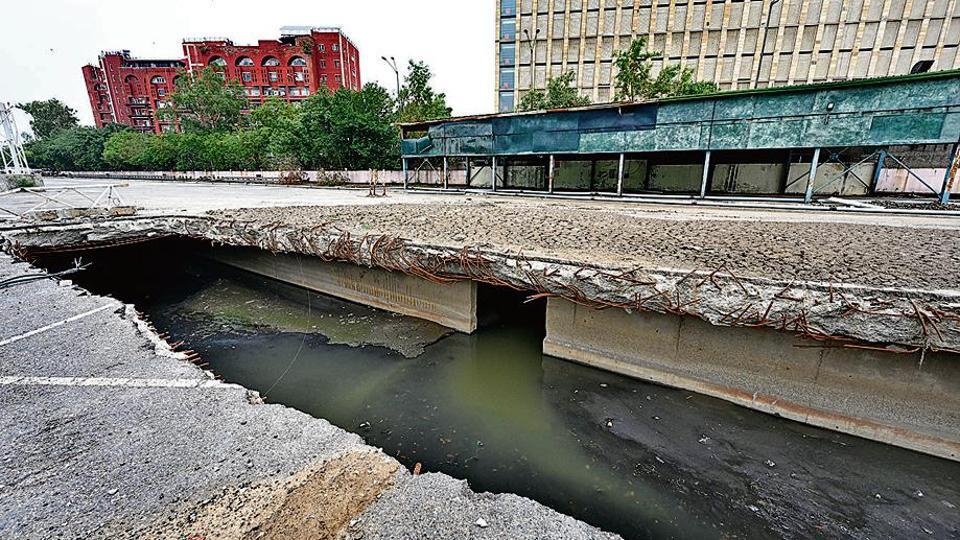
But a decade later, that plan has unravelled.
What was once a stormwater lifeline has turned into a fermentation chamber. Methane and hydrogen sulfide gases vent from sealed manholes. Slabs laid over the channel trap silt, clogging flow and leaving the colony waterlogged even after moderate rain. Now, every time these drains need to be cleaned, structures on top have to be ripped apart for agencies to have access to the drain underneath.
“None of the agencies have taken responsibility,” said Bhavreen Kandhari, a Defence Colony resident and environmental activist. “After the slabs were put in, we lost access to even inspect, let alone clean or de-silt, the drain. It’s not surprising that year after year, the colony floods even after moderate rainfall.”
The Kushak story is not unique. From Sunehri Pul to Maharani Bagh, stretches of natural stormwater drains across Delhi were boxed in with reinforced concrete and buried in an attempt to “beautify” them. But 10-15 years later, the situation is far from perfect.
A flawed vision
For hundreds of years, Delhi’s stormwater network has served as the city’s circulatory system — largely natural channels carrying rainwater towards the Yamuna. Many were already contaminated by sewage inflows, but they were visible, accessible, fixable, and still functioned as flood conduits.
Around 2009, civic planners embraced a different vision: covering drains to hide the mess.
Sections of Kushak, Defence Colony, Maharani Bagh and even Chirag Delhi were sealed shut, with surface land reused for roads, parks, or parking lots. The logic was aesthetic and well-meaning: residents wanted the stench gone, agencies wanted quick fixes before deadlines.
“The quantity of sewage was not much and though a stormwater drain on paper, it had some sewage. The ideal solution was to prevent sewage from entering it, but instead, these drains were covered and never cleaned for years after that,” said Rajeev Suri, a long-time Defence Colony resident who first flagged the issue before the National Green Tribunal in 2015. That petition eventually led to the NGT ordering a halt to the further covering of open drains until proper sewage diversion and treatment was ensured.
Yet, the damage was done: kilometres of city drains had already been entombed under concrete.
Cut off from access
The consequences are visible every monsoon. Waterlogging in upscale neighbourhoods like Defence Colony, Maharani Bagh, Golf Links and Greater Kailash has become more routine with every passing year.
In 2018, a draft drainage master plan prepared by IIT Delhi underlined the problem and the scale at which it was taking place. “Many drains in Delhi are covered fully or partially,” it noted. “Most do not have access for de-silting. If desilting is not carried out under the covered portion, the effectiveness of desilting the rest of the drain is reduced significantly.”
The report gave a rather terse bottom-line: it said that such covering was “equivalent to encroachment.” The Chirag Delhi drain, for example, was sealed and converted into a parking lot at Khanpur Chowk. Elsewhere, parks were built above buried channels, with little thought to their long-term maintenance.
A decade later, agencies admit they cannot keep these covered sections functional.
The Delhi government’s Irrigation and Flood Control Department (I&FC) said it lacks the equipment; the New Delhi Municipal Council (NDMC) tried robotic cleaning with limited success; the fire department has been asked to pressure-clean blockages; and now, in a surreal twist, the Delhi Metro Rail Corporation (DMRC) has been tasked with a ₹34 crore project to unclog the Kushak drain -- even though it has no prior experience in such work.
On September 19, the Delhi government unveiled a ₹57,000-crore drainage master plan, the first comprehensive overhaul in nearly 50 years. The 30-year roadmap promises to strengthen stormwater networks, reduce waterlogging, and prepare the city for extreme rainfall under climate change.
The plan identifies covered drains, improper gradients and irregular sections as key problems.
A 2018 IIT report had already recommended access points for de-silting and cautioned against further covering, but those suggestions gathered dust for years.
But activists pointed out that while the wider findings of the drainage masterplan study have not been released yet, policies so far have sidestepped the central question: what to do with already-buried streams.
Some piecemeal course corrections have begun. In parts of Defence Colony and Sunehri Pul, slabs have been broken open to allow desilting. But progress is slow.
NDMC launched a ₹170 crore Kushak revival project in 2024 with IIT-Kanpur as partner, but by mid-2025, residents say only two-thirds of the work is complete. The park built over the drain, once celebrated as a model of “green” urban renewal, is now vandalised, overgrown, and unsafe at night.
“It’s become a den for mischief. There’s no lighting, no horticulture. We’ve complained to councillors, MCD, even RWAs — but no one has moved a finger,” Kandhari added. “Other stormwater drains in Delhi are in similar shape — either encroached upon or buried.”
A ‘solution’ that created problems
The ecology has also suffered. “These drains were natural ecosystems. They were kept under wraps and forgotten, and now we are realising its plight after the problem has surmounted,” said environmentalist Diwan Singh, who has worked on restoring Delhi’s lakes. Instead of preventing sewage inflows, Delhi chose to cover them, he said. “Concrete was the last nail in the coffin. All drains need to be uncovered before the backflow creates even more trouble.”
Ironically, the push to cover drains came also from Resident Welfare Associations (RWAs) and citizens.
At the time, people were fed up with the stench, explained Atul Goyal, head of URJA (United RWAs Joint Action). “First the houses came up along drains knowing very well that these drains were part of the locality. Rather than tackling the sewage, covering them only led people to close their eyes to the underlying problem,” he said.
Experts argue that public impatience dovetailed with civic opportunism. Covering drains was cheaper in the short term than building sewage treatment plants (STPs) or strengthening stormwater lines. “Rather than fixing the underlying problem (sewage flowing into drains). the city chose subterfuge with nature,” said Singh.
The problem, experts said, mirrors Delhi’s larger approach to the Yamuna itself: addressing symptoms rather than sources.
“Earlier, people drew drinking water downstream of Najafgarh,” says Bhim Singh Rawat of the South Asia Network on Dams, Rivers and People (SANDRP). “When jaundice broke out, instead of tackling Najafgarh’s contaminants, Delhi built the Wazirabad barrage. We repeat this mistake with drains — concretising, covering, adding metro pillars and roads — without tackling sewage inflows.”
Rawat warns that drains are not nuisances but tributaries of the Yamuna. “Five or six of the larger drains once carried clean water year-round. Covering them has disrupted flows, increased pollution, and harmed the river. The only long-term solution is daylighting: uncovering and ecologically restoring them.”
The road ahead
Meanwhile, Delhi’s overlapping authorities struggle for answers.
In 2023, after citywide flooding, all drains were handed over to the I&FC to end jurisdictional confusion. But by March, I&FC admitted it could not desilt covered portions and asked MCD for help. When MCD too failed, the lieutenant governor directed DMRC to step in.
A DMRC official admitted they are still searching for an expert agency to even begin the task. No permanent solution is in sight.
Urban planners say the time for cosmetic fixes is over. “We don’t need piecemeal interventions,” said URJA’s Goyal. “Every drain must be seen as an ecological system. Smaller STPs should be built, inflows of sewage tapped, and vegetation like khus grass planted to purify water… Ultimately, all drains must be opened again.”
Rawat agrees: “This teaches us a lesson — no drain should ever be covered again. Treat them as part of the Yamuna’s ecosystem, not as urban eyesores. Don’t tackle symptoms but find solutions to underlying problems.”



Stay updated with all top Cities including, Bengaluru, Delhi, Mumbai and more across India. Stay informed on the latest happenings in World News along with Delhi Election 2025 and Delhi Election Result 2025 Live, New Delhi Election Result Live, Kalkaji Election Result Live at Hindustan Times.


