The Delhi government has so far achieved 86% of the targets it set out in its Electric Vehicles Policy 2020 amid a sharp rise in sales of such vehicles over the last three years, officials aware of the matter said on Wednesday.
Since the policy was implemented in 2020, the sales of EV two-wheelers has risen from 1,165 in 2020 to 34,596 in 2022, while the same for EV three-wheelers has jumped to 21,623 in 2022 from 10,328 in 2020, officials said. In the EV four-wheeler segment, sales went up from 886 to 5,641 in the same period, they added. While EV adoption has been high in Delhi, the sales have been higher in the two and three-wheeler segments, while lowest uptake has been among private four-wheelers, according to the EV cell.
The numbers were shared at a meeting on Wednesday where officials in the transport department, stakeholders and experts discussed areas which need to be worked upon in the new EV policy.
The existing EV policy expires in August this year. Under the policy, the government aimed to ensure that 25% of all new vehicles registered in the city were electric by 2025, and 100% of all delivery fleet as well as government vehicle fleet is converted to EV in the same period.
The existing policy saw 89% disbursement of incentives and fee waivers for EVs, setting up of 85% of the targeted charging infrastructure and creation of 70% of the targeted jobs, officials said. Besides, 63% of the battery recycling ecosystem has been developed and 50% of the dedicated EV fund has been utilised, they said.
In December 2022, they added, the sale of EVs in Delhi peaked at 17% — the highest-ever ratio by any state in India.
{{/usCountry}}In December 2022, they added, the sale of EVs in Delhi peaked at 17% — the highest-ever ratio by any state in India.
{{/usCountry}}Delhi transport minister Kailash Gahlot said that in the last three years, Delhi has emerged as India’s EV capital, while in the next three, the city will aspire to be a world EV leader. “Delhi’s EV policy is the most progressive... Its success is shared by all stakeholders, including Delhi’s citizens who adopted this new technology. We have always focused on inclusion, incentivisation and innovation, and collaboration is a guiding principle we abide by to ensure success,” said Gahlot.
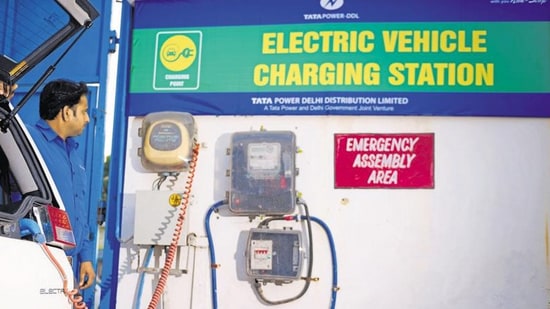
“Last year, Delhi averaged 10% EVs among total vehicle sales, with December 2022 witnessing the highest penetration so far at 17%, which is also the highest in India. The city now has more than 4,300 charging points and 256 battery swapping stations across 2,500 locations. A key measure of the successful implementation of the policy is the disbursement of subsidies amounting to ₹167 crore so far,” said N Mohan, CEO, Delhi EV cell.
He added that some of the measures that worked for Delhi include having a dedicated EV cell, non-lapsable state EV fund, public charging infrastructure database, incentives for buying electric vehicles, incentives for scrapping other fuel-based vehicles and new permits for e-autos. The government introduced electric buses and autorickshaws after 2020.
Experts present at the consultation said that the new policy needs to increase focus on skill development, electrification of commercial fleets and restructuring of incentives. They added that while the incentive schemes have worked well for the government in accelerating EV adoption, it may not be a viable long-term option.
“While the policy currently offers purchase incentives across different vehicle segments, continuing or slowly tapering off the purchase incentives in the next iteration of the policy will be important to avoid a rebound effect due to the abrupt removal of subsidies. The government can also ensure more affordable financing for EVs and provide usage incentives such as parking fee exemptions and toll fee waivers to EV users,” said Pawan Mulukutla, director-integrated transport, World Resources Institute, India.
Delhi transport secretary and commissioner Ashish Kundra emphasised on the need for tangible solutions through focused discussions.
“There are challenges that we are trying to overcome for better EV adoption. We are talking about electrification of fleets, but there are hardly any manufacturers yet who are producing electric water tankers, garbage dumping trucks or sweeping machines. Green energy is also a problem area as in many places,” said Kundra.
On the need for better financing schemes, Kundra said that they will explore the option to rope in banks for offering a viable financing option for buying EVs.
Stay updated with all top Cities including, Bengaluru, Delhi, Mumbai and more across India. Stay informed on the latest happenings in World News along with Delhi Election 2025 and Delhi Election Result 2025 Live, New Delhi Election Result Live, Kalkaji Election Result Live at Hindustan Times.
Stay updated with all top Cities including, Bengaluru, Delhi, Mumbai and more across India. Stay informed on the latest happenings in World News along with Delhi Election 2025 and Delhi Election Result 2025 Live, New Delhi Election Result Live, Kalkaji Election Result Live at Hindustan Times.