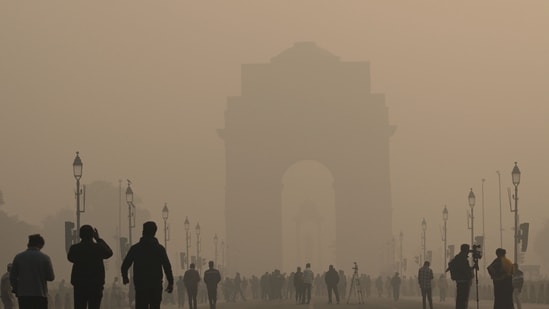
Delhi’s air quality remained in the “poor” category for the third consecutive day on Friday, with the average air quality index (AQI) reading at 230, as per Central Pollution Control Board’s daily bulletin.
Environment minister Manjinder Singh Sirsa subsequently directed district administration officials to identify pollution hotspots using air quality monitoring data and ensure time-bound action against local pollution sources.
During review meetings for southwest and west districts, Sirsa instructed officials to crack down on traffic congestion, road dust, illegal encroachments, unauthorised parking and open burning of garbage. He also called for strict enforcement of Stage I measures under the Graded Response Action Plan (Grap), invoked on Wednesday across Delhi-NCR.
On Friday, three monitoring stations -- Punjabi Bagh, Pusa and RK Puram -- recorded “very poor” air quality, with AQI readings of 302, 319 and 307, respectively. Of the 56 stations reporting data, 36 recorded “poor” air quality, while the remaining were in the “moderate” category.
Also Read | No consistent improvement of Delhi's winter air quality in past four years: CREA analysis
{{/usCountry}}Also Read | No consistent improvement of Delhi's winter air quality in past four years: CREA analysis
{{/usCountry}}The average AQI was 223 on Thursday and 245 on Wednesday -- both in the “poor” zone.
As per CPCB standards, an AQI between zero and 50 is considered “good”, 51 to 100 “satisfactory”, 101 to 200 “moderate”, 201 to 300 “poor”, 301 to 400 “very poor”, and 401 to 500 “severe”.
According to forecast by the Air Quality Early Warning System, Delhi’s air quality is likely to remain “poor” from October 24 to 26, and no immediate improvement expected over the following six days.
Sirsa directed district administrations to prepare hotspot-specific action plans, identifying pollution sources, remedial measures, responsible agencies and implementation deadlines, according to an official statement from his office. Officials were also asked to monitor PM10 and PM2.5 levels at vulnerable locations and undertake targeted inspections wherever particulate pollution is high.
Also Read | How pollution in Delhi surged on Dussehra night
Further, the minister called for stricter dust-control measures at construction sites, regular water sprinkling on roads, pothole repairs and treatment of exposed soil. Agencies were instructed to ensure proper waste collection, segregation and disposal to prevent garbage accumulation and open burning.
Focusing on traffic management, he also directed officials to coordinate with traffic police to regulate heavy vehicles entering Delhi. Action was also ordered against illegally parked heavy vehicles obstructing traffic, the statement read.
Transport was the largest estimated contributor to Delhi’s pollution on Friday, accounting for 20.38% of the concentration, according to the Decision Support System for Air Quality Management in Delhi. Stubble burning contributed an estimated 5.16% to PM2.5 levels on Friday, with its share projected to rise to 13.6% on October 26.
Appealing to residents to support pollution-control efforts, he urged people not to burn waste, maintain valid pollution-under-control certificates, use public transport and carpool wherever possible.
“Wherever pollution is being generated, its source must be identified and action must be taken at that very location,” he said.
Stay updated with all top Cities including, Bengaluru, Delhi, Mumbai and more across India. Stay informed on the latest happenings in World News along with Delhi Election 2025 and Delhi Election Result 2025 Live, New Delhi Election Result Live, Kalkaji Election Result Live at Hindustan Times.
Stay updated with all top Cities including, Bengaluru, Delhi, Mumbai and more across India. Stay informed on the latest happenings in World News along with Delhi Election 2025 and Delhi Election Result 2025 Live, New Delhi Election Result Live, Kalkaji Election Result Live at Hindustan Times.