The Delhi government is working on a new solar policy aimed at slashing the upfront cost of rooftop installations for households, with the draft modelled on the Centre’s Utility-Led Aggregation (ULA) framework under the PM Surya Ghar: Muft Bijli Yojana, officials said on Sunday.
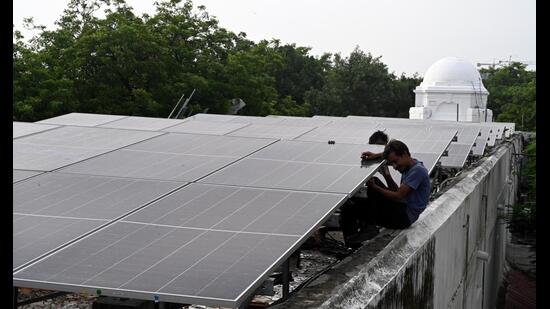
The draft policy, which was finalised earlier this week and is expected to be placed before the Cabinet this week, seeks to transition rooftop solar adoption from an individual, vendor-driven transaction to a discom-aggregated model. The ULA approach, which has already proven successful in Odisha, is being replicated to reduce the steep initial financial burden that has historically deterred residential consumers.
Under the proposed framework, the government is likely to bundle the existing capital subsidy with the five-year generation-based incentive (GBI) and release it upfront, rather than adjusting it against monthly bills over the years. Officials said this restructuring could bring down the upfront contribution for a standard 3 kW system to roughly ₹15,000.
Currently, a 3 kW system currently costs around ₹2.25 lakh. Households installing a 3 kW system are eligible for a total subsidy of ₹1.08 lakh ( ₹78,000 from the Centre and ₹30,000 from the state), bringing the contribution at ₹1.17 lakh. The GBI -- ₹3 per unit for systems up to 3 kW and ₹2 per unit for larger installations -- is paid out incrementally over five years.
The incentive is adjusted against monthly electricity bills, with any surplus credited to the consumer’s bank account by the discom.
{{/usCountry}}The incentive is adjusted against monthly electricity bills, with any surplus credited to the consumer’s bank account by the discom.
{{/usCountry}}By front-loading these benefits, the government aims to remove one of the biggest barriers to adoption and make solar energy more accessible to a wider cross-section of residents.
“We are bringing substantial changes to accelerate solar adoption in Delhi. The draft is likely to be placed before the Cabinet in its next meeting,” a senior official said.
Delhi currently has over 10,000 rooftop solar installations. The government has set a target of scaling this up to 203,000 units under the PM Surya Ghar scheme, making the proposed policy a critical lever in its renewable energy roadmap for the capital.
Stay updated with all top Cities including, Bengaluru, Delhi, Mumbai and more across India. Stay informed on the latest happenings in World News along with Delhi Election 2025 and Delhi Election Result 2025 Live, New Delhi Election Result Live, Kalkaji Election Result Live at Hindustan Times.
Stay updated with all top Cities including, Bengaluru, Delhi, Mumbai and more across India. Stay informed on the latest happenings in World News along with Delhi Election 2025 and Delhi Election Result 2025 Live, New Delhi Election Result Live, Kalkaji Election Result Live at Hindustan Times.