E-Paper



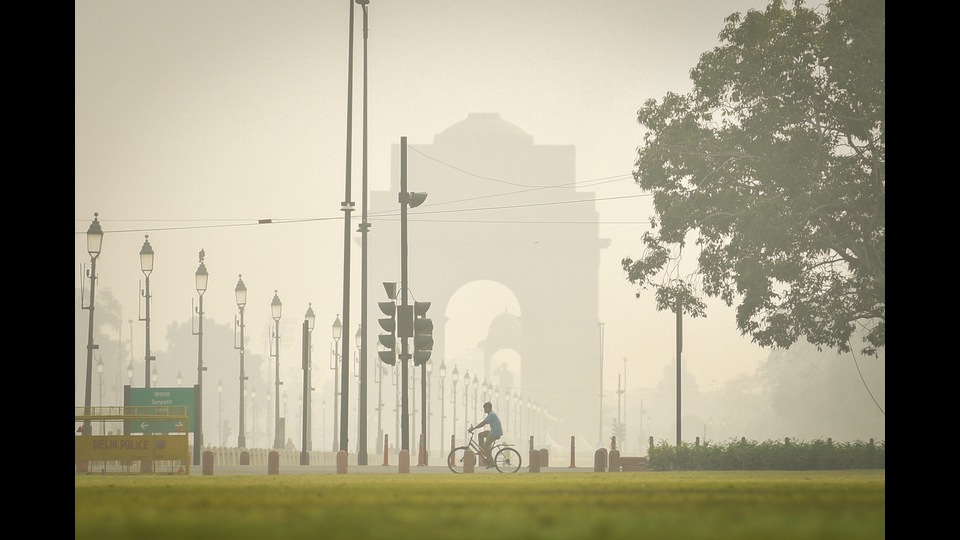
Delhi skies turn sepia as farm fire smoke shrouds Capital
Air quality in the next seven days could be worse as the fires peak during the first week of November. Last year, the contribution of stubble burning had touched 36% on November 5 and 48% on November 7, Safar data show. In 2020, the contribution of stubble burning touched a peak of 42% on November 5

 Prefer HTon Google


Smoke from farm fires is fast becoming the dominant source of particulate matter pollution in Delhi, according to the System of Air Quality and Weather Forecasting And Research (Safar), and air pollution is likely to worsen in the coming week as more fields are set on fire to clear crop residue ahead of the winter planting season.
The contribution of stubble burning to Delhi’s PM 2.5 concentration shot up to 26% on Sunday, up from 21% and 7% in the preceding two days, said the unit of the earth sciences ministry that analyses the impact of stubble burning on Delhi’s air every winter. It was as high as 54% for PM 10, fine particles between 2.5 and 10 microns thick.
Air quality in the next seven days could be worse as the fires peak during the first week of November. Last year, the contribution of stubble burning had touched 36% on November 5 and 48% on November 7, Safar data show. In 2020, the contribution of stubble burning touched a peak of 42% on November 5.
“The AQI (Air Quality Index) will remain ‘very poor’ for the next three days, owing to the combined effect of stubble emission transport, as well as local weather conditions,” Safar said on Sunday. Northwesterly wind is helping the transport of pollutants, it said. The ‘very poor’ category has AQI values between 301 and 400, and can lead to respiratory illness on prolonged exposure, according to the Central Pollution Control Board.
Punjab has seen the majority of the farm fires. Between September 15 and October 30, satellites have spotted 13,873 fires in the state, nearly 3,500 more than at the same time last year. The count in 2021 till October 30 was 10,374 fires, and 29,712 in 2020.
Haryana and Uttar Pradesh have recorded lower counts this year. There were 1,925 farm fires in Haryana till October 30, down from 2,561 at the same time last year. In Uttar Pradesh, the count is 748 fires, down from 890 at this stage last year, official numbers show.
While meteorological conditions had been favourable so far, ensuring Delhi did not get impacted too badly by stubble burning, transport winds have picked up pace over the past 48 hours and are expected to remain at that level till November 1, said Gufran Beig, project director of Safar.
“The contribution had remained below 10% prior to this weekend, but it tripled from 7% on Friday to 21% on Saturday, and Sunday’s contribution is even higher,” Beig said. “We expect it to remain similar or rise further till November 1, but it may drop on November 2 as winds speed pick up locally and the wind direction changes.”
Punjab, Haryana and Uttar Pradesh recorded a combined fire count of 1,916 on Sunday, a slight drop from the 2,083 recorded on Saturday, according to the Consortium for Research on Agroecosystem Monitoring and Modelling from Space (CREAMS) at the Indian Agricultural Research Institute.
While a fire count of over 2,000 is considered high, data from previous years show peak farm fires can breach 5,000 in the first week of November, experts said. Last November, the highest single-day fire count of 5,728 fires across Punjab, Haryana and Uttar Pradesh was recorded on November 5. On November 7, it was 5,427 fires.
This translated into a high contribution of stubble burning to Delhi’s PM 2.5 concentration, which was 36% on November 5, 41% on November 6 and 48% on November 7 last year.
In 2020, when the peak fire contribution of 42% occurred on November 5, the daily fire count was 5,067. A similar trend could occur this year, experts said. “If conditions remain ideal and the fire count increases similarly, the AQI may deteriorate further,” said V.K. Sehgal, principal scientist at IARI who is a part of CREAMS.
Farm fires were low initially due to late rains, said Anumita Roychowdhury, executive director, research and advocacy at the Centre for Science and Environment, a non-profit.
“We are now seeing a sharp spike in numbers and this generally peaks in early November, when meteorological conditions are unfavourable as the mixing height starts to drop, temperatures are low and wind speed is calm,” she said. “We are already seeing impact from calm winds.”
Pre-emptive action under Graded Response Action Plan (Grap), a set of anti-air pollution measures followed in the capital and its vicinity, can help combat the possible intrusion from stubble burning, Roychowdhury said.
A thick layer of smog has also engulfed Punjab, particularly in the Malwa region. The state government has suspended four officials of the agriculture department for failing to contain the situation.