
 E-Paper



Delhi: Yamuna level at season’s highest, short of ‘warning’
Yamuna's water level reached 204.14m, below the warning threshold, following heavy rains. Experts note improved water quality despite rising levels.

 Prefer HTon Google


The water level in the Yamuna rose to a season-high of 204.14 metres at the Old Railway Bridge on Sunday morning, buoyed by heavy rainfall in Himachal Pradesh and Uttarakhand over the past 48 hours. Though the river’s swelling prompted concern, it remained below Delhi’s official “warning” level of 204.5 metres.
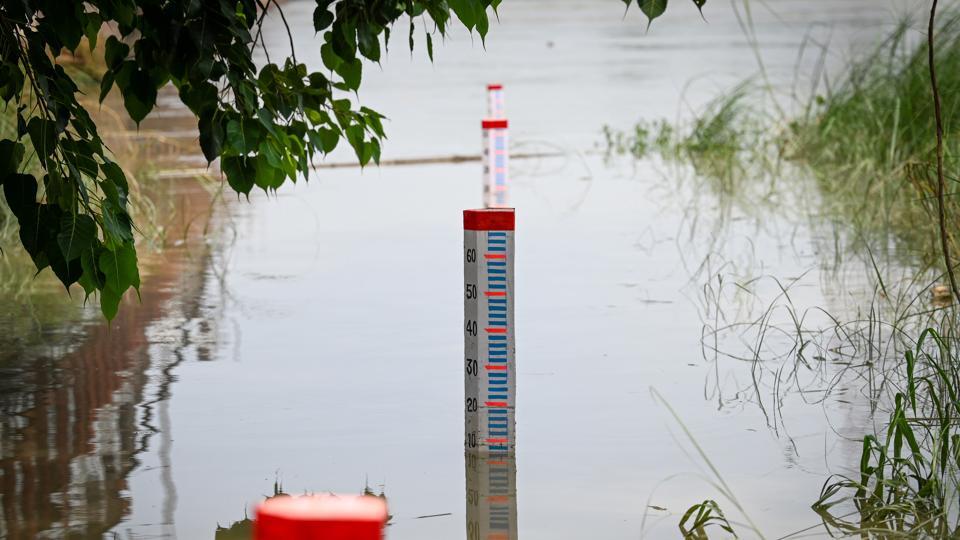
Central Water Commission (CWC) data showed the river had risen by over a metre since August 1. The peak level of 204.14m was recorded at 9am, followed by a slight dip afterwards. It stood at 203.08m at 4pm on Thursday, climbed to 203.54m on Friday, and surged to 204.04m by 4pm on Sunday.
Delhi categorises 204.5m as the warning level and 205.33m as the danger mark.
Experts, however, noted the water appeared visibly cleaner, thanks to the increased flow.
“The river is naturally cleaning itself. This seasonal surge flushes pollutants and improves water quality,” said Bhim Singh Rawat of the South Asia Network on Dams, Rivers and People (SANDRP). “Such fluctuations will continue until September, and August is typically when peak flood levels are observed.”
Last year, the river did not breach the warning level, peaking at 204.38m on September 26. But 2023 told a different story — on July 11, the Yamuna surged to a historic 208.66m leading to the river flowing out on the city’s streets. Water inundated parts of Mayur Vihar, ITO, Salimgarh Bypass, and Civil Lines, prompting the evacuation of over 23,000 residents in low-lying areas around the river and forcing the shutdown of three major water treatment plants – Wazirabad, Chandrawal and Okhla – that collectively supply around 25% of Delhi’s drinking water.
This year, officials said they are keeping a close watch. “Preparations are in place in case the water level rises further. But we’re not at the warning threshold yet,” said an Irrigation and Flood Control (I&FC) department official.
The flood control order, issued in mid-July, remains the last official directive. It mandates that the Central Flood Control Room will issue the first warning if the Hathanikund barrage discharge exceeds 100,000 cusecs. “Sector control rooms will then be activated and boats placed at vulnerable points,” the order stated.
This season, the highest discharge at Hathanikund -- located upstream in Haryana -- was just over 50,000 cusecs, recorded on July 21. To be sure, the current Yamuna swell is not the first time this year the river has crossed 204m. The previous seasonal peak of 204.13m was noted on July 22, after which the river receded.
Data from the I&FC department reveals that in 53 of the past 63 years (the earliest that records are maintained), the Yamuna has breached the 204.5-metre mark. The river has crossed 205 metres in 43 years, 206 metres in 14 years, and touched or surpassed 207 metres four times — most recently in 2023.
For now, environmentalists find reason for optimism. “This is how rivers breathe,” said Rawat. “Swelling is not always a sign of danger -- it’s cyclical a sign of the river’s life.”

Stay updated with all top Cities including, Bengaluru, Delhi, Mumbai and more across India. Stay informed on the latest happenings in World News along with Delhi Election 2025 and Delhi Election Result 2025 Live, New Delhi Election Result Live, Kalkaji Election Result Live at Hindustan Times.


