
 E-Paper



Delhi-NCR agencies sign up for standard road framework to mitigate dust pollution
Delhi PWD and neighboring states signed MoUs to create a road management system to combat dust pollution, enhancing road design and maintenance.

 Prefer HTon Google


New Delhi
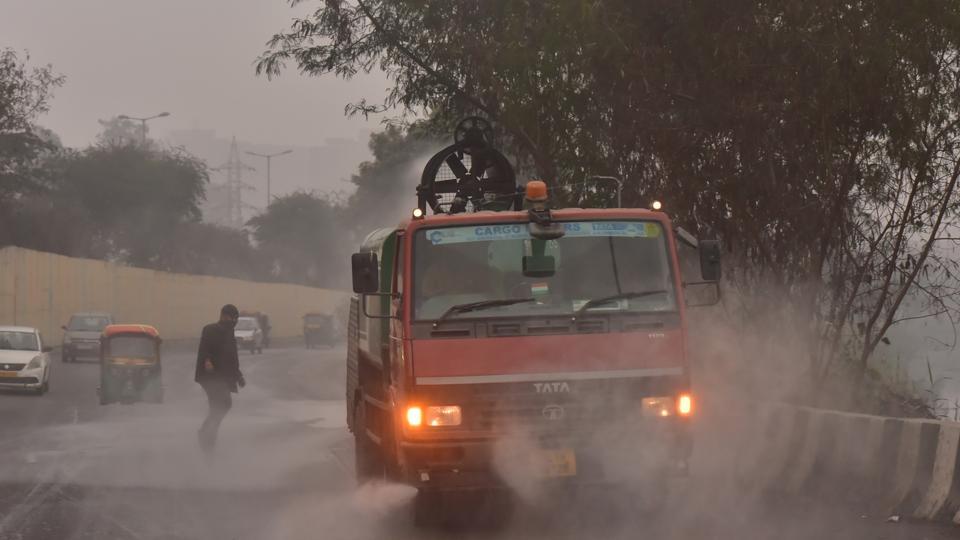
The Public Works Department (PWD) and urban departments of Delhi and NCR states of Haryana, Uttar Pradesh and Rajasthan, alongside expert institutes, on Tuesday signed memorandums of understanding (MoUs) to roll out a standard framework and road asset management system (RAMS) to tackle road dust in the region, as it is a key component of PM10 that causes pollution, officials aware of the matter said.
The signing was presided over by Union environment minister Bhupender Yadav at the Indira Paryavaran Bhawan. Officials said the MoUs are in line with the standard framework for paving and greening of urban roads issued by the Commission for Air Quality Management in NCR and Adjoining Areas (CAQM).
“The framework aims to improve road cross-sections, right-of-way (RoW) utilisation, greening measures and road maintenance protocols across the NCR. The need for such coordinated implementation has been emphasised in high-level review meetings to prepare structured action plans for control of dust from roads and open areas,” an official, who did not wish to be named, said.
Addressing the gathering, Yadav said that air pollution remains a major challenge in the Delhi-NCR and that the annual action plans of NCR states and their respective municipal corporations have been reviewed, with Delhi alone having 448 action points.
Highlighting the significant role of dust pollution, the minister called for the need of a special task force to be constituted to evaluate the social impact of the initiative and roads most affected by traffic congestion. “Dust pollution should be scientifically mapped,” he said, adding that bushes requiring less water should be planted in open areas, with around 30 suitable species already identified by the environment ministry.
The MoUs will focus on the evaluation of road redevelopment using concepts, such as Pavement Condition Index (PCI), timely maintenance of road infrastructure, mitigation of road dust through greening, development and commissioning of a Web-GIS-based RAMS for scientific road condition assessment and the adoption of sustainable and low-emission technologies in road construction and maintenance.
There is also emphasis on the use of modern data collection technologies, including Network Survey Vehicles (NSV), Falling Weight Deflectometer (FWD), Ground Penetrating Radar (GPR) and Automatic Vehicle Counter and Classifier (AVCC).
The minister appreciated the coordinated efforts of CAQM, the NCR state governments, and expert institutes CSIR-CRRI and School of Planning and Architecture (SPA) in Delhi, in advancing long-term structural measures to control dust pollution. He called for time-bound implementation and robust digital monitoring.
“CSIR-CRRI and SPA were requested to integrate greening components into their road design plans,” said the official, stating the minister has also suggested that such activities could be taken up under Corporate Social Responsibility (CSR) initiatives in the NCR.
The minister said that the greening guidelines already issued by the CAQM must be incorporated into development plans. “This MoU signing is not merely a procedural exercise but a collective commitment and mission to bring visible, on-ground change with tangible social impact,” Yadav said.


Stay updated with all top Cities including, Bengaluru, Delhi, Mumbai and more across India. Stay informed on the latest happenings in World News along with Delhi Election 2025 and Delhi Election Result 2025 Live, New Delhi Election Result Live, Kalkaji Election Result Live at Hindustan Times.


