This year’s Big Butterfly Count from September 1 to 30 has found 67 species of butterflies in the national capital region, including rare sightings of the Dingy Swift, Common Shot Silverline, Common Rose and Tailless Lineblue.
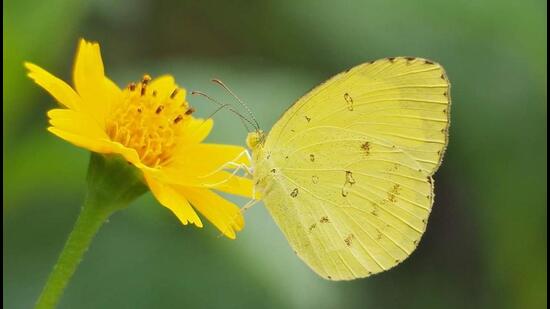
This years count was lower than 75 species found in 2021 and 74 in 2020, possibly due to low rainfall in the region during the monsoon, according to Sohail Madan, centre manager at the Bombay Natural History Society, which celebrates Butterfly Month in September.
This year’s Big Butterfly Count from September 1 to 30 has found 67 species of butterflies in the national capital region, including rare sightings of the Dingy Swift, Common Shot Silverline, Common Rose and Tailless Lineblue.
This years count was lower than 75 species found in 2021 and 74 in 2020, possibly due to low rainfall in the region during the monsoon, according to Sohail Madan, centre manager at the Bombay Natural History Society, which celebrates Butterfly Month in September. The count was conducted during the entire month, unlike a single day, as was done in the initial years of 2017 and 2018.
“Not only has the species count been lower, but the population density of butterflies was also noticed to be considerably less,” Madan said. “Prolonged heat over the summer and a long dry spell from August to mid-September could be the reason behind such low numbers.” However, no notable species were found to be missing, he added.
Also read: Protests in Delhi locality after 25-year-old murdered, 3 accused held
Among the most commonly sighted butterflies were the Plain Tiger, Blue Tiger, Common Grass Yellow and Common Emigrant. The Butterfly Month is now an annual occurrence in areas around Delhi, which includes activities such as walking with butterflies, big butterfly count, butterfly online workshops, butterfly habitat workshop, butterfly gardening workshop and butterfly campus count.
The general public, school and college students, underprivileged groups and children with special needs get involved in the activities in different stages.
The locations covered for this year’s count included the Asola Bhatti Wildlife Sanctuary, Sanjay Van, Jawaharlal Nehru University; parks and gardens in Rohini, Greater Kailash and Saket; Gautam Budh Nagar, Ayanagar City Forest, Hauz Rani City Forest, Jahanpanah City Forest, Taj Enclave City Forest, Garhi Mandu City Forest, Aravalli Biodiversity Park in Gurugram, and Neela Hauz, along with parks in Kalkaji and Dwarka.
While less rainfall is a key factor behind the low numbers, the bouncing back of activities after the pandemic is also likely to be impacting butterfly numbers, said Surya Prakash, a zoologist from JNU who covered areas like Gautam Buddha Nagar, JNU, Sanjay Van and Neela Hauz.
“We saw a very high number in 2020 and even in 2021. During both these years, there was less activity outside, be it vehicles, industries or construction activity, due to the lockdown and restrictions,” Prakash said. “Butterflies are very sensitive to the environment around them and they thrived most in the lockdown period as human interference was minimal, even in public parks.”
Also read: Delhi getting ready to Unwind at the biggest food and music festival!
This year, butterflies such as Plain Tiger, all three varieties of the Grass blue, Lesser, Dark and Pale, and Common and Mottled Emigrant were all found in abundance, he said. However, numbers for other species such as the Danaid Eggfly, Great Eggfly and White Arab were lower.
Rain and puddles are important for butterfly breeding, with butterflies often carrying out puddling, an activity where they spend time around damp sand or mud in order to drink water and mineralize.
One Subscription.
Get 360° coverage—from daily headlines
to 100 year archives.
Archives
HT App & Website
Stay updated with all top Cities including, Bengaluru, Delhi, Mumbai and more across India. Stay informed on the latest happenings in World News along with Delhi Election 2025 and Delhi Election Result 2025 Live, New Delhi Election Result Live, Kalkaji Election Result Live at Hindustan Times.
Stay updated with all top Cities including, Bengaluru, Delhi, Mumbai and more across India. Stay informed on the latest happenings in World News along with Delhi Election 2025 and Delhi Election Result 2025 Live, New Delhi Election Result Live, Kalkaji Election Result Live at Hindustan Times.