
 E-Paper



Delhi’s cloud-seeding experiment: Experts call for tackling emission sources, dismiss ‘quick fix’
Experts termed cloud-seeding as a costly and largely ineffective experiment that distracts from tackling the real sources of pollution

 Prefer HTon Google


Two rounds of cloud-seeding trials were carried out over the city, bringing the total to three so far – but not even a trace of rainfall was recorded.

Experts on Tuesday said the Delhi government must tackle sector-specific sources of emissions to improve air quality and provide reprieve from the annual winter pollution, instead of relying on “quick-fix” solutions in an attempt to bring artificial rain.
Also Read: Cloud-seeding fails to induce rain in Delhi, precipitates political row
They said the attempts at cloud seeding are a costly and largely ineffective experiment that distracts from tackling the real sources of pollution. While the idea of inducing artificial rain to wash away smog often resurfaces during peak pollution episodes, scientists and air quality specialists say such interventions have little scientific basis.
Sunil Dahiya, founder and lead analyst at think-tank Envirocatalysts, said that addressing air quality requires tackling sector-specific emissions from transport, power, and construction, without which no real impact can be achieved. “Cosmetic measures, such as smog towers, anti-smog guns, or cloud seeding may create short-term visibility benefits but are not sustainable solutions. The focus should instead be on coordinated action across states and agencies through an airshed-based approach that targets the actual sources of pollution,” he said.
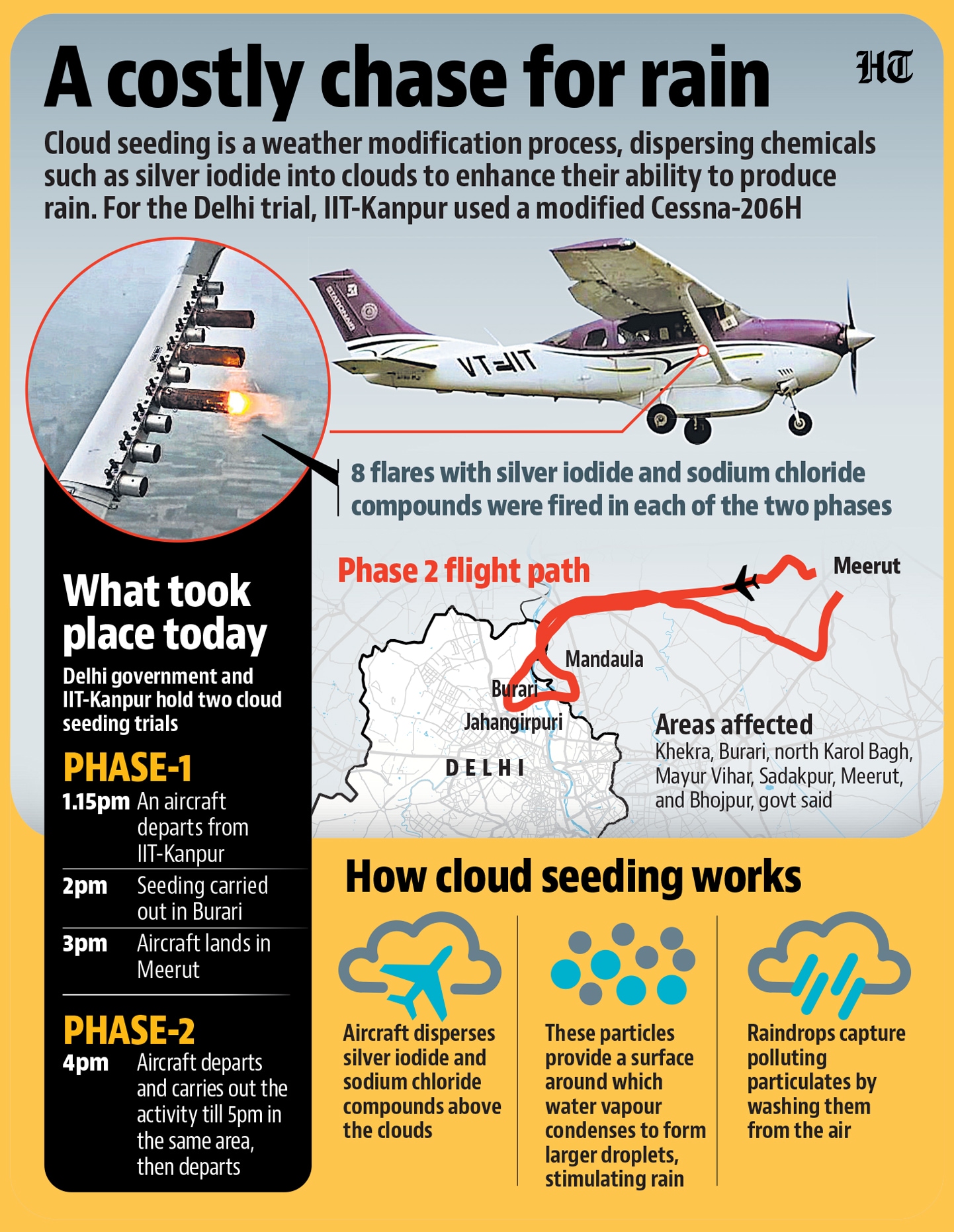
Cloud-seeding is a weather modification technique that improves a cloud’s ability to produce rain. Silver iodide (AgI) and other compounds are introduced to initiate microphysical changes in the cloud, encouraging the formation of ice crystals or raindrops. The Delhi government undertook two trials, and each time, fired off eight chemical flares containing silver iodide and sodium chloride compounds.
Dahiya said that globally, cloud-seeding has largely been used to tackle droughts, not air pollution. “There were experiments in Dubai, where cloud-seeding was done to tackle droughts, but the aim was not to reduce pollution. In Pakistan, something similar was tried but the AQI rebounded almost instantly,” he said.
Echoing this view, Mukesh Khare, air pollution expert at IIT Kanpur, said even under ideal conditions, the impact of such efforts is temporary and limited in scope. “Two factors are crucial for an improvement in air quality. High-intensity rain and a wide area of coverage. Even if that is achieved, gases will not be brought down. Also, the impact will only be for a very small period,” Khare said, adding that such attempts are “fairly difficult if the goal is to control air pollution.”
Experts said the weather conditions are rarely ideal for cloud-seeding.
Shahzad Gani, assistant professor at IIT Delhi’s Centre for Atmospheric Sciences, said, “Even setting aside the uncertainty around its effectiveness, it can only work when rain-bearing clouds already exist -- and those conditions are extremely rare during the weeks when pollution is at its worst. And even if any rain does fall, any improvement in air quality would be brief, because the sources of pollution continue.”
“Cloud seeding becomes a costly distraction from proven measures, such as cleaner transport, better waste and construction management, stricter industrial controls, and cleaner power. Delhi—and much of north India—needs sustained, year-round action, not temporary spectacles,” he said.
Krishna Achuta Rao, a professor at IIT Delhi’s Centre for Atmospheric Sciences, who has studied cloud seeding extensively, said while it might help during episodic events, it cannot address the underlying problem.
“Meteorological conditions need to be favourable firstly and one will eventually need to cover a large enough area to bring about a change in the particulate matter levels. We cannot do this every time there is high pollution as conditions may not be ideal,” he said. “The environmental and health impacts of releasing silver iodide also needed to be studied first.”
Meteorologists say the recent conditions over Delhi were not suitable for attempting the experiment.
Ashwary Tiwari, who runs the page IndiaMetSky on X, said cloud-seeding could at best offer a marginal, short-lived reprieve. “The problem of high air pollution impacts the entire Indo-Gangetic Plains, not just Delhi. Targeting the capital of India will bring better AQI, but for barely few hours, unless rains are on a widespread level,” Tiwari said.
“The atmosphere was fairly stable. Instead, we needed some lifting and instability. At the same time, moisture content was lower than typically needed,” he said.


Stay updated with all top Cities including, Bengaluru, Delhi, Mumbai and more across India. Stay informed on the latest happenings in World News along with Delhi Election 2025 and Delhi Election Result 2025 Live, New Delhi Election Result Live, Kalkaji Election Result Live at Hindustan Times.


