Delhi’s toxic air could be damaging the skin, the lungs, the overall health of each of us Delhiwale. Why should the historic Red Fort be allowed to remain untouched by Delhi pollution?
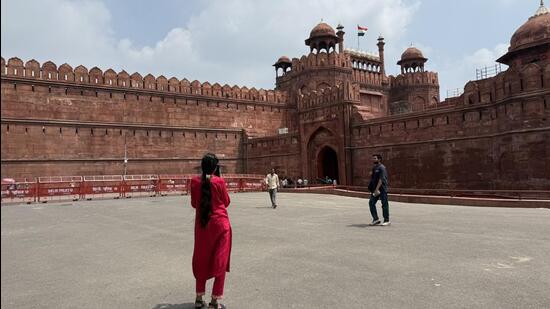
Earlier this week, this newspaper reported that the city air is damaging the Red Fort’s red sandstone walls. The dispatch cited an Indo-Italian research study ominously titled “Characterisation of red sandstone and black crust to analyse air pollution on a cultural heritage building: Red Fort, Delhi, India.”
So, we have reached a critical point where even the red of good old Red Fort can’t be taken for granted. The news gets more depressing on realising that the Red Fort, anyway, doesn’t have as much red as imagined. Actually, the Red Fort’s red is a bit misleading. When the monument was built 400 years ago by emperor Shah Jahan as his palace, the sprawling riverside complex was not identified with the colour red. Lal Qila, or Red Fort, was originally called Qila Mubarak, the Blessed Fort.
The stone-hard fact being that the Red Fort’s interiors aren’t that red. Nevertheless, the Red Fort gives an impression of being wholly red. Credit must go to the excellent PR of Red Fort’s thoroughly red facade—those red sandstone ramparts that stretch out to a great distance. Indeed, to every Indian, the national capital’s Red Fort means, first and foremost, this long length of red.
{{/usCountry}}The stone-hard fact being that the Red Fort’s interiors aren’t that red. Nevertheless, the Red Fort gives an impression of being wholly red. Credit must go to the excellent PR of Red Fort’s thoroughly red facade—those red sandstone ramparts that stretch out to a great distance. Indeed, to every Indian, the national capital’s Red Fort means, first and foremost, this long length of red.
{{/usCountry}}But the Red Fort’s signature red dramatically reduces on crossing onto the other side of the red ramparts. Almost all the private apartments within the Mughal royalty were built in white marble, or daubed in lime plaster with marble dust. One of the most beautiful buildings inside the Red Fort happens to be totally white. (Sadly, Moti Masjid remains locked).
In truth, Red Fort should ideally be called Red and White Fort. While raising the Red Fort, Shah Jahan had followed the red-white contrast used years earlier by his dadaji Akbar at Humayun’s Tomb, the Delhi monument further south along the Yamuna. In the Red Fort’s construction, the red sandstone was employed to build the fortifications and enclosures, and white marble was employed for the prominent edifices. Unfortunately, the Red Fort’s many enclosures that were red were demolished by the vengeful British following the first war of independence in 1857. And now, Delhi pollution is doing the rest of the job.
Presently, the Red Fort’s red continues to overwhelm the senses. One unbearably humid afternoon last month, a visitor was standing outside the Red Fort ramparts. She was dressed in… well, it was a case of red on red—see photo.
PS: As a tribute to the red of Red Fort, a lot of “red” has been generously sprinkled throughout the dispatch. Count the “red” yourself!
Stay updated with all top Cities including, Bengaluru, Delhi, Mumbai and more across India. Stay informed on the latest happenings in World News along with Delhi Election 2025 and Delhi Election Result 2025 Live, New Delhi Election Result Live, Kalkaji Election Result Live at Hindustan Times.
Stay updated with all top Cities including, Bengaluru, Delhi, Mumbai and more across India. Stay informed on the latest happenings in World News along with Delhi Election 2025 and Delhi Election Result 2025 Live, New Delhi Election Result Live, Kalkaji Election Result Live at Hindustan Times.