Old Delhi’s Farash Khana begins with two stories. Both try to explain how the street got its name. One account says the locality was settled by masons who laid the stone floors of the Red Fort. By this account, Farash is a corruption of farsh, the Urdu word for floor. But venerable Akhlaq Ahmad of RK Tailors, a Farash Khana establishment, offers an alternative account. According to him, the locality was home to men who carried ceremonial torches in the Red Fort. The torchbearer, he says, was called a farrash. So here we are, caught in a love triangle of two stories and one name. As for the second word in Farash Khana, khana means place in Urdu, though it also means food and to eat.
The rest of the street too is a saga of names. Its landmarks are as eye-catching for their names as for their appearances. Masjid Gular Wali valiantly strives to live up to its name. The mosque’s entrance is flanked by two potted gular plants. Gular leaves, of course, are a favourite food of Purani Dilli goats.
Elsewhere, the shops scattered along the long street carry names that evoke either other places, or the shops’ own peculiar character. Al Taj Bakery stands beside Zam Zam Moradabadi Biryani. Next comes Smart Look Hair Cutting Saloon. Then Jassi Sweets. Then Jassi Gajak Wale and Sweets, whose painted sign carries a turbaned portrait of the proprietor. Another bakery bears the name Pari Bakery. On closer inspection, the people inside do not appear to be pariyan, or fairies, but a band of hardworking men.
Then there is Sheesh Mahal, towards the other end of Farash Khana. Its name means Palace of Mirrors. This was once among the loveliest tea houses in Old Delhi. The walls were covered with coloured mirror work arranged in floral patterns that caught whatever little light entered the room. Today, the mirrors remain, but the chai is gone. Sheesh Mahal has become a biryani joint.
{{/usCountry}}Then there is Sheesh Mahal, towards the other end of Farash Khana. Its name means Palace of Mirrors. This was once among the loveliest tea houses in Old Delhi. The walls were covered with coloured mirror work arranged in floral patterns that caught whatever little light entered the room. Today, the mirrors remain, but the chai is gone. Sheesh Mahal has become a biryani joint.
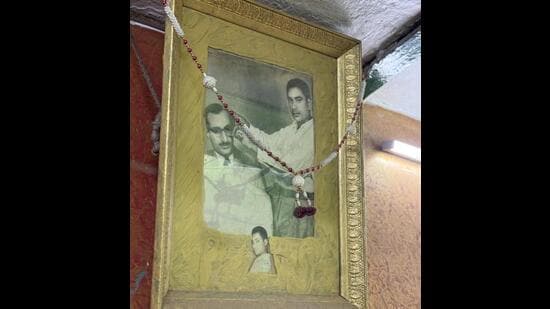
{{/usCountry}}That said, another landmark still stands on the street, lovely in its own fashion. But it has no name. It is a small barbershop with green and red walls. The shop’s history hangs on the walls.
A framed black-and-white photo shows the nattily dressed founder, the late Bhagwan Das, cutting the hair of a suited customer; see right photo. Another portrait, bearing faded colours, shows Bhagwan Das’s son, the late Sultan Singh.
Today, Sultan Singh’s son, Parveen, runs the shop. This afternoon he is sitting with his young sons, Keshav and Kartik. In effect, three generations are bunched together. The scene is priceless. See left photo.
Stay updated with all top Cities including, Bengaluru, Delhi, Mumbai and more across India. Stay informed on the latest happenings in World News along with Delhi Election 2025 and Delhi Election Result 2025 Live, New Delhi Election Result Live, Kalkaji Election Result Live at Hindustan Times.
Stay updated with all top Cities including, Bengaluru, Delhi, Mumbai and more across India. Stay informed on the latest happenings in World News along with Delhi Election 2025 and Delhi Election Result 2025 Live, New Delhi Election Result Live, Kalkaji Election Result Live at Hindustan Times.