
 E-Paper



DU at 100: Delhi College a silent witness to the Capital’s rich history
Celebrating a hundred years of Delhi University, a special series by HT commemorates the institution, its academics, students, schools, colleges, canteens, culture and the impact it has had on life in general in Delhi, and the country at large

 Prefer HTon Google


Zakir Hussain Delhi College is one of North India’s oldest educational institutes, whose history spans centuries. The institution predates the university and started off from the premises of Madarsa Ghaziuddin in Old Delhi’s Ajmeri Gate area.
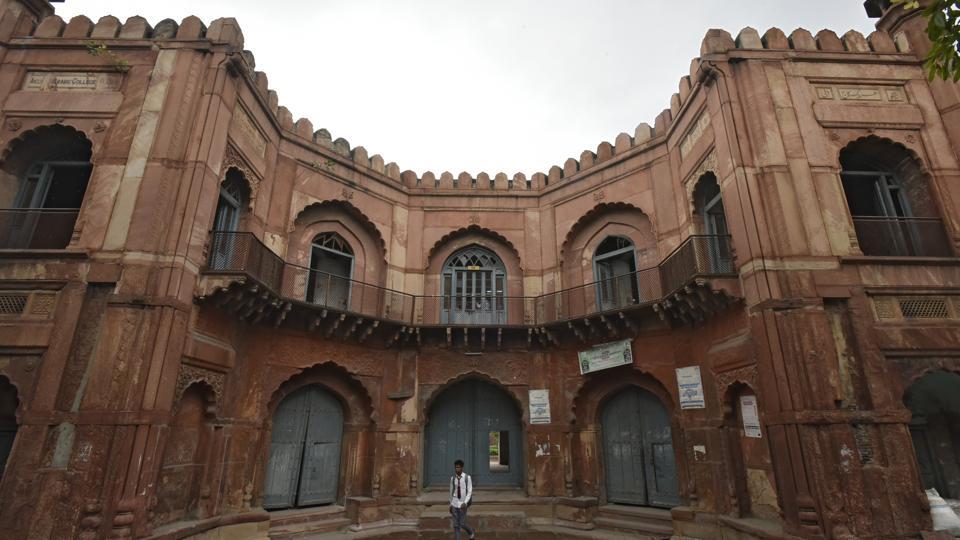
Nestled in the heart of the Capital, the college’s history is inextricably linked with that of the city as it witnessed Delhi’s transition through monumental changes including the mutiny of 1857, the freedom struggle, and the Partition. A witness to the changing histories of the city, erstwhile Delhi College (now Zakir Hussain Delhi College) is often cited as the institute where North India’s socio-cultural renaissance took shape.
Historian Ebba Koch writes that the madrasa was founded by Ghaziu’d-Din Khan, a commander under the reign of Mughal emperor Aurangzeb, at the end of the 17th or the beginning of the 18th century. Koch identifies the madrasa as one of Delhi’s leading places of learning and the oldest continuing school in the city where college classes began in 1825.
As per the Delhi gazetteer, subjects such as history, geography, mathematics along with science and natural philosophy were taught at the college in 1825. In the next decades, the college produced scholars such as professor Ram Chander, Maulvi Zaka Ullah, Deputy Nazir Ahmed, and Pandit Man Phool among others. In 1857, the college ceased operations as it was marred by violence in the aftermath of the mutiny. The principal, headmaster, master, and a Persian teacher at the college were shot dead on charges of taking part in the mutiny. The college was revived nearly two decades later in 1872 in a new temporary campus at Kashmiri Gate before it was moved back to its original location. Later in 1924, the college was affiliated with Delhi University.
Many illustrious persons came to be associated with the college over time. As per a popular anecdote, poet extraordinaire Mirza Ghalib was once invited to the college to apply for the new post of a Persian professor. Ghalib arrived at the institute in his palanquin but left unceremoniously after he was not personally escorted by the office bearers of the college. Many such oral anecdotes passed down over the generations elucidate the unique space that the college occupied in North India.
Noted educationist and founder of AMU, Sir Syed Ahmed Khan was inspired by the college while Muhammad Qasim Nanautavi, one of the founders of Darul Uloom Deoband was a student at the Delhi College. In fact, historians often cite the Delhi College as the precursor of the two supposedly opposing centers of Indo-Muslim cultural revival and reform in the late nineteenth century: Aligarh and Deoband.
The history of the Delhi College demonstrates that it played a vital role in the educational, social and cultural life of the people in North India. As per scholars, it was the first institution where the juxtaposition between Islamic and Western learning took place. “The acrimonious debates between Orientalists and Anglicists culminated in the establishment of this college and the local people got an opportunity to be educated simultaneously in their traditional Islamic and modem Western learning,” note scholars Martin Moir and Lynn Zastoupil in their edited volume The Great Indian Education Debate.
“The renaissance in North India is linked to the Delhi college,” said Mohd Aslam Parvaiz, former principal, who attributed this awakening to the creation of the vernacular society of Delhi College. Established in 1843, the society translated books from Mathematics and other science subjects into Urdu. Teachers such as Master Ravi Shankar and Maulavi Zakaullah translated more than 70 books into Urdu, which was then the lingua franca, he shared. “Through the vernacular society, western sciences were introduced into the college. The work translated and produced here shaped scientific temperament and encouraged critical thinking,” said Parvaiz.
While laying emphasis on the institute’s significance as a seat of modern education, he says that some of the largest mosques in the capital contributed to its development. The original campus of the college at Ajmeri Gate continues to bear a plaque mentioning the donations that the college received from Jama Masjid and Fatehpuri Masjid in the 1930s.
By providing a unique space for learning to people of all faiths and groups, the institute carved a unique space for itself. Its role was even more pronounced post-Partition as the institute threw its doors open for displaced migrants from across the country. When the college reopened post Partition after a brief closure, it was confronted with new challenges and responsibilities. Mirza Mehmood Beg was appointed as the college principal to steer the college in this decade. During his tenure, the college served as an institute that gave displaced migrants another chance at education. “Beg hailed from old Delhi. At that time, many Sindhi migrants were camping there. He facilitated the entry of Sindhi girls into the college to an extent that the first batch had over 90% Sindhi students. This move did not go down well with the Muslim population in old Delhi which also included displaced persons. Out of disdain, community members in old Delhi began to address Mr Beg as Mr Begnani, due to his overwhelming support to the Sindhi community,” recalled Parvaiz. He shared that similar support was also extended to migrants from Bengal. The college had a very strong Bengali language department with many faculty members inspiring and initiating the DUTA, he added.
A student of the Anglo-Arabic School, Parvaiz did his graduation in BSc (life sciences). Later, he returned to the college as a lecturer and eventually took charge as the principal in 2005. It was during his tenure as the principal that the college was renamed Zakir Hussain Delhi College from Zakir Hussain College in 2010.
“The college had been renamed after Dr Zakir Hussain on Indira Gandhi’s insistence. Since the time the college’s name was changed from Delhi College, there was a current of resentment among those associated with the college. The name Delhi College has a historical legacy and we did not want the link with the past to break. We were able to re-incorporate Delhi in the name under the chairmanship of prime minister Dr Manmohan Singh in 2010,” he said.
Riaz Umar joined Zakir Hussain Evening College in 1958 as a lecturer, the same year when evening colleges were initiated across the city. In 1992, Umar became the principal of the college. He recalled that while the Delhi College had been allocated space within the university campus, the college did not relocate due to demands from the location population that did not approve of the relocation. The space was later allocated to Daulat Ram College.
“The college used to offer all popular courses along with many language courses. This was the only college which was giving education in English, Arabic, Sanskrit, Persian and Bengali languages in those days. It offered both pass and honour courses and saw students excelling across all fields,” shared Umar. He added that many noted faculty members and alumni had been associated with the college. These included personalities such as Bhisham Sahni, professor Randhir Singh, Ali Sardar Zafri, Muhammad Qasim Nanautavi, Gopi Chand Narang, among others.
“Many great personalities used to teach here during my time as a student. Among them was Bhisham Sahni. He had a towering personality and had achieved a lot of fame due to Tamas and Garam Hawa. He was a well-groomed, soft-spoken person, and embodied the spirit of Urdu tehzeeb that was nurtured within the college,” recalled Parvaiz.
Delhi College is often credited for its immense contribution to the promotion of the Urdu language and culture. In her article “Delhi College and Urdu”, historian Gail Minault writes that the Delhi College contributed to the development of Urdu prose as a vehicle for the transmission of knowledge through its teaching, sponsorship of translations, and the writings and publications of its teachers and students. She adds that the college mediated between eastern and western cultures and mentalities through the Urdu language and contributed to the emergence of an Urdu-speaking and reading élite in North India, composed of individuals from all religions.
Mohd Naqi, 70, joined Delhi College for graduation in BCom. He retired from the college in 2006 as a lecturer. While reflecting on the history of the institute and the decades he spent there, he said that the college embodied the spirit of Hindustan as it provided a level-playing field to students from diverse backgrounds.
While outlining the key role played by the college towards the education and empowerment of women, he said that girls from old Delhi had greatly benefitted from the presence of the college in the vicinity. He said that then Prime Minister Indira Gandhi was also opposed to the move of the college’s relocation to the Delhi University campus because of the college’s contribution to women’s education. “The college was located at an intersection of old and new Delhi. “In those days, people were hesitant to send girls to far-off locations for education. In such a situation, the college gave students an opportunity to study in the vicinity of their neighbourhood,” said Naqi.
He said that while many people harboured the misconception that the college was a minority institute, it has always embraced students from all faiths and communities. “The Delhi College was a microcosm of Hindustan. It was like a giant family where everyone co-existed peacefully with little regard for each other’s religious identity. The college is a living example of secularism and its students continue to do well in all walks of life,” said Naqi.


