The Delhi government on Wednesday substantially narrowed the scope of its planned ban on older vehicles from neighbouring states, announcing that the prohibition would now be enforced only during the most severe air pollution episodes. This rollback comes just a day after officials declared that no vehicle registered outside Delhi with emission standards lower than Bharat Stage VI (BS-VI) would be allowed to enter the city starting Thursday.
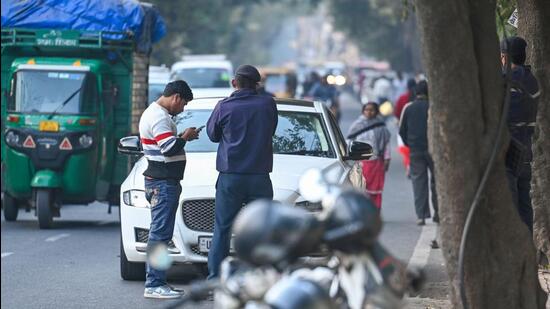
The final order, issued Wednesday, states that the restriction will apply exclusively when Stage 4 of the Graded Response Action Plan (Grap) is in force. Stage 4 is invoked when the Air Quality Index (AQI) surpasses 450, signifying “Severe Plus” conditions. This marks a notable shift from Tuesday’s clarification, which had said the rule would apply under both Grap stages 3 (AQI above 400) and 4.
A senior government official, speaking on condition of anonymity, explained the modification was made “to avoid large-scale disruptions.” The official noted, “Since a lot of vehicles come from NCR, it was decided to only keep it when Stage 4 is in place. The decision has been partially modified after discussions, also keeping in mind there is no disruption on Delhi’s borders.”
{{/usCountry}}A senior government official, speaking on condition of anonymity, explained the modification was made “to avoid large-scale disruptions.” The official noted, “Since a lot of vehicles come from NCR, it was decided to only keep it when Stage 4 is in place. The decision has been partially modified after discussions, also keeping in mind there is no disruption on Delhi’s borders.”
{{/usCountry}}The revised rule, if tied strictly to Grap Stage 4, may see limited use. Historically, Grap Stage 4 is invoked when the AQI exceeds 450, so it has been a rare measure. In 2024, for instance, Delhi recorded only three such days. However, this season has seen more severe pollution, with Grap Stage 4 remaining continuously in force since December 13 (despite the recent improvement in the air).
Plans for enforcement
Despite the scaled-back ambit, enforcement agencies have mobilised extensively, as Grap Stage 4 has been in effect in Delhi since December 13. The restrictions are therefore technically enforceable from Thursday.
“Approximately 580 personnel from the Delhi Traffic Police and local police, supported by 37 Prakhar vans, will be deployed at 126 border points,” said a senior Delhi Traffic Police officer. These include 13 major entry points from Uttar Pradesh and Haryana. Teams will be complemented by officials from the transport department and the Municipal Corporation of Delhi (MCD).
The ban targets all non-BS-VI vehicles (primarily BS-III and BS-IV models) entering from outside Delhi. Exemptions are granted for vehicles running on CNG, electricity, and those involved in essential services.
The scale of affected vehicles is substantial: according to collated RTO data, there are approximately 200,000 non-BS-VI vehicles in Gurugram, 400,000 in Noida, and 550,000 in Ghaziabad. Delhi itself has an estimated 6.4 million such vehicles.
Acknowledging that stopping every vehicle would be impractical and cause massive gridlock, police officials aware of the matter said they plan to rely on random checks “bolstered by technology”. Challan devices used by traffic police, they said, are linked to the national vehicle database (Vahan), allowing officers to instantly verify a vehicle’s emission category, registration date, and PUC status by entering its license plate.
In addition, Radio Frequency Identification (RFID) cameras installed by the MCD at key borders will automatically identify non-compliant vehicles. Police have also coordinated with counterparts in neighbouring states, requesting them to intercept and prosecute violating vehicles before they reach Delhi’s borders to prevent long queues.
Data shared by the Delhi Traffic Police underscores the scale of enforcement already underway. Between December 13 and 15, after Grap stages 3 and 4 were invoked, traffic police penalised 556 BS-III petrol and BS-IV diesel cars, along with 52 out-of-state light commercial vehicles and six diesel heavy goods vehicles.
Beyond border checks, the government is activating another enforcement layer at the city’s petrol pumps. As previously announced, vehicles without a valid Pollution Under Control Certificate (PUCC) will be denied fuel. To enforce this, two DTC driver marshals and one police personnel will be stationed at each fuel station, officials said.
“Technology will again play a central role. Automated Number Plate Recognition (ANPR) cameras have been installed at 500 fuel stations to detect vehicles without a valid PUC. As soon as a vehicle without a valid PUC is detected, the mike will announce the registration number of the erring vehicle,” transport minister Pankaj Singh said. Such vehicles will be denied fuel, and enforcement action may follow.
Government estimates from July 2025 suggest about 2.6 million of Delhi’s 8.5 million vehicles lacked a valid PUC. In a recent 24-hour period (December 16), over 17,000 PUCCs were generated, while 1,122 challans were issued via ANPR and manual checks.
Furthermore, under Grap Stage 4, trucks transporting construction material are banned and will be seized on the spot if found entering Delhi.
Commuters brace for disruption
Commuters and business operators from the NCR anticipate significant disruption and confusion. Many drivers are unsure about their vehicle’s exact emission category.
Rajesh Kumar, a daily commuter from Ghaziabad, fears chaos: “If vehicles are stopped randomly, it will create long jams at busy borders points such as Anand Vihar and Ghazipur.” Neha Sharma from Faridabad worries about commute delays impacting work schedules, despite her vehicle potentially being compliant.
Truck operators and small business owners are also anxious. Amit Singh, who manages logistics for a hardware supplier in Noida, said the ban on construction material trucks would hit deliveries. “Even if construction is banned, there are existing commitments. Seizing trucks on the spot will affect livelihoods,” he said.
Stay updated with all top Cities including, Bengaluru, Delhi, Mumbai and more across India. Stay informed on the latest happenings in World News along with Delhi Election 2025 and Delhi Election Result 2025 Live, New Delhi Election Result Live, Kalkaji Election Result Live at Hindustan Times.
Stay updated with all top Cities including, Bengaluru, Delhi, Mumbai and more across India. Stay informed on the latest happenings in World News along with Delhi Election 2025 and Delhi Election Result 2025 Live, New Delhi Election Result Live, Kalkaji Election Result Live at Hindustan Times.