New Delhi: Delhi introduced an ambitious and first-of-its-kind tree transplantation policy in 2020, which made it mandatory for all large construction projects in Delhi, which required more than 10 trees to be felled to transplant at least 80% of these trees, to preserve Delhi’s green cover.
Prior to that, trees for any development project were simply felled and agencies had to plant saplings in a ratio of 1:10, meaning for every tree cut, 10 saplings had to be planted.
New Delhi: Delhi introduced an ambitious and first-of-its-kind tree transplantation policy in 2020, which made it mandatory for all large construction projects in Delhi, which required more than 10 trees to be felled to transplant at least 80% of these trees, to preserve Delhi’s green cover.
Prior to that, trees for any development project were simply felled and agencies had to plant saplings in a ratio of 1:10, meaning for every tree cut, 10 saplings had to be planted. The new policy, which was approved in October 2020 and notified in December 2020, made it mandatory for compensatory plantation to continue, in addition to 80% of all trees being felled, to be transplanted, stating this will not only preserve the existing green cover that was to be felled, but saplings in the same ratio as earlier would continue to be planted. However, just 1.5 years into the policy, there appears to be a considerably low rate of survival of the transplanted trees, with only one in every three trees being transplanted, surviving the transplantation process.
As per the latest data, submitted by the Delhi forest department to the Delhi High Court, which took into consideration all tree transplantation efforts in Delhi since 2019, there is only one project in Delhi which has met the survival rate threshold of 80%, with Delhi averaging an overall survival rate of only 33.33% over these three years. While the policy was officially introduced in 2020, projects, such as NHAI’s Dwarka Expressway project had already been asked to begin tree transplantation, as part of its approval. Data submitted by the forest department in the form of an affidavit in the Delhi High Court in May 2022, reveals only 5487 out of the 16461 trees transplanted over the last three years between 2019 and 2021, have survived the transplantation process.
Despite expert input, transplantation fails
The policy, in addition to setting up a mandatory target of achieving a survival rate of 80% for the transplanted trees, also required construction companies and agencies in Delhi to take assistance from expert agencies. Soon after notifying the policy, four expert agencies were empanelled by the Delhi government under the policy and chosen by its tree transplantation cell for having previous expertise in carrying out similar transplantation projects in other parts of the country.
However, data for 2021 shows there appears to be no significant change in the survival rate of transplanted saplings. As per the affidavit submitted by the Delhi forest department, a total of 5296 trees were transplanted for 2021-22, but only 1,965 trees survived the process – a survival rate of just 37.10%. For the same year, the assessment of surviving trees cited by user agencies in each project pegged the survival rate to be even lower – at just 12.3% or 655 trees.
Vijay Dhasmana, an ecologist and curator at the Aravalli Biodiversity Park in Gurugram says while it is unknown what tree species were finally transplanted by the expert agencies but taking care of the transplanted for a period of up to a year is equally important. “First and foremost, older trees find it extremely difficult to ⁸ as they have deeper, developed roots. Also, some trees in Delhi, such as Khejri will never survive transplantation as their roots can go down as much as 30 metres in depth and cutting their roots down to 1-2 metres is not enough for the tree to survive. While I am unaware of which species were transplanted, it is also possible trees were transplanted on a large scale, which can be tricky,” says Dhasmana, stating each tree species requires a different kind of attention and each tree needs aftercare, similar to a newly growing plant. “It needs to be watered regularly and nutrients also need to be provided to the tree, as the roots are very shallow post-cutting. They are unable to absorb nutrients normally and therefore special attention is required for each tree. The expert agencies may be transplanting properly, but it is possible the attention afterwards is lacking,” he said.
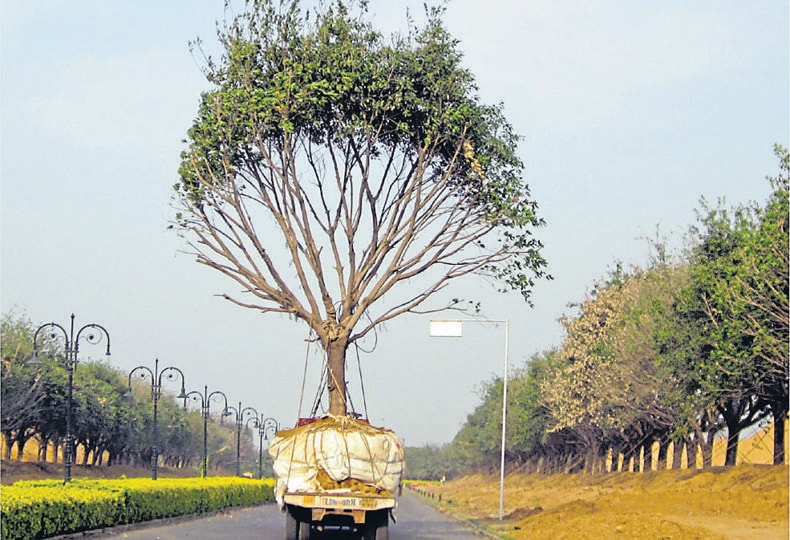
For a tree to be transplanted, the area around it needs to be dug, with its roots first chopped to form a ‘ball’ which consists of roots that grow once again. Its top canopy is often cut down to make the tree lighter and easier to transport, while reducing the food requirement for its existing leaves during the period the tree tries to acclimatise to its new soil. Once transplanted, the new tree needs physical support and constant watering, at least for six months. Transplanting each tree can cost anywhere from ₹50,000 to 1 lakh, making it a costly process too.
Delhi hasn't learnt from the past
Faiyaz Khudsar, scientist-in-charge at the Yamuna Biodiversity Park, where several trees were transplanted almost a decade ago, says the age of the tree and its species play an important role in determining whether the tree survives the transplantation process or not, stating each tree species requires a different plan of action and subsequent care.
“The Yamuna Biodiversity Park was made operational in 2002 and around the Common Wealth Games period, we experimented with transplanting some trees to the Park. We found that a majority of the trees that were older than 10 years in age, found it difficult to survive the process. It is possible they can still survive the process, but it would be limited to certain species and may require a lot of aftercare. A majority of them were ficus trees, including peepal and they still haven’t been able to grow their leaves back again,” said Khudsar, stating a Semal tree, which was less than 10 years in age, has grown its full canopy back again and is performing ecological functions.
More recently, in 2018, out of the 2,583 trees that were to be cut for the Pragati Maidan redevelopment project, 1,713 were transplanted, however, a National Green Tribunal appointed expert panel had later found that only 573 trees from these could survive the ‘shock’ of transplantation. Out of these, only 36 trees (2.1%) were identified, and based on health, form and good structure were found viable enough to be transplanted.
Ecologist CR Babu and head of the Centre for Environmental Management of Degraded Ecosystems (CEMDE) says the root structure, the age of the tree species and the species type are all determining factors.
“If the roots are deep, there is little chance of survival as the tree is unable to adjust to being planted elsewhere, particularly when its deep root system is disrupted or cut. This is true for trees like Jamun or neem. On the other hand, species with shallow roots like Peepal or Pilkhan can survive transplantation as their roots spread along the surface and not vertically downwards,” says Babu, stating the older the tree, the more complex the root system is. “It is both expensive and difficult to transplant older trees. Also, aftercare is crucial and in most cases, the trees are being transplanted but not being watered or being provided adequate care afterwards. A tree that may appear to be surviving may suddenly dry up within a matter of a month,” he says.
Pradip Krishen, an environmentalist and author of the book ‘Trees of Delhi’, says soil type and the moisture regime available to the tree are crucial as trees find it difficult to adjust to a new soil type or terrain.
This, he says stands true for the Central Vista project, for which a large majority of the 404 trees were transplanted farther away to the NTPC Eco Park in Badarpur. The forest department in its affidavit said only 121 or 30% of the 404 trees survived the transplantation project. Amongst these, 272 trees from the project were transplanted to the NTPC Park in Badarpur, with the remaining trees being transplanted at the existing parliament campus itself.
“The Central Vista soil is a remnant of the old Yamuna floodplains and so for the trees that were transplanted nearby and within the Central Vista project site, the soil type and the moisture regime were almost the same. However, at the Badarpur site, the terrain is rocky and is an extension of the Aravallis, which makes the survival of the trees extremely difficult. The site also had fly ash being dumped earlier from the Badarpur thermal power plant and even if artificial soil is dumped to create a park, the trees can never adapt to a new soil type,” he says, stating only certain rare species that are hardy, can survive the process.
How to make it successful
Activists say a detailed tree preservation report should be prepared for each project before the transplantation, which considers past survival rates of each tree species and whether on-site preservation is possible or not.
“This was one of the suggestions given earlier when the project was being formulated, but this is not being done. Now that data is available, agencies can easily prepare a detailed plan on the soil type at the site it is being transplanted, the land topography, species type and the health of each tree,” says Bhavreen Kandhari, an environmental activist based in Delhi, stating transparency and public participation needed to be encouraged.
“All project details should be made public as these are the lungs of Delhi and any change to the same will have far-reaching impacts. Public involvement plan and strategy must be in place for each transplantation,” she says.
One Subscription.
Get 360° coverage—from daily headlines
to 100 year archives.
Archives
HT App & Website
Stay updated with all top Cities including, Bengaluru, Delhi, Mumbai and more across India. Stay informed on the latest happenings in World News along with Delhi Election 2025 and Delhi Election Result 2025 Live, New Delhi Election Result Live, Kalkaji Election Result Live at Hindustan Times.
Stay updated with all top Cities including, Bengaluru, Delhi, Mumbai and more across India. Stay informed on the latest happenings in World News along with Delhi Election 2025 and Delhi Election Result 2025 Live, New Delhi Election Result Live, Kalkaji Election Result Live at Hindustan Times.