
 E-Paper



Fog acting as a lid, pollutants stay trapped, worsen Delhi’s air
The AQI was a mild improvement from Monday’s 434 – with both recordings being the highest in two months, since air pollution first reached crisis levels due to smoke from farm fires and calm winds that are typical of pre-winter months.


Delhi’s air quality index (AQI) remained in the ‘severe’ category for a second consecutive day on Tuesday, despite some improvement, with a reading of 407 as per the Central Pollution Control Board’s (CPCB) bulletin at 4 pm.
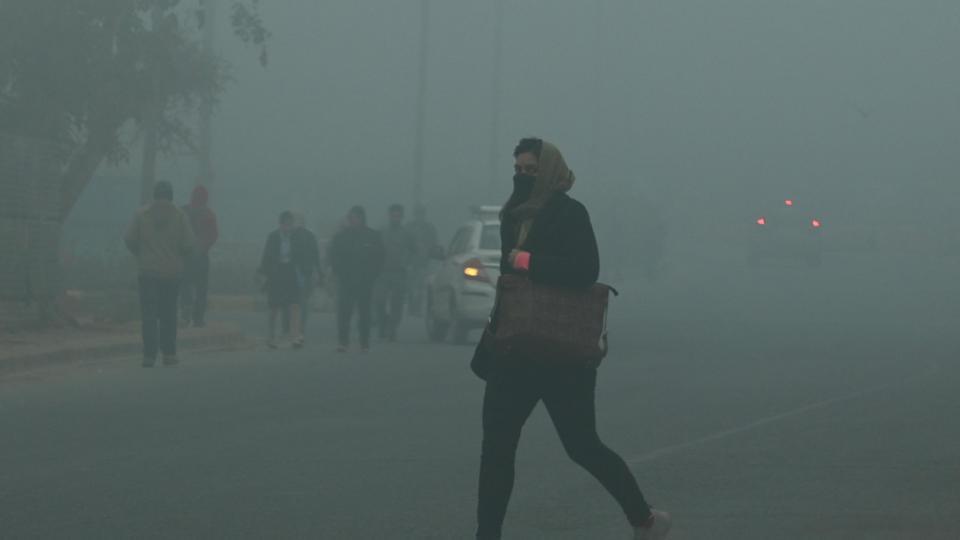
The AQI was a mild improvement from Monday’s 434 – with both recordings being the highest in two months, since air pollution first reached crisis levels due to smoke from farm fires and calm winds that are typical of pre-winter months.
Experts say for the current spell, a similar meteorological phenomenon as then is to blame: thermal inversion.
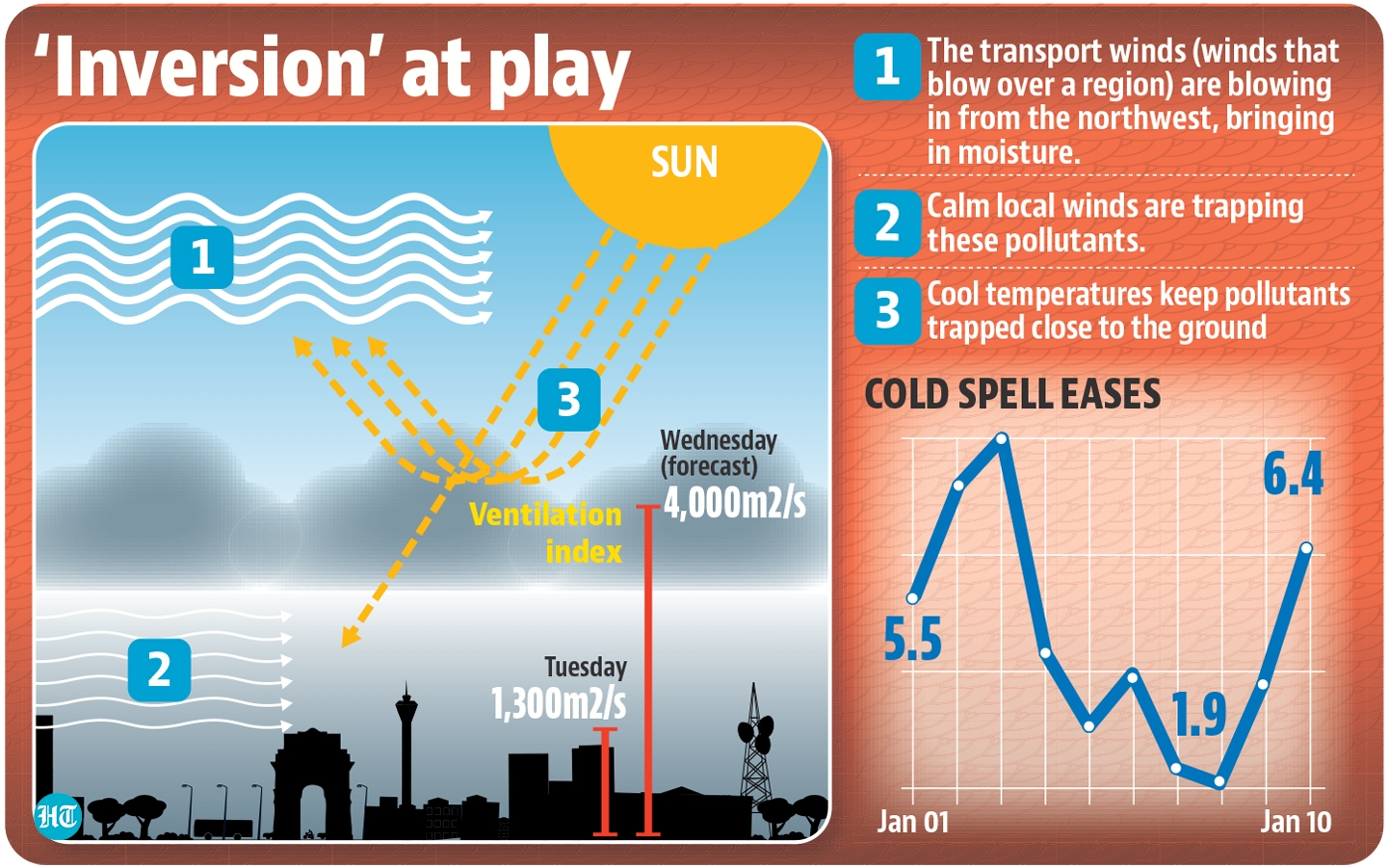
Thermal inversion is when air is cooler near the surface than higher up, opposite of what normally happens. What this ends up doing is creating a layer of cold, calm winds that trap pollutants, closer to the ground, creating a blanket of haze – above this layer is warmer air, heated up by sun rays that otherwise fail to penetrate to the ground.
Experts say this time, the phenomenon has happened due to fog as moisture heavy winds from the north-west combine with the cold of North India to create condensate.
Dipankar Saha, former head of CPCB’s air laboratory, said such spells of low temperature and high pollution are common during this time of the year, largely being aided by dense fog. “We see the impact of inversion during this time of the year more when fog fails to dissipate even during the day. This does not allow the temperature to rise and keeps the mixing height low,” Saha said.
In the pre-winter months, thermal inversion occurs when smoke from farm fires begins creating a blanket of haze that similarly blocks out the sun.
These hazy blankets trap pollutants because they reduce the room for emissions to be blown away, either horizontally or vertically. The vertical movement is known as the mixing layer.
“There were calm winds through the majority of the day and we saw mixing height dip gradually and drop as low as 80 metres from the surface, meaning pollutants barely had any room to move. Low temperatures also make the air more stable and stagnant, not allowing movement of pollutants,” said VK Soni, scientist at India Meteorological Department and part of the Commission of Air Quality Management (CAQM) sub-committee.
Tuesday’s improvement further strengthened the understanding of these factors, as winds picked up, lifting the fog and helping sunlight reach the ground. “Monday was an exceptional case as the fog refused to give way and low temperatures persisted, which kept the mixing height low. We will now see less fog and while cloudy skies will continue over the next three days, wind speed will be strong, owing to a western disturbance. This will dissipate pollutants,” Soni added.
Data from the Decision Support System (DSS), which comes under the Ministry of Earth Sciences (MoES) and is being used by the Commission for Air Quality Management (CAQM) in NCR showed while stubble burning is no longer a source of pollution, as it was in November, however, pollution from outside Delhi is still contributing to Delhi’s PM 2.5 more than local sources.
On Tuesday, the estimated contribution of sources from outside Delhi is estimated to be 70% by the system, while sources within Delhi are contributing to around 30% of the total PM 2.5 load.
Amongst local sources, the transport sector is contributing to around 40% of the total pollution load, followed by Delhi’s industries, which are contributing to around 33.33% of the pollution load. Forecasts for the next three days shows these two sources will contribute between 75 and 80% of the total pollution load within Delhi. Interestingly, open waste burning is only contributing around 3-5% of the total pollution.
Outside Delhi, pollution from cities outside NCR are the sending a large chunk of their pollution to the capital, owing to northwesterly winds. Jhajjar’s contribution to Delhi’s PM 2.5 concentration was estimated to be around 18% on Tuesday, followed by Rohtak (5.3%) and Sonipat (3.6%), DSS data showed. Outside sources which were unaccounted for, were as high as 36%, DSS adds.
A scientist from the Indian Institute of Tropical Meteorology (IITM), who has worked on DSS, said sources of pollution have largely remained similar, barring stubble burning, which has reduced, but has been replaced with open burning and the contribution of pollution from industries.
“While the contribution from industries was around 5% to the total pollution load in November, it is currently around 10%. While the sources have not changed, but owing to unfavourable meteorological conditions, these local sources are leading to pollutants getting trapped in the air,” the official said, stating open burning is also highest during this time of the year, when temperatures are low.
Experts said solutions lie in long-term fixes along.
Anumita Roychowdhury, executive director, research and advocacy at the Centre for Science and Environment (CSE) said until there is a significant reduction in the sources of pollution, such spikes in pollution will continue each year, based on the change in meteorological conditions.
“We have seen high AQI each time winds become calm or the temperature dips, as local sources and even external sources are fairly high and can accumulate in the region. This will invariably lead to severe air each time and while Grap is an emergency-level plan, it is not the long-term solution, which will remain cutting down pollution at the source. The move to ban coal and other dirty fuels across NCR from January 1 is a step in the right direction to tackle one such source,” she said.


