
 E-Paper



Govt corners AAP as CAG flags excise losses
The report highlights that the now-scrapped 2021-22 excise policy alone resulted in notional revenue losses of ₹2,002.68 crore.

 Prefer HTon Google


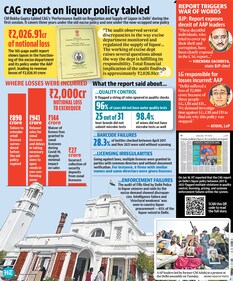
The Comptroller and Auditor General’s (CAG) performance review on Delhi’s excise policy between 2017 and 2022, the first of 14 pending reports by the audit agency to be tabled in the Delhi Assembly, flagged a string of major violations in awarding licenses, quality control, and pricing, leading to a notional loss of over ₹2,000 crore to the exchequer.
The Bharatiya Janata Party (BJP) government seized on the report’s findings to attack the Aam Aadmi Party (AAP), which governed during the audit period. The BJP demanded “answers” from the AAP over decisions made regarding the excise policy, and said that “those involved in corrupt practices will be held accountable”.
The report highlights that the now-scrapped 2021-22 excise policy alone resulted in notional revenue losses of ₹2,002.68 crore. These include ₹890 crore from the failure to retender surrendered retail licenses, ₹941 crore from exemptions and relaxed rules for zonal licensees, ₹144 crore from unwarranted Covid-19 fee waivers, and ₹27 crore from incorrect security deposit collections.
The report also highlighted a string of shortcomings of the old policy, which it analysed over a period of three years. Of the eight chapters in the entire audit report, seven are on the old policy while one chapter audits the new policy.
After the findings of the report were tabled, Delhi BJP president Virendra Sachdeva alleged the report exposes a “liquor scam,” accusing Arvind Kejriwal of acting as a middleman for the liquor lobby.
“The new excise policy removed government control and handed over the market to private companies. In several cases, commercial licenses were wrongly issued for shops operating illegally. Liquor licenses were issued without quality check reports, and Kejriwal and his team must answer for these actions. Those involved in these corrupt practices will be held accountable,” Sachdeva said.
Former Delhi CM and Leader of Opposition in the assembly Atishi defended the AAP, arguing that the report validated its long-standing claim that the old policy fostered black marketing, price manipulation, and corruption.
“The new policy was more transparent, designed to prevent black marketing and increase revenue to the exchequer. Due to deliberate obstructions of new excise policy by BJP’s LG, ED and CBI, the Delhi government was not able to reach revenue targets and fell short of estimated revenue by ₹2,000 crore. Had they allowed new excise policy to be implemented, Delhi’s excise revenue would have increased from ₹4,108 crores to ₹8,911 crores in just one year,” Atishi said, citing revenue growth in Punjab due to new policy.
What the report found
The CAG report traces the formulation of the new excise policy to an expert committee formed in September 2020. While the committee recommended a government-controlled wholesale liquor system, the policy instead allowed private firms to dominate the market.
The report highlighted that although 367 IMFL brands were registered in Delhi, there was a clear lack of market diversity. Top 10 brands accounted for the sale of 46.46% of liquor sold in Delhi whereas top 25 brands accounted for 69.5% of liquor sold. This meant that three wholesalers exclusively supplied 19 of the 25 top-selling brands.
Examining the earlier excise policy (2017-2020), the report uncovered systemic failures, including gaps in barcode tracking of liquor bottles, rule violations in license issuance, lack of transparency in pricing, and poor enforcement. To be sure, the report did not quantify financial losses under the old policy.
The CAG audit found severe quality control failures, with 12 L1 licensees submitting certificates from 15 labs, seven of which were either unaccredited or lacked approval for required tests. It also found that many of these labs were linked to manufacturers, raising concerns about third-party oversight.
In 2020-21, 12 licensees failed to submit any quality certificates, yet their licenses were approved. The report found that 37% of mandatory liquor quality tests were never conducted, while 96% of required water quality tests were ignored. Crucially, nearly all wine brands (98.43%) skipped microbiological tests, and only six of 31 beer brands conducted them.
The report also flagged inadequate testing for methyl alcohol – a toxic compound linked to alcohol poisoning and hooch tragedies.
The CAG added that there has never been a “realistic assessment of actual demand” of country liquor in Delhi. It flagged that supply was capped at 30 million bulk litres per annum, despite discrepancies found in police FIRs and excise department raids.
Delhi Congress chief Devender Yadav joined the BJP chorus in attacking the AAP. He said that the findings of the CAG report confirm what his party had long alleged — massive financial losses due to a flawed excise policy.
“CAG has uncovered unprecedented corruption in the liquor policy which Kejriwal had tried to hide from public scrutiny by not tabling the reports in the assembly,” he said adding that AAP “deceived the people of Delhi by projecting a false façade of honesty.” Yadav demanded a strict follow up action to punish those responsible for misappropriating the tax payers’ money to line their pockets and that all other reports should also be tabled soon.



Stay updated with all top Cities including, Bengaluru, Delhi, Mumbai and more across India. Stay informed on the latest happenings in World News along with Delhi Election 2025 and Delhi Election Result 2025 Live, New Delhi Election Result Live, Kalkaji Election Result Live at Hindustan Times.


