On January 3, a single Indian pariah dog bit seven staffers outside Terminal 3 of Indira Gandhi International (IGI) Airport, near the VIP gates. Kept briefly under observation, the dog bit another staffer the following day before being picked up by the Municipal Corporation of Delhi (MCD) as an “aggressive” animal, officials aware of the matter said.
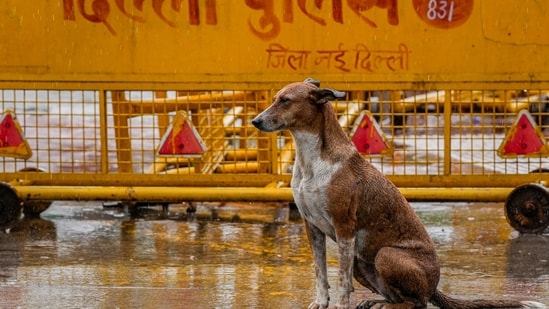
That incident set the tone for what has become an escalating crisis at India’s busiest airport. IGI has recorded 24 dog bite cases since January 1, 2026 — as of Friday — against 30 for the entirety of 2025, data sourced from airport officials and shared with the civic body shows.
Twenty-two of those 24 cases involved airport staff: airline workers, security guards, ground crew, housekeeping personnel, many working through the night when the terminals empty out and the dynamics around the dogs shift.
Sukhdeep Singh, a Punjab-based employee of a private airline, was among those recently bitten. “I was bitten around 2.30-3am while going towards gate number one. As soon as I took the turn, the dog came and bit me. I was given rabies injections immediately, but I have become more wary especially during night hours,” he said.
For an airport that serves as many visitors’ first encounter with the Indian capital — and which is home to approximately 250 community dogs, concentrated primarily in the forecourt areas of its terminals, according to MCD records — the numbers present a challenge that is as much about getting the response right as about the bites themselves.
{{/usCountry}}For an airport that serves as many visitors’ first encounter with the Indian capital — and which is home to approximately 250 community dogs, concentrated primarily in the forecourt areas of its terminals, according to MCD records — the numbers present a challenge that is as much about getting the response right as about the bites themselves.
{{/usCountry}}Under Indian law, these animals are entitled to live where they are. The Supreme Court, whose suo motu proceedings on stray dog management are awaiting a final verdict, has already moved away from a removal-based approach: its amended directive requires community dogs be sterilised, vaccinated, and dewormed before being released back to their localities, in line with the Animal Birth Control (ABC) Rules, 2023.
Simply rounding up community dogs is not the answer the law currently permits. The question is whether the humane alternative is being implemented rigorously enough to work.
At IGI, the answer so far is: not quite.
The incident log from January alone traces the challenge across the airport: a security guard bitten outside Terminal 3 on January 15; a ground-handling employee at the multi-level car park on January 16; a security staffer near the Cargo Terminal on January 18; a housekeeping worker near Terminal 1 on January 31. The most recent case was on February 20, when a RAXA security guard was bitten near Terminal 1’s VIP entry point.
“We are working closely with the Municipal Corporation of Delhi (MCD), in line with prescribed guidelines, to ensure a balanced, humane and responsible approach to managing community dogs around the Delhi airport premises. We recognise that these animals are part of the urban ecosystem, and their welfare and safety are as important as the safety and comfort of passengers and airport staff,” said DIAL chief executive Videh Kumar Jaipuriar. The airport has designated specific dog-feeding zones near the terminals and has urged passengers and animal feeders to use only those areas, on the grounds that unregulated feeding in high-traffic zones creates unpredictable conditions for both people and dogs.
Jaipuriar said structured measures — vaccination, sterilisation, and managed care in coordination with civic authorities — were aimed at creating a safer environment for both passengers and the community dogs themselves. Officials said DIAL and the MCD have held recent meetings to work toward more effective management.
The MCD, for its part, is constrained by the same legal framework. “As per existing law, we don’t have any authority to pick up all dogs. In case any aggressive dog is reported to us, we can send them to the ABC centre for observation for any rabies symptoms,” a senior municipal official said, adding that the operating procedure would firm up once the Supreme Court delivers its verdict.
An MCD spokesperson did not respond to requests for comment. The corporation has also urged the airport to strengthen its perimeter to prevent dogs from nearby areas such as Mehram Nagar from entering in search of food.
Animal activists say the solution lies in doing the basics more rigorously — and that the airport is not yet there. There needs to be clear signage asking passengers not to feed the dogs, said Sonya Ghosh, an activist who has worked with the Animal Welfare Board of India (AWBI) to designate feeding points across city neighbourhoods. “There are designated feeders at the airport and passengers should not feed these dogs. It is highly irresponsible and creates erratic behaviour — a dog may get food one day from a passenger, but not the next,” she said.
Ghosh said involving those designated feeders was essential to any workable solution — and that a verified count of the airport’s community dog population was a prerequisite for everything else. “Only once we know how many dogs there are can they be sterilised and vaccinated. It is also important to then keep records of vaccination,” she said. “Proper coordination is needed on all fronts.”
The fuller legal backdrop reinforces why that coordination matters. The Supreme Court’s suo motu proceedings originated from rising incidents of dog bites, particularly involving children, in public and institutional spaces. They began with an August 11, 2025 order by a two-judge bench that had directed the rounding up of all stray dogs in the National Capital Region, prohibiting their release and requiring the creation of large shelters. Animal rights groups sharply criticised the directive as inhuman and scientifically unsound, and the court subsequently amended it. The court on January 29 reserved its final order, which will also examine whether its November directions — mandating capture from institutional areas and barring release even after sterilisation — should continue to operate.
Stay updated with all top Cities including, Bengaluru, Delhi, Mumbai and more across India. Stay informed on the latest happenings in World News along with Delhi Election 2025 and Delhi Election Result 2025 Live, New Delhi Election Result Live, Kalkaji Election Result Live at Hindustan Times.
Stay updated with all top Cities including, Bengaluru, Delhi, Mumbai and more across India. Stay informed on the latest happenings in World News along with Delhi Election 2025 and Delhi Election Result 2025 Live, New Delhi Election Result Live, Kalkaji Election Result Live at Hindustan Times.