E-Paper



Intense rain: Delhi records another extreme weather event
This monsoon, Delhi has received 554.6mm of rainfall between June 1 and August 1, with two individual spells of 228.1mm on June 28 and 107.6mm on August 1 accounting for over 60.5% of the total

 Prefer HTon Google


New Delhi
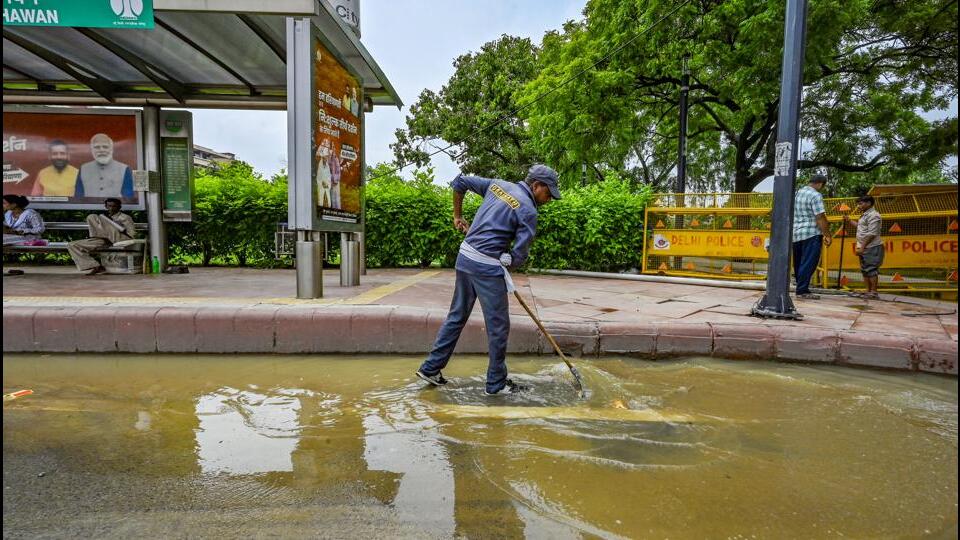
The Capital received 107.6mm of rainfall between Wednesday evening and Thursday morning, marking yet another extreme weather event this monsoon as it eclipsed the total rainfall recorded in the entirety of August in 2023, as well as 2022, according to the India Meteorological Department (IMD) data for the Safdarjung weather station, which is considered representative of Delhi weather.
This monsoon, Delhi has received 554.6mm of rainfall between June 1 and August 1, with two individual spells of 228.1mm on June 28 and 107.6mm on August 1 accounting for over 60.5% of the total.
Further, 107.6mm was the single highest-day rainfall recorded by the Safdarjung observatory since 2021, when 138.8mm of rainfall was recorded on August 21, 2021. The overall rainfall in August 2022 was 41.6mm and in August 2023 was 91.8mm.
To be sure, the rainfall recorded on the last day of a month is added to the total of the next month, i.e., the rainfall recorded since 6.30pm on July 31 will be counted under the total rainfall for August.
Between Wednesday evening and Thursday morning, at least seven stations across Delhi-NCR received over 100mm of rainfall, according to IMD data.
The Mayur Vihar weather station in east Delhi clocked 147.5mm, Delhi University station in north Delhi logged 104.5mm, Safdarjung and Lodhi Road stations in New Delhi areas clocked 107.6mm and 107.5mm, respectively, Najafgarh station in southwest Delhi logged 113mm, and Pusa station in west Delhi logged 86mm.
Neighbouring Gurugram clocked 119.5mm, and on the other side, Noida clocked 145mm of rainfall, indicating widespread and equally intense rainfall across the national capital region.
The other IMD stations to receive “heavy” rainfall — over 64.4mm in a 24-hour period — were Ayanagar (71.4mm) and Palam (68mm).
“Such rain occurred due to the monsoon trough coming over Delhi-NCR. Till Tuesday, it was south of its normal position, but made a transition on Wednesday. At the same time, moisture was being fed from both Bay of Bengal and the Arabian Sea, converging over Delhi from two different directions to create a charged area,” an IMD official said.
The IMD forecast a reduction in rain intensity, but said light to moderate showers are likely on Friday.
Mahesh Palawat, vice president at Skymet, a private weather forecaster, said the monsoon trough was moving away again, but there was still a possibility of light to moderate rain till Friday night. “The intensity will not be like we saw on Wednesday. It will mostly be light rain with some isolated parts recording moderate showers,” he said.