The Supreme Court on Tuesday posed a series of probing questions to the Enforcement Directorate (ED) while hearing Arvind Kejriwal’s petition against his arrest in the Delhi excise policy case — and even redirected to the agency a question by his counsel about the arrest coming close to the Lok Sabha elections — as it underlined the importance of liberty and highlighted concerns over the timing and procedural aspects of the Delhi chief minister’s arrest.
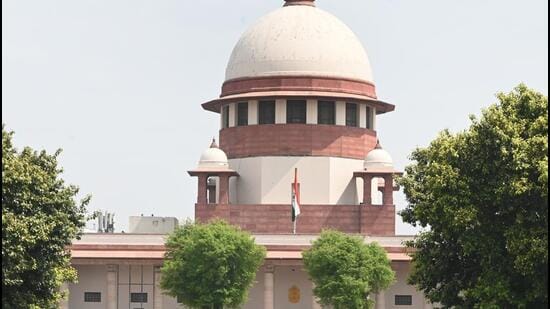
“Liberty is extremely, extremely important. We can’t deny that,” said a bench of justices Sanjiv Khanna and Dipankar Datta, asking the agency to come prepared on May 3 with answers to a number of pointed queries.
The bench raised questions regarding the initiation of criminal proceedings without adjudicatory proceedings, citing previous legal precedents. “Without there being adjudicatory proceedings, can you have criminal proceedings initiated?” the court asked, referring to the absence of attachment proceedings in Kejriwal’s case and demanding evidence of the CM’s involvement.
It asked additional solicitor general (ASG) SV Raju, representing the agency, to clarify how the court should interpret Section 19 of the Prevention of Money Laundering Act (PMLA), highlighting the onus placed on the prosecution and the accused regarding arrest. The bench pondered whether the threshold for bail should be higher to ensure fairness and consistency in determining guilt.
“The threshold of Section 19 casts onus on the prosecution which is fairly high and thus asking for regular bail does not happen as they are confronted with Section 45 and onus shifts on them... So, how do we interpret it? Do we make the threshold much higher?” asked the bench, pointing out that Section 45 of the PMLA is based on a reverse onus, requiring an accused to show absence of guilt for being released on bail.
{{/usCountry}}“The threshold of Section 19 casts onus on the prosecution which is fairly high and thus asking for regular bail does not happen as they are confronted with Section 45 and onus shifts on them... So, how do we interpret it? Do we make the threshold much higher?” asked the bench, pointing out that Section 45 of the PMLA is based on a reverse onus, requiring an accused to show absence of guilt for being released on bail.
{{/usCountry}}The bench also deliberated on the time gap between the initiation of proceedings and the subsequent arrest, citing the provisions of Section 8 of the PMLA, which imposes a limit of 365 days on the completion of an investigation.
As Raju responded that there are times when the investigations cannot be completed in 365 days on account of the complex nature of crimes and addition of accused, the bench retorted: “Then, the other way is you don’t make arrest until you are sure of complying with the provision... liberty is extremely important.”
The court also asked the ASG to address the timing of the arrest, referring to a vehement submission by senior counsel Abhishek Manu Singhvi, who appeared for Kejriwal. Singhvi cited the proximity of Kejriwal’s arrest to the general elections, raising questions about the motive behind the timing.
Furthermore, the court sought a clarification on the implications of its previous findings in the Manish Sisodia case, questioning where Kejriwal’s case stands in the light of such precedents.
“As far as the Manish Sisodia judgment is concerned, there are two parts. One in favour of accused and the other against accused. Which part does this case fall in?” it asked Raju, who replied that the present case was not one where Kejriwal was seeking bail.
By a judgment in October 2023, the top court had dismissed former Delhi deputy CM Sisodia’s bail plea while noting the allegation levelled by the Central Bureau of Investigation (CBI) and the ED that the now-scrapped excise policy for 2021-22 profited wholesale distributors by ₹338 crore, which amounted to a public servant being bribed. The judgment, at the same time, held that detention or jail before being pronounced guilty of an offence should not become punishment without trial and that if the trial gets protracted despite assurances of the prosecution, the prayer for bail may be meritorious.
The Delhi CM had rushed to the Supreme Court on April 10, less than 24 hours after the Delhi high court rejected his plea against the arrest on March 21 while holding that the ED possesses adequate evidence to suggest Kejriwal’s involvement in money laundering related to the excise policy case.
Replying to the Delhi CM’s petition by filing an affidavit last week, the agency told the court that there are no special provisions under the PMLA that differentiate the arrest of a chief minister and an ordinary citizen. Calling Kejriwal “the kingpin and key conspirator of the Delhi excise scam”, the ED stressed that the decision to arrest him was made based on substantial evidence and legal grounds. It refuted the AAP convener’s contention regarding the timing of his arrest — that it was to disable him from campaigning for his party during the Lok Sabha polls — and highlighted the CM’s alleged evasion of investigation for nearly six months during which he skipped nine of the agency’s summonses.
Rebutting the ED’s contentions, Kejriwal, filing his rejoinder affidavit on Saturday, vehemently contested his arrest, labelling it as “illegal” and an “unprecedented assault” on the pillars of democracy, besides condemning the agency’s actions as a glaring display of “high-handedness”.
The CM’s affidavit argued that his arrest not only violates his personal rights but also undermines the democratic fabric of the nation, portraying his arrest as an unprecedented attempt to undermine the principles of free and fair elections and federalism. The Delhi CM, who remains in judicial custody, painted the money laundering case against him as a calculated move by the ruling central government to suppress its political opposition, particularly AAP, and its leadership.
Earlier in the day, Singhvi highlighted discrepancies in the evidence presented by ED, noting selective reliance on incriminating statements while disregarding exculpatory ones.
“There will be no liberty in the wake of these draconian statutes if there are no procedural safeguards. They (ED) include all inculpatory statements and leave out all exculpatory statements saying the complaint will be too long if we include everything...they are guilty of concealment of material facts,” the senior counsel told the bench.
The ED’s investigation was riddled with irregularities, including the deliberate concealment of exculpatory evidence and the coercion of witnesses to furnish false statements, said Singhvi, adding the lack of concrete evidence linking him to any wrongdoing rendered the arrest baseless and illegal. He further claimed that the co-accused were allegedly forced to make statements that implicated Kejriwal in return for leniency. According to Singhvi, the ED breached fundamental justice and due process norms by using such coerced confessions as justification for Kejriwal’s incarceration. He also refuted claims of financial impropriety during the Goa elections, arguing there was no substantiating evidence to link Kejriwal or his party to any illicit activities.
Stay updated with all top Cities including, Bengaluru, Delhi, Mumbai and more across India. Stay informed on the latest happenings in World News along with Delhi Election 2025 and Delhi Election Result 2025 Live, New Delhi Election Result Live, Kalkaji Election Result Live at Hindustan Times.
Stay updated with all top Cities including, Bengaluru, Delhi, Mumbai and more across India. Stay informed on the latest happenings in World News along with Delhi Election 2025 and Delhi Election Result 2025 Live, New Delhi Election Result Live, Kalkaji Election Result Live at Hindustan Times.