The National Capital Region Planning Board (NCRPB) in its draft Regional Plan-2041 for NCR envisages an environment plan that includes a mixture of greenery and technology to combat pollution in the region.
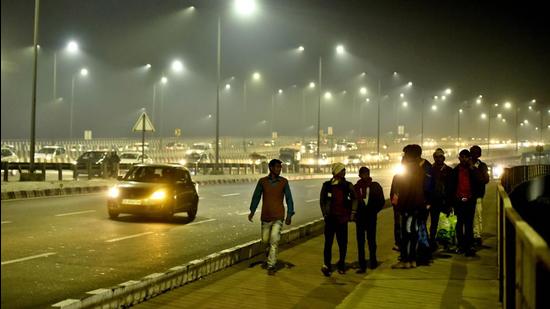
The plan that has been put in the public domain seeking suggestions and objections suggests creating green corridors, green barriers along highways and a dense biodiversity park network, along with implementing technologies such as smog towers and floating water drones/robots to collect garbage and waste from the river to check rising pollution in the region.
“Pollution mitigation technologies like smog towers, smog guns should be set up. Delhi has already initiated installing smog towers in 2020 and other urban areas in NCR should follow the same,” says the draft plan.
The plan states each NCR district will have to mandatorily establish a continuous automatic weather monitoring station by 2024, with air quality monitoring equipments to be set up in each urban ward and village in a time-bound manner.
“Green corridors/tree barriers should be developed wherever possible along roads to act as buffer and to reduce air pollution and noise pollution impacts. All highways shall have noise barriers/ tree corridors, especially when they are passing through or close to residential areas, hospitals, old age homes, educational institutions, courts, religious places and appropriate dense plantation should be done in such areas along roads,” the plan states.
{{/usCountry}}“Green corridors/tree barriers should be developed wherever possible along roads to act as buffer and to reduce air pollution and noise pollution impacts. All highways shall have noise barriers/ tree corridors, especially when they are passing through or close to residential areas, hospitals, old age homes, educational institutions, courts, religious places and appropriate dense plantation should be done in such areas along roads,” the plan states.
{{/usCountry}}Delhi has seven existing biodiversity parks, and the plan envisage development of similar parks across NCR. It states that each NCR state should have at least one botanical garden and a zoo in each city and regional centres by 2030.
To clean rivers in the region, it also asks for a revival and rejuvenation action plan to be prepared by the Central Pollution Control Board (CPCB) by 2022, which will ensure zero discharge of untreated sewage into rivers such as Yamuna, Hindon and Kali. It also calls for exploration of possibilities to revive the old Sahibi river, which would feed the Najafgarh lake.
Use of technology has been suggested to trap waste from flowing into the rivers. “Autonomous drone technologies like waste-sharks/aqua drones which work similar to vacuum cleaners should be adopted by NCR states for cleaning of rivers, channels and water bodies to help in reducing water pollution,” says the plan.
Dipankar Saha, former head of CPCB’s air laboratory, said the plan’s focus should be more on creating sufficient buffer zones for the region, an exercise which can commence from identifying and re-designing the correct land-use pattern. “We have to preserve our existing buffers and add more, wherever possible. Reliance on technology need not be as much as we look at creating more green pockets to provide fresh air. Technologies can only be adopted if there is some scientific backing,” he said, asking for more research before implementing air purifiers and smog towers.
Stay updated with all top Cities including, Bengaluru, Delhi, Mumbai and more across India. Stay informed on the latest happenings in World News along with Delhi Election 2025 and Delhi Election Result 2025 Live, New Delhi Election Result Live, Kalkaji Election Result Live at Hindustan Times.
Stay updated with all top Cities including, Bengaluru, Delhi, Mumbai and more across India. Stay informed on the latest happenings in World News along with Delhi Election 2025 and Delhi Election Result 2025 Live, New Delhi Election Result Live, Kalkaji Election Result Live at Hindustan Times.