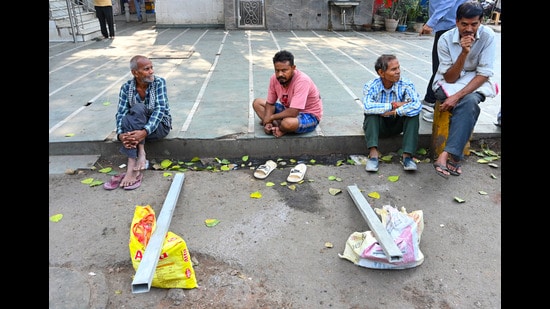
Tiger Kumar, 34, stands at the corner of Govindpuri Labour Chowk, clutching a cloth bag containing the tools he needs to earn a living. A construction worker specialising in the alignment of high-end tiles, he has been waiting at the same spot for nearly four hours. His otherwise motionless stance changes only when a motorcyclist pulls up looking to hire a daily-wage worker. He rushes forward, competing with more than a dozen others gathered there, all hoping to secure a few hours of work. The competition may be fierce, but the pay is modest: around ₹1,000 a day.
In the first 13 days of November, Kumar said he has found work on only two days, earning a total of ₹2,400.
The motorcyclist hires someone else, leaving Kumar dejected. “With the construction ban in place in NCR, securing a daily-wage job has been reduced to a matter of luck. In the rare instance someone is hiring, there are dozens competing for the job, but only one can get it,” he said.
Kumar moved to Delhi from Bihar’s Munger district when he was 11, driven by his family’s financial hardship. He began as a construction-site helper, loading and unloading materials, and gradually acquired skills to become a specialised worker in high-end tiling. Helpers earn around ₹700-800 a day, masons ₹1,000-1,200, and semi-skilled tile-setters up to ₹1,600, he said.
Also Read | Real estate bodies Naredco, Credai seek calibrated approach to CAQM's construction curbs in NCR
{{/usCountry}}Also Read | Real estate bodies Naredco, Credai seek calibrated approach to CAQM's construction curbs in NCR
{{/usCountry}}“After waiting here every day from 9am to 2pm for nearly 10 days, I found work only twice. The job involved tiling the floor of a 120-square-metre shop, for which I was paid ₹1,200 a day. Now I am back to waiting here,” he said.
Unlike hundreds of other workers who have left the city, Kumar cannot return to his hometown. Both his children are enrolled in a government school in Delhi, and moving back would disrupt their education.
As part of its winter action plan, the Delhi government has prohibited dust-generating demolition and outdoor civil construction activities from November 1 to January 31, with exemptions for essential public infrastructure projects. Minor works, including finishing, plumbing and electrical work, are permitted.
The restrictions have left construction workers across the city grappling with a severe shortage of employment. While many have left Delhi, others, like Kumar, continue to wait at labour chowks in the hope of finding work.
Several workers who spoke to HT said they had not received any compensation from the government. To qualify for compensation during the construction ban, workers must be registered with the Delhi Building and Other Construction Workers Welfare Board. But many at such labour chowks – informal open-air points where daily-wage workers such as masons, painters and plumbers gather in search of employment – work independently and are not associated with organised contractors.
Animesh Das, President of Indian Federation of Trade Unions (Delhi Committee) said the unemployment labour count is relatively lower in the city as many workers have gone to their hometowns for Chhatth. “Construction workers in Delhi are primarily from Bihar and Eastern Uttar Pradesh. Earlier they would return after celebrating the festival, but with the ban, that trend has changed in the past few years. Electricians and carpenters might return, but those involved in activities that create dust, like mason and painters are unlikely to,” Das added.
Vishal Maurya, 50, who moved to Delhi from Bihar’s Katihar district in 1992, said he had managed to find some work cutting threads during last year’s ban. “My wife works in a garment factory. So last year, she helped me get some thread-cutting work, and I earned ₹150-250 a day. In the first few days, I would end up cutting the cloth instead of the thread. It was bound to be difficult as for the past three decades I have worked on construction sites,” he said.
Also Read | Pollution crackdown: DPCC inspects 3K sites, sends closure notice to 103
“But when you come down from earning around ₹700-800 to ₹150-200, the financial struggle is enormous. My two children went to government school, so the expenses used to be less, but now they are in college and the expenses have increased,” he added.
Maurya’s daughter studies at Delhi University and his son at Jamia Millia Islamia. He said he did not want to burden them with financial responsibilities before they completed their degrees.
Workers at labour chowks in Govindpuri, Sangam Vihar, Patel Nagar and Kalyanpuri said the shortage of work had forced them to accept jobs at nearly half their usual wages.
Abdul Rahman, 27, who usually loads and unloads construction material and clears construction and demolition (C&D) waste, said he previously earned ₹700-800 a day for such work. He is now being offered just ₹300-400. “There is hardly any work available. So, you either accept whatever they are willing to pay or starve for the day,” said Rahman, who had spent four to five hours waiting for work at a labour chowk in Sangam Vihar.
Several labour chowks remained crowded well into the afternoon as workers struggled to find employment. Many who arrived as early as 8am were forced to return home empty-handed. With no seating arrangements, they spent hours standing, occasionally bending down to rest or taking brief walks, while constantly scanning the road for potential employers.
“Last I worked was before Diwali. I come here looking for work every day, and stay from 8am till 5pm. I am thankful to the gurudwara next to the Govindpuri chowk as at least I don’t have to worry about food and water, and they allow us to use the washroom,” said Amrit Singh, 70, who is originally from Punjab’s Gurdaspur district. “At my age, it’s difficult to learn any other work.”
Also Read | Grap 3 curbs implemented in Delhi-NCR as air quality remains in ‘very poor’ category
“We don’t have a fixed employer. We work at a different site almost every day, so we cannot find an employer who can vouch for us, which is a necessary requirement for registration,” said 28-year-old Nasir Hussain.
Workers at a labour chowk in Patel Nagar reported similar difficulties. The junction, which typically sees around 300 workers skilled in masonry, tile-setting, carpentry, painting and C&D waste removal, has also been hit by the shortage of work.
“Just a few days before the ban, I worked for three days. But the contractor didn’t give me the payment. After repeated calls, he told me that construction work had been banned and blocked me. He owes me ₹3,000,” said 60-year-old Surendra Sharma.
Stay updated with all top Cities including, Bengaluru, Delhi, Mumbai and more across India. Stay informed on the latest happenings in World News along with Delhi Election 2025 and Delhi Election Result 2025 Live, New Delhi Election Result Live, Kalkaji Election Result Live at Hindustan Times.
Stay updated with all top Cities including, Bengaluru, Delhi, Mumbai and more across India. Stay informed on the latest happenings in World News along with Delhi Election 2025 and Delhi Election Result 2025 Live, New Delhi Election Result Live, Kalkaji Election Result Live at Hindustan Times.