E-Paper



Record summer beats life out of Delhi’s Mungeshpur farms
With a population of nearly 10,000, Mungeshpur hit the headlines as it reported the maximum temperature across the country on Sunday at 49.2 degrees Celsius

 Prefer HTon Google


It’s a little after high noon, and northwest Delhi’s Mungeshpur village, near the Haryana border, looks deserted, as if nobody lives there. Those manning the few local shops that are open despite the searing heat are half-asleep under fans. There are no customers, there is no bustle; the only occasional movement on the village road is of stray animals.
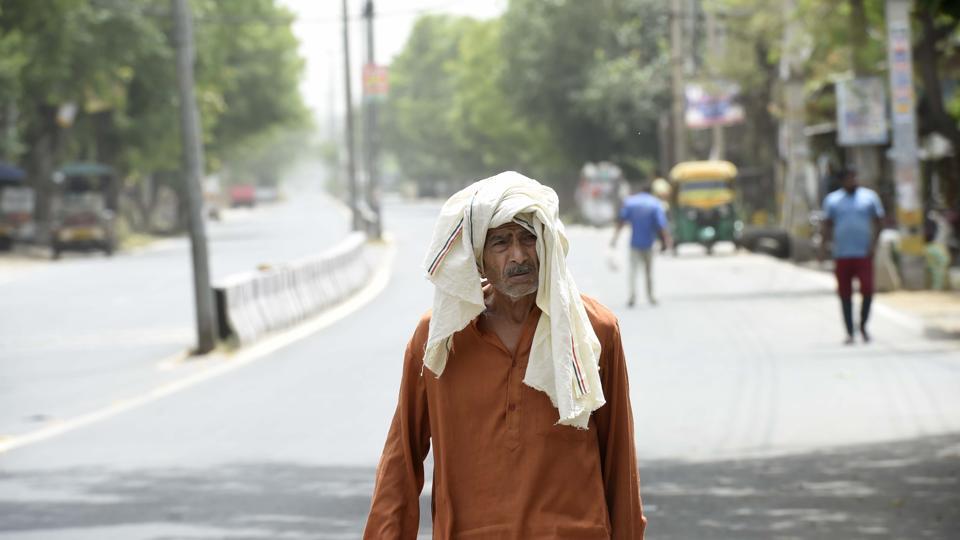
With a population of nearly 10,000, Mungeshpur hit the headlines as it reported the maximum temperature across the country on Sunday at 49.2 degrees Celsius (°C).
Sixty-five-year-old Ram Niwas, an ex-serviceman, who grows vegetables and jowar (sorghum) in his fields, is among the handful of people out in the fields on Monday afternoon, braving the heat. Niwas says he has no option but to head out once during the day to check on his crop, which, he says, is struggling to survive the scorching weather. “Jowar is one of the most heat-resilient crops a farmer can grow, but even that has failed to survive this intense heat,” he says, pointing to his dry fields.
Ram Niwas uses water from a tubewell to irrigate the field as most ponds in the village are dry. “People would bring their cattle to these ponds, but the drop in water level has been steep. Now, we rarely take them out of the house and instead try to keep them cool by using a hosepipe. The milk yield has dropped to half,” he says.
Vikas Rana, another resident, who works with the Delhi Transport Corporation (DTC), says they did not know exactly how terrible the heat was until he saw the newspapers on Monday morning. “We could feel it on Sunday, and no one dared to venture out. Most houses in the village don’t have air conditioners, and still rely on desert coolers. But, on Sunday, fans and coolers were ineffective. Some people poured water on the floor and used wet clothes to cool themselves,” Rana says.
“In all my years in Delhi, I have never seen such a torrid summer and it appears it will only get worse.”
Many locals HT spoke to said that though power outages are not an issue in the village, water supply is.
“Water is supplied between 6am and 8am, and sometimes in the evening. Since people in the village need water for their house, as well as their livestock and other purposes, they sometimes have to go out in the heat to fetch water from public water points set up near the fields. People also use drinking water bottles in the absence of running water,” says Harish Kumar, another local.
Anil Kumar, who runs a grocery shop in the village, says most of the sales happen in the evening since only a few venture out during the day because of intense heat. “We open around 8am and by 10am, most people buy what they want. Around noon, the village is completely deserted and people rarely come out,” he says.
A semi-urban area characterised by a combination of concretised spaces and open farm fields, Mungeshpur overlooks a number of industries in Haryana, a factor that residents said could be feeding the ongoing heat spell.
The India Meteorological Department’s (IMD) Mungeshpur automatic weather station is set up at the Jawahar Navodaya Vidyalaya school in the village. The area around the station has several trees and greenery but locals say many industries are located across the border in Haryana “500-1,000 metres away”.
“Industries are located barely 500 to 1,000 metres away, and over the last few years, the emissions and heat from these newly set-up factories must have a role to play in the high temperatures in the village,” says Vikas, another resident who works in one such unit.
Umesh Singh, a local resident, says there were a number of trees in the area not long ago. “But slowly, development work, such as the Bawana industrial area, which is not too far away, or on the Haryana side, where a number of factories have sprung up, added to emissions and the heat. The village has also evolved and with construction work, the number of trees has reduced.”
For Mungeshpur, they all fear, the worst may be yet to come.